


Pavlov's Dogs Deep Dive
What the Community Thinks About Pavlov's Dogs
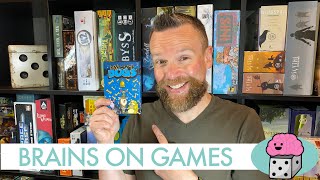
Two very different channels land on the same core appeal: a simple counting game that turns into a memory test once the rules start piling up. Brains On Games describes Pavlov's Dogs as a "simple Simon Says style" memory game with basic addition layered on top, and host Dr. Brian McDonald is clearly won over by the history angle. Having studied psychology at university, Dr. McDonald sees the dog scientists as a playful way to learn about the field.
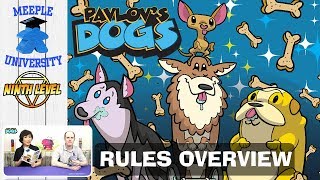
Meeple University treats the game as a party game preview, filmed as it was about to launch on Kickstarter. Its reviewers describe a memory-driven game that scales from gentle to very hard and suits children and adults alike. Because they worked from a prototype, they warn that the art, rules, and components may change before release, so the details here should be read with that caveat in mind.
Taken together, the picture is consistent. Reviewers find the game easy to start, charming to look at, and more demanding than it first appears once the later rounds arrive.
Core Mechanics That Define Pavlov's Dogs
Memory
Memory is where the game earns its reputation. One player each round takes the role of the dog tour, the scientist running the experiment. They draw a rule card, show it to the table, and then tuck it behind the screen, so the rule has to be carried in the players' heads. Brains On Games explains that the dog tour keeps the active rules on the screen's tabs where they can be checked, while the other players rely on what they remember. Each round adds another rule on top of the existing ones, and Meeple University notes that by the end players may be holding between three and eight rules at once.
The rules are also deliberately tricky to hold. Brains On Games singles out the card that makes every beg card worth five as "one of the harder ones honestly," because the running total jumps in a way that works against the basic addition players are already doing.
Cooperative Game
Pavlov's Dogs is built so the table wins or loses as one. Players work together to finish a sequence of counting tests, and every mistake costs a bone. Brains On Games stresses that a single slip does not eliminate anyone, but the team fails if any player runs out of bones entirely. Meeple University points to the key safety valve: players can redistribute bones between rounds, so the group can cover for a teammate who is struggling to keep up with the rules. The leftover bones become the team's final score, which gives a finished game a clear number to beat.
The Pavlov's Dogs Experience
Escalating Memory Pressure
The opening round feels approachable, with players alternating cards and announcing running totals. The tension comes from layering. Meeple University describes how a newly added test card can flip the logic of the round, leading to what the reviewers call "confusion and hilarity." Brains On Games points out that the difficulty is adjustable, since harder cards can double certain values and easier ones keep the rules simple, so the pressure can be tuned to the table.
Lighthearted Family Fun With Psychology Puns
Beneath the pressure, the game stays playful. Players bark like dogs when yellow cards appear, imitate other doggy behaviors, and hear the dog tour call out "good dog" or "bad dog" as the round goes on. Brains On Games notes that the game is aimed at kids aged eight and up, and Meeple University describes it as well suited to children and adults alike. Meeple University also credits the clever psychology puns and jokes for giving the game its personality.
What Makes Pavlov's Dogs Stand Out
Charming Dogs With Psychology Puns
Both channels respond to the artwork. Dr. McDonald says the artwork and the dogs are a favorite, and Meeple University highlights a sharp design with cute canine features. The dogs are the heart of it, and each one is a pun on a famous thinker. John B. Wagson stands in for the behaviorist John Watson, Sigmund Fetch for Sigmund Freud, and an Anna Freud card is a fetch as well. A dog based on Abraham Maslow asks players to remember that "doggy needs" sit at the top, and a B.F. Skinner dog makes blue cards subtract from the total.
A Screen and Rulebook That Do Real Work
Brains On Games praises the physical screen as "so well done." Its little tabs let the dog tour keep every active rule in view while the other players only see each rule once, which keeps the memory challenge fair. The rulebook adds a second layer of value. Each dog is based on a real psychologist, and the rulebook includes a short biography of each one, so a child who reads through to the end picks up a little history of the field along with the game.
Potential Drawbacks
A Heavy Memory Load as Rules Accumulate
The most consistent concern is the memory burden. Brains On Games warns that "there is a lot of memory as this game becomes more complicated," and Meeple University's note about three to eight simultaneous rules shows why. Players who want light, casual play may find the later rounds more of a test than a party. The screen and the bone redistribution help, but the table still has to hold the rules in mind, and a single forgotten rule costs a bone.
Difficulty Spikes in the Hardest Cards
Meeple University notes that the rule cards are ranked from easy to very hard, and that the very hard mental math cards can be a bit too challenging for some groups. Brains On Games echoes this with its comment that the beg rule is one of the harder ones. The option to double certain cards or pick gentler rules gives tables control, but the jump from the easier cards to the hardest ones is significant, so groups should choose their starting difficulty carefully.
If You Enjoy Pavlov's Dogs
Pavlov's Dogs suits families and mixed-age groups who want a quick game with a clear goal. Brains On Games describes a play time of about 20 minutes, while Meeple University gives a range of 20 to 45 minutes, and both highlight how easily the difficulty can be adjusted. Players who enjoy Simon Says style games, cooperative tables where the group rises or falls together, and light psychology history will find the most to like here.
What Reviewers Are Saying
"There is a lot of memory as this game becomes more complicated."
— Brains On Games
"One thing that I appreciate is that the rule book has a little biography of each of the real psychologists that these dogs are based on."
— Brains On Games
"The game is well suited to children and adults alike with its wide scope to vary the difficulty. The game has a sharp design with cute canine features and clever psychology puns and jokes mixed in."
— Meeple University