





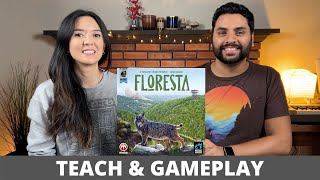
Floresta Deep Dive
What the Community Thinks About Floresta
Floresta has earned respect as a game that combines thematic depth with genuine mechanical challenge. Reviewers praise its strategic complexity and the way it creates meaningful tension through its fire system, though they acknowledge the game plays with genuine teeth. The consensus is that Floresta rewards thoughtful play and multiple playthroughs, offering a satisfying puzzle of land management and crisis mitigation that feels earned rather than arbitrary.
Core Mechanics That Define Floresta
Hand Management with Spatial Control
At its heart, Floresta is built on card play that gates your ability to take actions on the board. Each card has two functions: its number and color determine where you can place trees across five different forest regions, while its special effect offers additional benefits when activated. This creates a constant tension between where you want to place trees and what other advantage you might gain. Before You Play describes this as featuring "hand management as well as some puzzly area control aspects," and that puzzle element is key. Each forest region has its own placement rules and scoring conditions, making the board function as a collection of interconnected mini-puzzles. Players must balance immediate board presence with strategic positioning, knowing that a tree placed now might lock them into specific card choices later.
Fire as a Dynamic Threat and Victory Opportunity
The fire system transforms Floresta from a quiet placement game into an active race against escalating danger. Fires spread across the board each round, and players who have built Watchtower pieces can deploy fire trucks to extinguish blazes. Extinguishing fires awards points, but leaving fires uncontrolled means your trees take damage and you lose points. The designer elegantly ties fire extinguishing to progression: only players who have invested in building their Watchtower can access the fire truck, making that build path strategically valuable. Fires don't just threaten; they create urgency and force players to make tactical decisions about where to position their resources.
The Floresta Experience
Escalating Tension and Decision Weight
Floresta creates a mounting sense of pressure as the game progresses. Early rounds feel spacious and manageable, but fire cards in the deck gradually populate the board. Players describe seeing "a lot of fire that's a lot of fire" as blazes spread through regions and cascade along paths. The game's tension comes from the knowledge that you cannot control everything. Some fires will escape your fire trucks. Some trees will be threatened. The question becomes not whether you will suffer loss, but how you will minimize it and still position yourself to score. This weighs heavily on decision-making and creates genuine moments where players wrestle with competing priorities.
Engaging Puzzle-Solving Gameplay
The five forest regions each offer distinct puzzle experiences. Some regions require trees to be connected for scoring, creating spatial puzzles about efficient placement. Others have linear pathways where placement order matters critically. Still others demand careful resource management with animal tokens. Reviewers engaged with these puzzles actively, discussing strategy and contingency planning. The game rewards players who think multiple moves ahead, who understand how card plays now constrain or enable future options, and who position their Watchtower to control the regions that matter most to their scoring plan.
What Makes Floresta Stand Out
Variable Watchtower Abilities for Replayability
Floresta includes four different Watchtower locations, each offering a unique ongoing ability. One lets you treat a color as wild when placing trees within its reach. Another lets you ignore placement restrictions. A third lets you break the rule against placing fire breaks where fires already exist. These variable abilities mean that the game you play depends heavily on which Watchtowers are in play. Players who claim a particular tower early unlock access to strategies unavailable to their opponents, creating asymmetry and encouraging multiple plays to explore different approaches and discover which tower abilities prove most valuable in different board configurations.
Thematic Integration of Victory Conditions
The game's scoring structure mirrors its theme intimately. You score points for connecting trees in forest regions, which represents building a healthy ecosystem. You lose points for every animal token left unplaced at game end, representing the cost of failing to reintroduce wildlife. You score bonus points for fire extinguishing and endgame Watchtower construction. The game ends when a player runs out of trees to place, which is both a practical timer and a thematic representation of depleting your restoration efforts. This tight thematic coherence means that strategic decisions about where to build and what to protect feel meaningful beyond their point totals.
Potential Drawbacks
Fire Spread Can Feel Overwhelming and Punishing
The fire system, while engaging, can become difficult to manage if several fire cards appear in quick succession early in the game. Multiple fires spread through regions simultaneously, and without enough fire trucks deployed, blazes spiral. Players experience moments where the board seems engulfed and their options suddenly constrained by fire placement rules. The challenge is steep enough that some players may find the game feels punishing if they fall behind on Watchtower construction or if the deck presents unfavorable fire timing. This isn't a flaw so much as a design choice that creates a particular experience: Floresta is not a relaxing euro; it has teeth.
Complex Regional Rules and Player Count Scaling
Each of the five forest regions has distinct placement and scoring rules. Learning these rules takes time, and the interaction between regions can be subtle. For instance, the region requiring animal tokens has a harsh penalty for any tokens left in hand, which creates pressure that feels asymmetrical to regions with gentler scoring. The game also scales the board differently for two-player versus multiplayer, using blocking trees to adjust space availability. New players may find the cognitive load of tracking five different rules sets and managing the implications of fire spread across them significant, especially on their first play.
If You Enjoy Floresta
Floresta suits players who want their card-driven puzzles to carry real stakes rather than unfold at a leisurely pace. The appeal lies in the combination of a quiet placement puzzle with a system that actively pushes back: every round of planning has to account for where the next fire might spread, not just where the next tree might score. Players drawn to Watchtower-style asymmetric powers will also find plenty to explore, since claiming a particular tower early can unlock an entirely different approach to the same board.
What Reviewers Are Saying
"We are in Central Portugal we're deep in the forest where we're trying to plant trees protect the wildlife and of course save those trees and animals from fires. This is a two to four player game that features hand management as well as some puzzly area control aspects."
— Before You Play
"Each time you take this action you'll only be putting out one piece at a time and each Watchtower location can only hold one player's pieces which means you're essentially reserving a watchtower because each tile also has a special ability that only you'll be able to use."
— Before You Play
"That's a lot of fire that's a lot of fire we're going to want to try to extinguish them maybe this is the time to build your Watchtower maybe because you can get some points doing that and if we don't extinguish these fires next fire phase they are going to spread into all of the different areas that they are connected to."
— Before You Play