

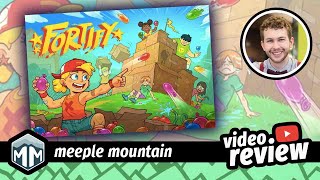


FORTIFY Deep Dive
What the Community Thinks About FORTIFY
Reviewers present FORTIFY as a quick, competitive two-player game that fuses dice rolling with a tile-placement puzzle. Meeple Mountain describes it as a filler that runs about 15 to 20 minutes, praising how the puzzle and the dice halves reinforce each other. Board Games for One approaches it as a playful, slightly chaotic battle best shared with a friend, and returns to the theme repeatedly. Across the coverage, the consistent takeaway is that the rules are easy to pick up, the sessions are short, and the time pressure creates more tension than the cardboard-and-balloon theme first suggests.
Every reviewer is working from a prototype or advance copy. Both channels stress that the board, printed pieces, and cards may still change before the Kickstarter release, so the impressions below concern gameplay and feel rather than final production values.
Core Mechanics That Define FORTIFY
Dice Combat With Balloon, Umbrella, and Wild Faces
Combat is resolved entirely through dice. As Meeple Mountain explains, each player rolls one die for their main fort plus one for every water balloon thrower enclosed in their fort. Those dice carry a direct hit symbol for each base color, a block umbrella that stops a hit aimed at the main fort, and a wild symbol. Unblocked direct hits place splash markers, and the first player to collect three splash tokens on the opposing base wins. Board Games for One highlights the same logic in the cousin die, which carries balloons and an umbrella for defense, and the jerk die, which carries only attacks and wilds. Reviewers note that colored water balloon throwers cannot land a direct hit on the base but can still slow an opponent by removing dice, which turns the color-matching puzzle into a genuine tactical decision.
Lock-and-Reroll Dice Rolling Under Pressure
Meeple Mountain describes the rolling phase as a deliberate trade-off. Players may lock in direct hits and blocks and reroll whatever remains, so a careful player can keep chasing the exact result they need. The catch is that the first player to finish locking all their dice claims the jerk token, which grants an extra roll with the jerk die at the end of combat. Board Games for One shows the same race in action, adding a 12-second window in which every die must be placed on a matching color before the next roll. The reviewer's panic at the timer makes clear that placement, not only the dice themselves, is where games are won or lost.
The FORTIFY Experience
A Summer Water Balloon Fight Built From Cardboard
Meeple Mountain says the art style immediately evokes a nostalgic cartoon feel, with its neighborhood kids and larger-than-life cardboard fortresses. The reviewer calls the result a knock-down, drag-out fight between neighbors, a blown-out summer dream that comes across more as fun than as competition. Board Games for One reinforces the mood, describing the game as a rambunctious water balloon battle and treating the fort-building as the playful centerpiece of each session.
A Tightrope Between Careful Thinking and Racing the Clock
The most memorable part of the experience for Meeple Mountain is the decision about how fast to play. Players can take their time, reroll, and plan, or they can rush to claim the cousin and jerk tokens that grant extra dice. The reviewer describes this as a catch-up tension in which a player does not need to be the best, only the fastest, and calls the balance between these options a fun tightrope walk. Board Games for One experiences that pressure firsthand when a 12-second timer leaves little room for strategy, and the reviewer ends up placing dice wherever they can.
What Makes FORTIFY Stand Out
Catch-Up Tokens That Reward Speed
The cousin and jerk tokens are the feature reviewers return to most often. Meeple Mountain notes that the cousin token goes to the first player to finish building their fort, while the jerk token goes to the first player to lock in every die. Because the extra dice are awarded on speed rather than on board position, a player who falls behind in one phase can still swing the next round. The reviewer describes this as a really fun kind of catch-up mechanic that keeps the game from settling into a predictable lead.
Symmetric Two-Player Balance and the Waterproof Edition
Meeple Mountain is especially enthusiastic about the design's balance. The reviewer notes that two-player games tend to reveal imbalances quickly, but FORTIFY avoids that problem because it has no asymmetric abilities. Each side plays the same fort-building and dice rules, which leaves the outcome dependent on decisions rather than on unequal starting powers. Board Games for One adds a separate standout in the waterproof edition of the game, which turns the water balloon theme into a more tactile experience. The reviewer says the waterproof components let them imagine a squirt-gun-style fight, with the player able to throw a water balloon in an opponent's face from a short distance.
Potential Drawbacks
Prototype Components and Rules That Are Still Changing
Because the reviewed copies are prototypes, several concerns come with the territory. Meeple Mountain explicitly cautions that the board, printed pieces, and cards are not final and will be refined for production. Board Games for One notes that some dice in the prototype were of lower quality and would be upgraded in the final release, and that a towel buddy component was added after the prototype copy was made. The same reviewer admits to making up parts of the rules while playing, which suggests that the rulebook and the components are still moving targets.
Luck, the Clock, and a Steep Learning Curve
Meeple Mountain describes FORTIFY as lightly luck-based, while adding that the luck is mitigatable through choices such as rerolling and placement. Still, the dice remain a meaningful source of variance, and the timer can magnify a bad roll. Board Games for One illustrates how quickly a 12-second window can unravel a turn, with the reviewer admitting to panicking and losing ground. The reviewer also says they do not fully remember how the connecting rules work, and the fan-made solo variant shown in that video is explicitly described as a practice option rather than a true solo mode for the two-player game.
If You Enjoy FORTIFY
Reviewers suggest FORTIFY for players searching for a short, lively two-player game that feels different from typical strategy fare. Meeple Mountain recommends it to anyone who wants a new two-player experience that pairs an engaging cartoon theme with solid, puzzle-driven mechanics. Board Games for One suggests the game is best played with a friend or family member, particularly by players who enjoy a bit of friendly chaos at the table. Players who prefer deliberate, low-variance decisions may find the dice and timer less satisfying, but those who enjoy racing against the clock while still rewarding careful planning will likely find FORTIFY a good fit.
What Reviewers Are Saying
"The theme is engaging and the mechanics are solid, you're pairing up the puzzling aspect with the dice rolling aspect in a really fun and meaningful way. It's not complicated, it's not hard, but it is made competitive by the timed aspect where you are having to compete with your opponent to get done as quick as possible."
— Tyler Williams, Meeple Mountain
"The great thing about this game is it doesn't have that, because there's not asymmetric abilities. There's nothing crazy that could make this game get lopsided."
— Meeple Mountain
"The true fun is the bonding experience, you and your buddy going at it with each other. It's a fun time."
— Board Games for One