





Fight 5 Deep Dive
What the Community Thinks About Fight 5
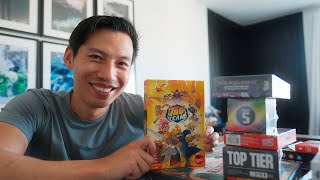
Fight 5 is a small-box card game from Chip Theory Games that reviewers describe as a modern take on War, the classic card game most players learned as children. Opinion splits along the question of whether that update goes far enough. Grant of Grant's GameRex covers the game in a monthly preview of titles heading to retail, and recommends it to anyone who wants a fresher version of War. The coverage reads as a rules overview rather than a report from extended play, so Grant's enthusiasm rests mostly on the design. Alex Rackle of BoardGameCo takes the opposite view. In the Gen Con 2025 recap, Fight 5 is among the games that did not stay in the collection, concluding that the game "was war" with more players and a little more choice, and that it was not a fit. Tim Chuon's haul video covers the game more briefly: after receiving a copy, Tim Chuon calls it an update on War and works through a sample trick, but stops short of a verdict. The overall picture is a split: Grant sees a worthwhile twist on a familiar game, BoardGameCo sees War with extra decisions layered on top, and Tim Chuon's first look is descriptive rather than evaluative.
Core Mechanics That Define Fight 5
Grant and Tim both explain the game through the layout of cards that players contest, and that layout is the foundation for everything else in play.
Face-down contests over a shared layout
According to Grant, Fight 5 gives players a set of positions to fight over rather than a single pile. A two-player game uses one row of cards, a three-player game adds a spoke that extends from a middle card, and a five-player game adds several spokes. Because of this arrangement, players are always contesting positions against the player to their right or left. Each round, players play cards from their hand face down onto the positions, everyone flips them, and the highest card claims the card in the middle. Tim offers a concrete example: with a five in the middle, a seven played against a six wins the contest, and the winner then scores points based on the piles they have collected. Grant also explains that a tie leaves the card in place, so whoever wins that position later claims everything that has built up there.
Choosing where to commit each card
Grant emphasizes that players choose what to play onto each position from their hand, which makes the decision less about any single flip than about anticipating where opponents will commit. Grant frames the dilemma as whether to beat an opponent to a position they appear to want, or to play a low card there, let them have it, and turn attention to other positions. Tim Chuon makes a similar point, describing the winning play as one that beats both the opponent's card and the card already in the middle. Scoring rewards collecting high-value cards and cards marked with stars, so the question of which positions to contest carries through to the end of the game.
The Fight 5 Experience
Familiar War tension with more to decide
Grant describes Fight 5 as a lightweight game that plays in 10 to 15 minutes for two to five players and that is easy to learn. Grant presents War as a game that is a lot of fun when you are young but offers few choices, and describes Fight 5 as keeping the battling over cards while adding decisions. BoardGameCo describes the same gap from the other side. Alex Rackle calls it War with agency, meaning players have decisions that War does not provide, but in that assessment those decisions do not change the underlying rhythm of flipping cards and battling over them. The experience, then, is one of recognizable War tension that the reviewers disagree about in terms of how much extra depth it adds.
Reading the table
Grant's description leans heavily on the social side of the game, pointing to the question of whether an opponent is going for a particular position, and whether to contest it or to let it go and attack elsewhere. The emotional pull Grant describes comes from trying to outthink the players on either side of you, since every position you contest is also a position someone else may be planning to take. This is the feature Grant returns to when explaining why the game is worth checking out, and it is the part of the design that the critical review does not address directly.
What Makes Fight 5 Stand Out
A layout that changes with player count
Grant highlights how the same core battle scales. The game uses a row of cards for two players, adds a spoke from a middle card for three players, and extends several spokes for five players. In each case the contest is always with a neighbor, so the number of players changes both the shape of the layout and the set of opponents you have to read. For a small-box card game, that scaling is what Grant considers the most distinctive part of the design.
Ties that carry tension forward
Grant describes how a tied contest does not award the card to anyone. Instead, both cards stay in place, and whoever wins that position in a later round claims all of them. Grant presents this as a source of tension, because players must decide whether to press a contest while cards are accumulating and what those cards will be worth. Combined with scoring for high-value cards and star symbols, the rule gives each contested position a history that players can use to plan their next move.
Potential Drawbacks
It may still feel like War to experienced players
The most direct criticism comes from Alex Rackle of BoardGameCo, who describes Fight 5 as War played with more people at the same time and a little more choice, and who concludes that ultimately it was war. For players who are looking for something that changes how a card game feels rather than how it is organized, that assessment is the central caution. The decisions Grant describes all take place within individual rounds of flipping and claiming, so anyone expecting a deeper strategic arc should weigh BoardGameCo's view before buying.
Uncertain staying power
BoardGameCo's decision to let Fight 5 leave the collection after playing it over the past year suggests the novelty of the twist may not hold up for every group. Tim Chuon's account is also tentative, hesitating over how to classify the game, first describing it as a trick-style game before settling on the framing of an update on War, and not saying whether to keep playing it. Grant's enthusiasm is positive, but because the coverage centers on the rules and the design, the long-term table appeal of the game is not something these discussions resolve.
If You Enjoy Fight 5
Fight 5 is most naturally recommended to players who enjoy War and want the same flip-and-claim rhythm with more agency. Grant's framing of it as a modern take on the classic game suggests it will appeal to anyone who found War too simple as they grew older but still likes the directness of a card game. Players who enjoy reading what the table will do with each card, and who find satisfaction in deciding whether to contest a position or concede it, are likely to find the most to like. The short playing time Grant describes also makes it a practical choice for families and groups who want a light filler game between longer sessions. Players who want War unchanged, or who expect a deeper strategy experience from a card game, should give extra weight to BoardGameCo's assessment, since that reviewer found the added choices insufficient to change what the game feels like.
What Reviewers Are Saying
"War is a lot of fun when you're young, but doesn't have a lot of choices to it. So, the idea of this one is it's doing that sort of battling over cards, but it's giving you more choices."
— Grant, Grant's GameRex
"It was war but with multiple players at the same time with a little bit more choice because of that. So it was war with agency and more players, but ultimately it was war. Not for me."
— Alex Rackle, BoardGameCo
"For instance, if there was a five in the middle and I had a seven, I can play that seven face down and then my opponent will play a six. In that case, I would win because the seven beats the six and the five in the middle, and I would take that trick, and then you score points based on the piles that you win."
— Tim Chuon