




The Feds Deep Dive
What the Community Thinks About The Feds
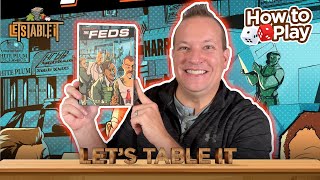
The Feds has quietly earned strong praise from reviewers across multiple channels, though it remains overlooked on major game databases. Tabletop Tolson celebrates it as a masterclass in compact game design, while Hungry Gamer, after rediscovering the game sitting on a shelf, champions it as a clever, accessible filler that deserves far more attention than it receives. Let's Table It provides a thorough how-to-play walkthrough, highlighting its elegant area majority framework. The consensus is striking: this is a well-designed game with surprising depth for its small footprint, held back only by its publisher's exit from the market and an underperforming BGG rating that reviewers believe misrepresents its actual quality.
Core Mechanics That Define The Feds
Simultaneous Action Selection with Hidden Deployment
The heart of The Feds is a two-phase turn sequence: all players simultaneously choose and play one agent card face down to a location on their player board, then in turn order, each player reveals their card and places it into the field. The catch is the mole mechanic. If a location is empty, your card becomes the mole: placed face down, secret, mysterious. Only when the next player targets that location does the mole get flipped and moved to the field, exposing your play. This hidden-information layer transforms what could be a straightforward area control game into a game of reading opponents and managing the unknown. Tabletop Tolson calls it the "main heart of the game," and it works because it forces real decisions: do you play strength to win a location outright, or risk staying hidden longer to spring a surprise?
Area Majority with Cascading Scoring
Players deploy agents across four locations (Club, Restaurant, Docks, Warehouse) and accumulate strength through card values and special powers. At game end, the player with the highest strength at each location claims criminals, the game's scoring currency, in order, then second-place does the same, and so on. Scoring happens after all cards are played, so the math is deferred and tense. Strength isn't just raw card numbers; it's affected by special power triggers and the city card in play, which changes which powers do what. Utility tokens (worth 0–4 points) at each location reward the strength leader. The elegance is in the economy: you're not just fighting for first place, second place is always worth playing for, and the spread of points means no lead is safe until cards are revealed.
The The Feds Experience
Bluffing and Strategic Deception
The Feds rewards bluff and inference. Because play is simultaneous but hidden, you're gambling on opponent behavior. Will they ignore the Club to focus on the Restaurant? Can you trick them into overshooting strength in the Docks by showing weakness elsewhere? Hungry Gamer describes it as having "a little bit of blind bidding": not true blind auction, but the uncertainty echoes that vibe. The hidden-mole mechanic means your biggest move might stay hidden for a round or two, and the tension of waiting for it to be discovered is part of the fun. Reviewers note the game "just works so well" because that uncertainty isn't random noise; it's baked into the structure.
Accessibility and Elegant Simplicity
Despite its hidden-information depth, The Feds is repeatedly described as "very easy" and "simple." Tabletop Tolson highlights the color-blind friendly symbols on player cards, a thoughtful inclusion in a compact box. Hungry Gamer emphasizes that the rules are straightforward enough to teach quickly: "you're going to blindly pick, kind of like a blind bidding thing, you're doing an area control", but the city variants ensure every play feels fresh. The small box size means efficient components: the double-sided player board (play on one side, score on the other) keeps spatial footprint minimal while maintaining full functionality. This is game design that respects both the table and the player.
What Makes The Feds Stand Out
City Variants That Reshape the Game
The Feds ships with six cities: Chicago, Detroit, Houston, New York, Los Angeles, New Orleans, and Washington DC, and each one assigns different outcomes to three special power types: Infiltrate, Redeploy, and Patrol. Chicago's Infiltrate lets you steal a card from the next player's hand. New Orleans adds siren tokens and mini-busts. This isn't a gimmick; reviewers emphasize that city selection "completely changes the game." Hungry Gamer notes that the "just a little bit" difference between cities is "just enough to make it feel like a completely different game," meaning a player who has mastered Chicago with infiltrate tactics faces a completely different puzzle in New Orleans. Six cities mean six experiences from one box, preserving replayability across player counts and returning players.
Efficient, Thoughtful Component Design
Tabletop Tolson spends time praising the physical design: figures are different shapes, not just different colors, aiding visibility and inclusivity. The double-sided board economizes space without sacrificing clarity. The bag for holding figures is a small touch that respects table organization. Hungry Gamer, after rediscovering the game, took the step of sleeving it, a sign of genuine care for a game one wants to preserve. In a market flooded with overstuffed boxes, The Feds proves that smart constraints breed elegant solutions.
Potential Drawbacks
Publisher Scarcity and Print Uncertainty
Dr Finn's Games (or Dr. Finn's Games: the publisher's name appears in both forms in the transcripts) is no longer producing board games. Both Hungry Gamer videos mention this as a concern: if the game is damaged or components are lost, no replacement printing is guaranteed. Hungry Gamer sleeved the cards specifically to protect against this reality. The game exists, but access is finite. This is a meaningful friction for potential buyers: The Feds is out of print or difficult to acquire, and supply may only dwindle.
BGG Rating Misalignment and Turn-Order Overhead
The Feds does not have a high rating on BoardGameGeek, and multiple reviewers express frustration that the BGG community has undervalued it. Hungry Gamer says plainly: "This is a game that does not have a high score on BGG, and I think that's a shame." Let's Table It notes that "sometimes players can lose track of turn order during this step," suggesting the turn-order rules, while not fundamentally broken, can create friction in play. The hidden-mole mechanic and special power activations add layers of state to track, and with simultaneous card play and hidden information, the cognitive load is real, not deal-breaking, but present.
If You Enjoy The Feds
Reviewers in the transcripts do not name specific games to compare it to, so recommendations are drawn from The Feds' mechanical roots. If you enjoy the simultaneous-action architecture, try 7 Wonders, which uses the same "pick and pass" concurrency to build civilizations. If area majority is your draw, Carcassonne offers similar spatial majority play with modular replayability. For hidden-deployment tension and bluff, The Resistance or Coup offer deduction layers, though simpler. If you value elegant constraint and city-based variation, Ticket to Ride's modular map design echoes that philosophy. But the closest experience is likely another Steve Finn design: reviewers consistently position Finn as a craftsman of small-box games that punch above their weight, so exploring Finn's back catalog is a natural next step.
What Reviewers Are Saying
"It's very easy. It just is simple. You're going to blindly pick so kind of like a blind bidding thing you're doing an area control and you're placing your cards down in different regions on the board as you're trying to infiltrate these criminal organizations is the theme behind it and it just works so well."
— Hungry Gamer
"This is a strong game, it's a clever game, and I think yet again Steve Finn—I mean, I say he's the master of the small box—absolutely just solidifies my impression. It's a clever game and I like those mechanics that are paired together."
— Tabletop Tolson
"It's a clever, fast filler game with this weird little bidding mechanic that you're doing, and has all these different cities that you're able to play, which changes up the rules just a little bit, but that just a little bit is just enough to make it feel like a completely different game."
— Hungry Gamer