







Mutagen Deep Dive
What the Community Thinks About Mutagen
Mutagen is a mediumweight worker placement game from Drander Games, designed by Alexandros Kakas and set in a 1920s biopunk world built around a powerful element called the Great Shard. Reviewers and previewers consistently frame it as worker placement with a twist: the workers themselves are the centerpiece. Before You Play presents the game as a contest across four rounds in which players send their crews to six locations, collect elements, and mutate their workers to become the next Keeper of the Great Shard. Board Stupid included Mutagen among its most anticipated games at Spiel and praised the way the theme and the mechanics reinforce each other. Get into games, after playing with friends, described the core interaction as worker placement that rewards following other players onto the board. Across the commentary, the prevailing tone is enthusiasm about the design, admiration for the production, and a shared interest in seeing how the system plays out over repeated sessions.
Core Mechanics That Define Mutagen
Customizable Worker Placement
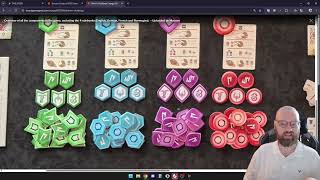
Each player commands four workers: a robot, a thug, a spy, and an engineer. Before You Play explains that three of the four can be mutated, while the robot cannot be mutated but acts as a wild, allowing its owner to choose any of the three worker-specific actions. At the start of each round, players draft mutation cards in reverse turn order and attach them to their workers, which adds new abilities such as gaining Shards whenever that worker is sent out. Board Game Dad singled this out as the feature that sets the game apart, noting that players "must strategically mutate their workers to fit their evolving strategy." Board Gaymes James went further, describing how the wooden meeples are physically upgraded and how mutation cards add small accessories to the pieces. Get into games echoed the point by mentioning the little hands and additions that appear on characters once they mutate.
Shared Space Reactions
Each location has as many worker spots as there are players, so a two-player game uses only the top two spaces. Before You Play notes that when a worker is placed on a space already occupied by another player, the owner of the worker directly above gains a reaction and can activate one of that worker's mutations. Placing multiple workers on the same location does not grant a reaction, and players choose the order in which their four workers are deployed. Get into games highlighted how this lets players build on the choices of others, which is the part of the design that stood out to them most.
Element Placement and Adjacency Rules
Installing elements into an airship works as a placement puzzle. Each slot requires a specific color or element type, gray slots accept anything, and no two adjacent elements may share a characteristic. Before You Play explains that completing a column of storage spaces scores its printed value at the end of each round, which encourages players to plan their airship layout as carefully as their worker routes. Board Stupid described the game as combining set collection with tile placement, and the adjacency rule is the clearest expression of that spatial side. Elements also feed the Sacred Tree, where tree cards demand specific combinations, and matching pairs of fulfilled cards are worth more at game end.
The Mutagen Experience
A Theme That Shapes the Actions
Reviewers repeatedly return to the biopunk setting. The floating cities, the Industrial Revolution aesthetic, and the Great Shard are presented as more than backdrop, since the actions themselves, from mining elements to delivering them to the Sacred Tree, match the story of an airship economy. Board Stupid's hosts said the vibe of the world drew them in before they had seen the full rules, and Board Game Dad described a theme that makes the worker mutation system feel natural rather than bolted on.
Tactical Choices With Limited Workers
Because each player has only four workers per round, every placement carries an opportunity cost. Before You Play emphasizes that the actions a worker can take are chosen in any order, so a single placement can trigger a location action, a worker-specific action, and several mutation actions. Mutation actions have a cost that depends on whether they are taken on your own turn or as a reaction, which adds a resource decision to each activation. Shards serve as the main currency for hiring crew, paying for airship storage, and advancing the progress track, so the game constantly asks players to decide what to spend and what to save.
Shared Table Tension
The reaction system creates an atmosphere of watching the board. Players are not simply filling spaces on their own schedule, since the next player may be in a position to exploit or follow a placement. Get into games described enjoying the way the board responds to other players, and that interaction gives the experience a more social quality than a purely solitaire optimization exercise.
What Makes Mutagen Stand Out
Workers That Evolve Over Time
Board Game Dad described Mutagen as offering "a fresh Twist on the worker placement genre," and the upgradeable workers are the reason. Because mutation cards are drafted each round, the same four workers can become very different specialists by the end of a session, which means no two games are likely to produce the same crew. The physical upgrades reinforce the idea. Board Gaymes James specifically praised the approach of upgrading a meeple with a physical component rather than a token.
Production and Art Direction
Board Gaymes James and Board Stupid both highlighted the production. The screen-printed wooden pieces, the artwork associated with Mico, and the overall presentation were cited as reasons the game looked worth seeking out. Several commentators treated the presentation as a signal of the care that went into the design.
Multiple Scoring Paths
Victory points come from several sources at once: installed elements, completed airship columns, progress along the four element tracks, crew cards that reward specific track positions, and matched pairs of Sacred Tree cards. Before You Play's walkthrough makes clear that no single track dictates the outcome, so players must balance an airship engine, a crew strategy, and an element economy. This variety is what reviewers seem to anticipate most when they describe the game as rich in decisions.
Potential Drawbacks
A Dense Web of Interacting Systems
Before You Play covers six locations, four element tracks, a progress track, airship columns, crew cards, and the Sacred Tree before the first round is even complete. Players will need to track several of these at once, and the interaction between the workers, the tracks, and the scoring can take a session or two to internalize. The walkthrough format that Before You Play used is one way new groups can ease into that density.
Limited Hands-On Evidence So Far
Much of the commentary comes from previews, unboxings, and a pre-production copy shared with reviewers. The Broken Meeple received a preview copy and indicated that a fuller review would follow, and most of the other discussion is based on first impressions rather than extended play. The positive reception reflects enthusiasm and design promise, but the long-term replay value and balance of the mutation system remain questions that the wider community is still working through.
If You Enjoy Mutagen
Players who enjoy Mutagen's shared-space reactions will find similar satisfaction in Lords of Waterdeep, where every placement on the common board shapes what the next player can accomplish and blocked spaces force creative rerouting. Players who are drawn to the way Mutagen rewards building a specialized engine from workers and resources may also appreciate Tzolk'in: The Mayan Calendar, which combines worker placement on shared action spaces with a turn structure that rewards long-range planning. Both games share Mutagen's appeal of a crowded board where a single placement carries consequences beyond the space it occupies.
What Reviewers Are Saying
"Mutagen stands out through its varied and upgradeable workers, each player controls four different workers and each one gains a distinct bonus based on the action space they occupy."
— Board Game Dad
"This is a game that utilizes work placement but it does what I really love where you have different types of workers, yes, and they will activate in different ways depending on where they're placed and then what the ability of the specific workers. So you've got different workers, four workers in fact, that react differently depending on where they go. And it's really great, so you place them there and they'll activate an action, but you can also upgrade those workers as well."
— Wayne, Board Stupid
"What I liked about that was that you sort of piggy back off of the spaces that other people go to."
— Get into games