




Quorum Deep Dive
What the Community Thinks About Quorum
Quorum stands as a carefully engineered card game that respects both player agency and time. Reviewers recognize it as a clever synthesis of familiar mechanics brought together with unusual precision. The game courts players drawn to strategic puzzles, though newcomers should expect a learning curve. Most praise Quorum for its remarkable pace and the satisfying interplay between competing objectives, though some find the track-climbing system underutilizes its thematic potential. The consensus leans positive, with reviewers noting its appeal depends partly on player count and whether a group values dynamic interaction.
Core Mechanics That Define Quorum
Set Collection
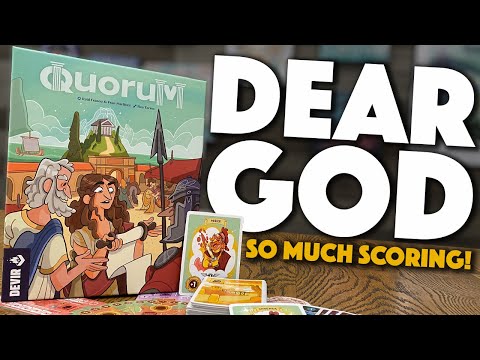
Set collection anchors Quorum's scoring structure. Players build a tableau of twelve cards organized by type and value. Each card type scores differently: military cards earn points in consecutive numbered sequences, trade cards reward clusters of matching symbols, architecture cards grant points for unique illustrations, and intrigue cards multiply by power levels in the hand. Designers Raul Franco and Fran Martinez crafted scoring rules where no single collection path dominates; a player focusing entirely on military strength will starve other categories, forcing constant trade-offs. This structure turns card selection from passive drafting into active strategy.
Compound Scoring
Beyond end-game tableau scoring, Quorum overlays six province tracks that activate based on player position. When a player leads on a province track, they score all cards of a certain type (e.g., military cards in Gallia) multiplied by that province's influence rating. Those in second place score a reduced multiple; third and fourth often score nothing. This dual-layered system means every card serves dual purposes: advancing a tableau set AND jockeying for position on tracks. Publisher dV Giochi added god cards that manipulate province influence values mid-game, letting skilled players hedge their bets or sabotage opponents' scoring corridors.
The Quorum Experience
Intense Mental Engagement
Quorum demands evaluating dozens of scoring paths simultaneously. When playing a card, players weigh its tableau contribution against track advancement against helping or hindering opponents. Each placement compounds the next; early card choices ripple through endgame scoring. Reviewers consistently note that casual play yields poor results compared to methodical optimization. The game does not punish random draws the way pure luck-driven games do; instead, it punishes poor decisions under complexity. Players accustomed to minimal brain-burn may find this exhausting over multiple plays in a session, though the thirty-to-forty-five-minute runtime keeps any single game contained.
Rapid Decision Windows
Despite its strategic depth, Quorum moves quickly. Individual turns are spare: draw one card, play one card, advance one track. No movement, no resource management, no production chains. This speed masks the game's weight, creating a deceptive ease of play. A group comfortable with light games might start Quorum expecting a breezy experience, only to discover turns demand focused thought. Over twelve rounds, this compressed decision-making rhythm creates a satisfying push-and-pull, as players swing between periods of analysis and rapid table-talk.
What Makes Quorum Stand Out
Synergy Between Card Play and Track Advancement
Quorum's defining achievement is the interlocking economy between tableau building and province tracks. A card is only truly valuable if both its immediate tableau type AND its banner color advance useful tracks. This forces players to consider every placement as a dual-purpose move. The god cards amplify this effect by letting players adjust province influence values retroactively, transforming earlier decisions from fixed to fluid. Reviewers praise how this system avoids the "dominant strategy" trap where one avenue overshadows the others.
Clean Mechanical Execution
The game uses mechanisms reviewers have seen before: set collection, track climbing, hand management, even card drafting. Yet the blending of these parts reaches a level of refinement that reviewers note is uncommon. There are no superfluous rules, no redundant scoring tracks, no thematic disconnects. Every element pulls in the same direction, creating a cohesive economic system where every category feels essential and no player feels locked out of scoring.
Potential Drawbacks
Track Climbing Lacks Individual Character
While the six province tracks serve the game's economy well, reviewers note they function as interchangeable scoring multipliers rather than distinct systems with their own identity. Tracks do not offer special abilities when reached or crossed; they simply act as gates to base scoring. The reviewer from Chairman of the Board suggested that individual tracks might gain more engagement if they mimicked mechanisms from games like Keltus, where hitting checkpoints triggers cascading effects. The critique is not that tracks fail mechanically, but that they represent the most conventionally executed element in an otherwise clever design.
High Barrier to Entry on First Plays
Newcomers face complexity that two-to-four-player dynamics do not fully address on a debut session. The scoring system interleaves six province tracks with five distinct card-type scoring rules, each with its own algebra. Most groups require a second play before strategy coalesces. Man vs Meeple noted that a two-player first play was particularly vulnerable to this barrier, as reduced player counts lower the frequency of god cards and shrink the card pool visible in the display, muting the game's interactive tension. Groups committed to replaying after a baseline learning session will unlock deeper strategy; those seeking immediate gratification may leave puzzled.
If You Enjoy Quorum
Reviewers did not reach for a single obvious sibling when describing Quorum, but the design points squarely at a few neighbours. Chairman of the Board wished the track-climbing had more of the "Keltis mechanism," where hitting a checkpoint on one track lets you push another and chain combos, so players who want that flavour of race-to-the-top scoring should look at Reiner Knizia's Keltis and the two-player line it grew out of, Lost Cities. The 12-card tableau, where every suit scores by its own rule (runs, matched icons, cascading numbers, multipliers), sits in the same family as set-collection card games such as Arboretum and Parade, which reward planning a small hand toward several competing end-game conditions. And the god cards, which shift the value of adjacent provinces for everyone at the table, will appeal to players who enjoy the shared-market manipulation of Modern Art more than purely solitary optimization. Quorum plays faster than most of these, closer to 45 minutes, with 12 card plays per player.
What Reviewers Are Saying
"I think this game has a lot to offer. I think it's a really well-designed clever games using again mechanisms we've seen before. It doesn't really do anything new, but the blending of those different moving parts works extremely well and it's been done to a high standard."
— Chairman of the Board
"I think the real decision, the real brain burning decision in this game is when you're playing a card: is the card helping you build your 12 card strategy or is it helping you go up the tracks you need to make some of these cards worth more points, and that is a really tough thing to decide."
— Man vs Meeple
"The mechanic is simple: draw a card and play a card, but then the scoring there's a lot going on with the scoring, and then you can mess with other people with those god cards by putting the tokens up and down for the scoring."
— Tantrum House