



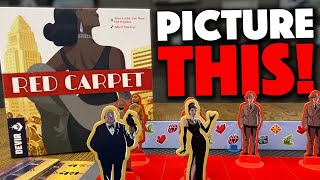





Red Carpet Deep Dive
What the Community Thinks About Red Carpet
Reviewers agree that Red Carpet has one of the most distinctive hooks of recent releases. Its premise is simple: you are a photographer at the awards ceremony, you pull out your phone, set it on a tripod, and shoot celebrities walking down a red felt carpet. Almost everyone who discussed the game started with that idea. Grant, Grant's Gamerecks said the Hollywood premiere theme speaks to them personally and called the use of a real phone camera the part that makes them "way too happy." kovray admitted they were unsure whether using a phone would pull attention away from the tabletop, then said the play session won them over.
Where opinions diverge is on execution. TheGameBoyGeek called it a game that is different from everything else on the shelf, light but with real agency, and said it is not for everyone. The Dice Tower was more restrained. Chris Ye gave it a six, praising the illustrations as some of their favorites in a while but judging that the mechanics do not deliver on the concept. Man vs Meeple described the game as mean and cutthroat, with players constantly moving each other's celebrities around. The consensus is that Red Carpet is novel, charming, and visually striking, while its tension and downtime are polarizing.
Core Mechanics That Define Red Carpet
Multi-Use Cards
Every round, each player draws a hand of five cards, and each card can be used in one of three ways. As TheGameBoyGeek explained, a card can move a celebrity or an entourage member, reposition your tripod to the matching numbered space on either side of the carpet, or cast a vote for a nominee. Only one use is possible per card. Man vs Meeple laid out the rhythm: you play three cards, discard one, and the last card must be used to vote. That forced final vote is what makes the hand feel like a puzzle. Players often plan a shot with their best cards only to discover that the card left over is the one they need for voting, and that the voting card is the only one that can reset a shot if an opponent disrupts it.
Publisher Dve built the system so that every card choice has an opportunity cost. kovray noted that it is easy to get distracted by the three cards that line up a perfect shot and forget that the cards are also your only way to set up or defend your photos. Because each player's cards can disrupt everyone else's shots, the same card that improves your angle may be the one that keeps an opponent's photo ruined. Reviewers consistently describe this multi-use design as the engine that gives a light game genuine decisions.
Compound Scoring
Scoring in Red Carpet is built from several separate tallies that are added together when each photo is taken. According to TheGameBoyGeek, a celebrity facing the camera earns points, a close-up with nothing obstructing the head or shoulders earns more, and shooting straight down the correct column adds a bonus. A visible logo from the billboard behind the subject adds a point, while every visible entourage face subtracts points. Each photo is therefore a checklist, and a single shot can mix bonuses and penalties.
The voting phase adds a second layer. The Lifetime Achievement award doubles the points of any photo of that celebrity, and the winner of each category in each column also doubles. Man vs Meeple explained that players can bank points early on a celebrity no one else is photographing, and that voting on a nominee you already shot can be a way to maximize a strong photo late in the game. Because photos, votes, and the award bonuses are tallied independently, reviewers note that several different strategies can land near the same total.
The Red Carpet Experience
Cutthroat Paparazzi Jockeying
Most reviewers describe the moment-to-moment feel as a playful tug-of-war for attention. Players are not just setting up their own shots. They are turning celebrities around, swapping their positions, and pushing entourage members into other people's frames. Man vs Meeple said the game almost feels like a tug-of-war as everyone jockeys for the attention of the same stars, and that a player who spends too much time sabotaging rivals may end up with a weak photo of their own. TheGameBoyGeek called it a glorified take-that game, with a lot of mischief in each round. Reviewers find this funny rather than punishing, which is part of why the game is recommended for lighthearted groups.
Theatrical, Tactile Spectacle
The second feeling is the theatrics of the photo moment itself. Players physically place a phone in a holder, zoom to 2x as the rules direct, and line up the shot while the rest of the table watches. kovray remembered a point where everyone was standing around the table trying to position the cast for the perfect picture, and a rival calling over a celebrity to turn away at the critical moment. That kind of reaction is what reviewers enjoy most. The red felt board and the artwork reinforce the glamour, and TheGameBoyGeek noted the felt surface feels genuinely good under the hand.
What Makes Red Carpet Stand Out
A Phone as the Camera
Nearly every reviewer singled out the use of a real phone camera as the game's defining feature. Grant, Grant's Gamerecks described holding the phone in its holder, looking through the lens, and adjusting the arrangement until the frame scores the most points. TheGameBoyGeek said the uniqueness is the game's main selling point because it is different from every other game they play. TheGameBoyGeek also ranked it at number ten on an anticipated list because it felt novel compared with the usual lineup of Gen Con releases. The physical act of photographing the board makes scoring feel like an event rather than a tally.
Artwork and Production
Reviewers repeatedly praised the presentation. The Dice Tower called the artwork gorgeous and said it contains some of their favorite illustrations in a game they have seen in a while, even while criticizing the scoring. kovray highlighted the production value of the components in their list, and TheGameBoyGeek singled out the fuzzy red carpet board as a nice touch. Several channels said the look alone makes the table inviting, which matters for a game designed to be played in public view.
Potential Drawbacks
Downtime and Debatable Rulings
The most common criticism is pacing. Photo taking is a slow, visible process, and while one player lines up a shot, everyone else waits. TheGameBoyGeek warned that the zoom and alignment can take time, and that players should expect some downtime. The scoring also invites argument. Their example was whether a celebrity's partly covered shoulder should cost points, and they observed that different players would call it differently. Reviewers accept this as part of a light game, but groups that want precise, quick decisions may find the photo phase frustrating.
Chaos at Higher Player Counts and Phone Dependence
Reviewers say the experience changes sharply with player count. TheGameBoyGeek found two players can do what they want, while four players turn it into a chaotic knife fight. The Dice Tower raised a related concern about the technology itself: the hardware in the game is a phone, and phone cameras have diverged since the design was conceived. Chris Ye reported that a player with a wide foldable phone captured much wider pictures than everyone else, which changed the balance of the shots. The same reviewer argued that the idea is strong but the execution does not fully match it. Some players may also simply reject the requirement to use an electronic device at the table.
If You Enjoy Red Carpet
The game most often compared to Red Carpet is Picture Perfect from Arcane Wonders. TheGameBoyGeek described it as a heavier deduction game in which players also photograph a subject, while Red Carpet is lighter and more about interaction. Grant, Grant's Gamerecks said Red Carpet has a spatial puzzle similar to Picture Perfect's standees, and Foster the Meeple said the game gives them the same feeling of setting up a picture and then checking what the phone captured. Players who enjoy Red Carpet's phone-as-camera hook will likely find similar satisfaction in Picture Perfect, though they should expect a more deductive and less confrontational experience.
What Reviewers Are Saying
"As light as this game is, they give you a good amount of agency over what you're trying to do."
— TheGameBoyGeek
"One of the things that is dumb and silly and makes me way too happy is that you use your actual phone camera in the game. There are like phone holders and you slide this around."
— Grant, Grant's Gamerecks
"It's a neat idea. I don't think the execution of it is as good as the idea is."
— Chris Ye, The Dice Tower