






























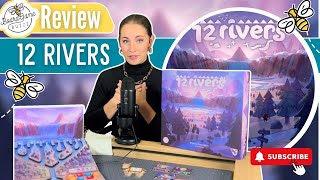









12 Rivers Deep Dive
What the Community Thinks About 12 Rivers
12 Rivers has earned respect from reviewers as a well-crafted gateway game that delivers exactly what it promises: a beautiful marble-rolling mechanism wrapped around genuine strategic decisions. The consensus centers on a fundamental divide: reviewers agree the first play is memorable and engaging, but opinions split sharply on whether the experience sustains across repeated plays. Most celebrate the game's accessibility and production quality, while some worry that its novelty fades as the mechanics become familiar.
Kari from Board Game Buzzz considers it an excellent family game that children gravitate toward instinctively, giving it a solid 7 out of 10 while acknowledging it lacks the depth for repeated adult play. Alex Radcliffe from BoardGameCo is more critical, rating it a 3 out of 5 and noting that the charm wears off noticeably after the first session. In contrast, TheGameBoyGeek offers enthusiastic praise, highlighting the strategic flexibility and excellent player interaction. Jess and Sean from Allies or Enemies strike a middle ground, calling it a well-executed gateway game that does what it sets out to do—delivering light, engaging play without pretense.
Core Mechanics That Define 12 Rivers
Worker Placement with Marbles
12 Rivers' most distinctive feature is its combination of worker placement with a physical marble mechanism. Players place tribe tokens at various points along tributaries on a tilted foam board. When everyone has finished placing, the floodgates release a cascade of marbles that roll down the rivers, stopped by each player's tokens. The higher up the river a player places their token, the more cards they must spend—but they also secure access to more valuable pearls before they flow downstream. This creates the game's central push-your-luck tension: spend resources now to guarantee a pearl, or save your cards and hope enough pearls survive the journey to your position. The marble mechanism itself carries surprising weight beyond spectacle. Watching the physical flow of marbles creates momentum and drama without adding randomness; every outcome is deterministic based on token placement. This makes the marble drop feel satisfying rather than arbitrary, rewarding clever positioning over lucky rolls.
Set Collection Through Villagers
The second pillar is set collection driven by villager tiles. Each villager has specific slots for different-colored pearls and unique scoring conditions. Some villagers score automatically once claimed, regardless of whether they're filled. Others reward complete sets with bonus points. Players collect pearls via the marble mechanism and must decide whether to place them immediately on villagers—locking in points but reducing storage space on their alpaca—or hold them to pursue higher-value combinations or race for alpaca bonuses. This flexibility is what reviewers consistently praise. TheGameBoyGeek notes that removing the "must fill" requirement makes the game feel open and rewarding rather than restrictive. The villager variety creates endless combinations and synergies, giving players genuine strategic puzzles to solve beyond the marble placement decisions.
The 12 Rivers Experience
Satisfying Tactile Engagement
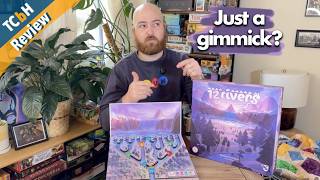
What strikes reviewers most is the almost hypnotic quality of the marble mechanism. Kari describes being "hardwired" to enjoy watching objects roll down tracks, and the game leans into this universal appeal without apology. The foam board holds marbles beautifully, the marbles slot into place with a pleasing fit, and the moment the floodgates release them creates a genuine rush of anticipation. This isn't a gimmick bolted onto a mediocre game—reviewers confirm the mechanic genuinely enhances the experience. TheGameBoyGeek explicitly credits the toy factor as foundational to the game's charm, and even skeptics like Alex Radcliffe acknowledge the mechanism works. The satisfaction comes from seeing your strategic placement decisions validated (or punished) in real time as marbles cascade down, making the abstract worker placement mechanic visceral and memorable.
Light, Interactive Competition
The game delivers what Allies or Enemies calls "sneaky meanness"—players spend significant effort trying to block opponents from accessing the pearls they need. Rather than direct conflict, 12 Rivers creates indirect player interaction where positioning your token doesn't just secure a pearl for you; it denies options to others. Reviewers appreciate this approach. The card abilities add another layer of surprise; a fishing net card can steal two pearls instead of one, or a movement card can reposition a token after seeing what opponents placed. This keeps players engaged even when it's not their turn, watching for threats and opportunities. Rolling Dice & Taking Names emphasizes how the blocking mechanic creates meaningful decisions: Do you guarantee the marble you want, or risk going lower and hoping others don't cut off your access? This generates tension without eliminating agency.
What Makes 12 Rivers Stand Out
Beautiful Production and Component Design
Multiple reviewers highlight the game's exceptional presentation. The foam river board is functional art—it looks beautiful while serving the marble mechanic perfectly. The anime-style villager illustrations remind Jess from Allies or Enemies of Studio Ghibli, while others note the art creates a cohesive, almost whimsical world. The marbles themselves feel premium, and the alpaca boards are clever thematic touch that works. Reviewers mention the board scales elegantly for two, three, or four players without feeling hollow. When players see 12 Rivers set up on a table, it draws attention; the marble mechanism and beautiful art work together to create what several reviewers call "table presence." This isn't just window dressing—the components directly support the game's appeal and accessibility.
Dual-Purpose Cards Creating Meaningful Choices
The camp cards function as both currency (spent to place tokens higher on the river) and as tools (pairs of matching cards unlock special abilities). This dual purpose forces constant difficult decisions. TheGameBoyGeek calls this "multi-use" system elegant because it means your hand is never dead—discarding cards for placement is still valuable, so no card feels wasted. A hand that looks weak for abilities might still give you the resources to outbid opponents for high-value pearls. Reviewers appreciate that this prevents analysis paralysis; many paths forward remain available even when luck doesn't deliver ideal card draws. The flexibility of the system lets newer players focus on basic strategy while veterans hunt for synergies and clever card timing.
Potential Drawbacks
Limited Replayability and Worn Charm
The most consistent criticism concerns the game's staying power. Alex Radcliffe from BoardGameCo articulates it directly: the first play is genuinely fun, but the second and third plays feel noticeably less engaging. The core decisions—where to place tokens, which pearls to chase—remain the same each game. While villager variety changes from game to game, the broader strategic landscape feels familiar quickly. Kari from Board Game Buzzz similarly notes that once you've experienced the marble drop a few times, the spectacle loses some force. Neither reviewer calls the game bad, but both express hesitation about pulling it off the shelf repeatedly. This isn't a problem for casual players or families, but hobby gamers who value long-term engagement may feel disappointed after initial enthusiasm fades.
Imbalanced Card and Token Abilities
Kari observes that certain fairy tokens and card abilities outshine others—the fishing net card, for instance, seems stronger than most alternatives. Alex Radcliffe notes that some villagers offer dramatically better value than others, creating temptation to chase specific ones rather than adapting to what's available. While the card draw mitigates this somewhat, the imbalance means some games feel less competitive than others. Neither reviewer considers this a critical flaw (the game remains playable and fun), but it suggests the balance could be tighter, especially if players become experienced enough to optimize effectively.
If You Enjoy 12 Rivers
Players who enjoy 12 Rivers's marble mechanism will find similar satisfaction in Potion Explosion, which also uses marbles as a satisfying tactile delivery system for set collection. Both games prioritize the joy of watching objects fall and interact. Those drawn to the strategic blocking and turn-order manipulation might explore Fireball Island, which shares the board-as-obstacle-course DNA and emphasizes player interaction. For a game with similar themes of resource management and set collection but with less toy factor, River Valley Glass Works offers comparable puzzle solving without the marbles. If you crave a heavier worker placement experience with similar spatial decision-making, Barrage delivers deeper strategy around action placement and resource allocation.
What Reviewers Are Saying
"I really don't quite know why it's so satisfying to sit and watch things roll down tracks, but I genuinely enjoy it so much. There's something so genuinely fun about having marbles on a track, releasing them and seeing where they go."
— Board Game Buzzz
"This is a game where you're going to drop marbles down a thing. You're going to collect up those marbles. You're going to put them on villagers. It's a very light game, and this is very much a gateway game, but it does that thing you're expecting it to do pretty well."
— Allies or Enemies
"The fact that you don't have to fill everything to trigger every ability—I'm glad they made that choice. It's very open and free-flowing. It doesn't feel restrictive. There's always good choices to make, even if you do end up getting blocked."
— TheGameBoyGeek