





Aspens Deep Dive
What the Community Thinks About Aspens
Aspens is a two-player game designed by Neil Edwards and Luke Roberts and published by Ludavore Games. The opinions gathered here come from a single channel, Where There's A Wilz, There's a Play, whose hosts Ian and Stacy return to the game in their favorites segments. Ian and Stacy describe Aspens as one of their most played games and as a standout from their year-end lists. The publisher gifted the channel a copy for content, and the channel plans to give the base game away in a contest, so the publisher's involvement is part of the record. Everything below rests on that one channel's recurring commentary, supplemented by a sponsored rules teach from kovray that is used only for factual confirmation.
Core Mechanics That Define Aspens
Dice Rolling
Each turn starts with two dice. The sun die sets a threshold: every space you own that holds at least that many trees produces a new tree for your supply. Both players collect trees on the roll, but only the active player plants them. The wind die sets direction, so new trees can only be planted in the rolled direction or in the two directions adjacent to it. Stacy's shorthand for the approach is that you just need to roll and go, and the game rewards decisive play over long deliberation. The kovray rules teach confirms the four-step turn structure: roll for sun and wind, gain trees, plant trees, and resolve cascades.
Area Control
Territory is the scoring engine. For each tree it plants, the active player chooses between two options. Growing up stacks a tree on a space you already own, which increases how many trees that space can produce on later rolls. Growing out places a tree on an empty adjacent space within the wind direction, and that new space is yours immediately, so you can plant from it on later turns. When you wall off a region your opponent cannot reach, you create a cascade, and the enclosed spaces become yours. Ian and Stacy describe the result as a blocking forest, where the goal is to keep the other player out of your area.
The Aspens Experience
A Push and Pull Between Growing Up and Growing Out
Ian and Stacy both keep returning to the tension between the two planting options. Growing up makes future turns more productive, but it spends a tree on land you already hold. Growing out claims contested ground now, yet if you expand without building up what you have, you can run short of trees later. Stacy frames the central question as how much to grow up before growing out, since an opponent who sees a large open area may claim it while you are still investing. That timing question is what keeps the choices meaningful even though each individual decision moves quickly.
Cute on the Surface, Thinky Underneath
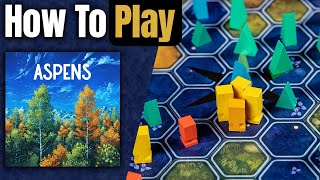
The surprise factor is the idea Ian and Stacy come back to most often. The wooden forest, the colorful pieces, and the simple rules make the game look light. Stacy describes it as "a thinky game, but it moves quickly," and adds that you "can't be an overthinker" to play it well. Ian admits the game "looks like such a cute simple game and it's not." That gap between appearance and substance shows up most in the moment a cascade triggers: a wall of trees that looked like simple decoration suddenly hands one player an entire enclosed region, and the player on the losing end of it realizes the quick rolls they had been making all game were building toward exactly that outcome.
What Makes Aspens Stand Out
Chunky, Colorful Pieces and a Bag for Each Player
Ian calls the pieces chunky, fun, and colorful. Stacy singles out the storage, praising the bag each player keeps trees in as "such a nice bag." Because each player's trees live in their own bag, there is nothing to sort before play begins, which makes setup and teardown quick. Stacy and Ian both treat the components as a major part of the appeal, and their enthusiasm for the look of the game is consistent across segments.
Variable Starting Lakes for Replayability
Each game begins with three water tiles, which act as the lakes where the starting forests are seeded. Ian points out that you can move the lake to a different starting point on the board, which "gives a different experience" from game to game. The kovray rules teach walks through the same setup, and for a game with a small rulebook, that variety is a clear reason to keep returning to the table.
Potential Drawbacks
Base Edition Trees Look Plainer Than the Deluxe Set
Ian says the base game "does not have these fancy shaped trees" that the deluxe edition includes, and describes the base trees as "just straight sides." That distinction matters because the look of the pieces is central to what Ian and Stacy praise about Aspens elsewhere: a forest built from flat-sided blocks reads as a plainer, less tactile table presence than the shaped trees they were anticipating in the deluxe set. For a game whose appeal leans heavily on its physical presentation, shipping the standard edition with the less distinctive pieces is a real cost to the experience, even though the underlying rules play out identically either way.
Two Players Out of the Box, Four With an Expansion
The base game is for two players, full stop. A four-player game requires buying an expansion, and the kovray rules teach confirms that the expansion adds team play, with aspens facing evergreens across the table. Teammates share cascades and can take trees from one another, which means a larger group has to learn a second layer of rules before the game works at four. Groups looking for a bigger table should budget for the expansion and expect a longer learning session. Ian and Stacy's praise is for the two-player game as it ships, and anyone hoping for a four-player box at the base price will not find one.
If You Enjoy Aspens
Readers who like the forest-building, blocking, and dice-directed growth in Aspens may enjoy the following games. These suggestions are based on shared mechanics and feel, not on a comparison made by the channel.
- Photosynthesis shares the tree-growing theme and the idea that a large tree can shade out a neighbor's growth, which echoes Aspens' blocking strategy.
- Kingdom Builder rewards claiming regions of a shared board and controlling the most territory in each area, which parallels Aspens' area control, though its moves come from cards rather than dice.
- Catan ties dice rolls to resource production from placed positions, a familiar form of the roll-driven expansion that Aspens uses to gain trees.
What Reviewers Are Saying
"It's a thinky game, but it moves quickly. It's easy to get to the table. You have such a nice bag that your pieces go into for storage and for drawing out of. It's just a beautiful simple game."
— Where There's A Wilz, There's a Play
"This was my surprise of the year and it's because it looks like such a cute simple game and it's not. There was a lot of thinking as to where are you going to go? What are you going to do?"
— Where There's A Wilz, There's a Play
"There is this really interesting kind of push and pull as what you're doing, when you're going to do it, how quickly you're going to do it."
— Where There's A Wilz, There's a Play