





Trailblazer: The Arizona Trail Deep Dive
What the Community Thinks About Trailblazer: The Arizona Trail
The board gaming community has embraced Trailblazer: The Arizona Trail as a standout release, though reactions reveal an important split: unanimous praise for its artistic beauty and thematic impact, paired with cautious enthusiasm about its complexity. Reviewers consistently describe the game as gorgeous and striking in person, drawing comparisons to the earlier John Muir Trail while noting that this sequel meaningfully expands the design scope. Some players, particularly those already invested in the predecessor, express eager anticipation, while others approach it as a reluctant pass, concerned that the increased complexity may exceed their collection's sweet spot. Across multiple channels, the emotional draw of the Arizona landscape and the craftsmanship of the game's artist emerge as the game's most compelling elements.
Core Mechanics That Define Trailblazer: The Arizona Trail
Unique Movement and Observation Mechanism
Each round unfolds through a distinctive movement and observation system that sets Trailblazer apart from traditional resource-management games. Rather than standard worker placement or simple turn order, players navigate the Arizona Trail using this novel mechanism to guide their decisions about where to explore and which resources to gather. Reviewers note that this system creates an emergent puzzle: players must constantly weigh which observations to prioritize and how movement decisions ripple across future turns. The mechanism ties the traversal fantasy directly to the mechanical expression, making the act of hiking the trail feel tactile and intentional rather than abstracted.
Polyomino Placement and Personal Mural Building
Central to Trailblazer is the creation of a personal mural of Arizona through efficient polyomino placement. Players acquire natural and personal resources and convert them into geometric depictions of Arizona wonders, terrain tiles, flora, and fauna, which they arrange onto a personal grid. This polyomino system rewards spatial reasoning and long-term planning, encouraging players to think several moves ahead. Reviewers appreciate how this creates multiple paths to victory: two players may end with radically different murals reflecting their unique journeys through the landscape, yet both can still compete for the final score through accumulated Arizona Grit and Superstition Gold.
The Trailblazer: The Arizona Trail Experience
An Emotional Journey Through Arizona's Wilderness
Players and reviewers consistently emphasize that Trailblazer captures something ineffable about traversing the Arizona Trail. The game's imagery and narrative arc evoke genuine nostalgia and wanderlust. Those who have hiked or visited the regions depicted report that the experience of playing feels like reliving those moments. The blend of real geographic landmarks, from Saguaro National Park through the Ponderosa pine forest to the Grand Canyon, with imagined encounters of wildlife creates a sense of authentic exploration. This emotional resonance elevates the game beyond mechanical puzzle; it becomes a vehicle for memory and aspiration.
Engaging Strategic Depth and Designer Complexity
Reviewers familiar with Stefan Feld's work note that Trailblazer echoes that design philosophy: a game packed with interacting systems where players must chain actions together thoughtfully. Multiple scoring tracks, resource conversion paths, and spatial constraints create a satisfying puzzle-like quality on each turn. The game demands that players recognize not just individual good moves, but how those moves open or foreclose future opportunities. This depth appeals to gamers who relish games that reward planning and system mastery, though it also signals a significant leap in complexity from its predecessor.
What Makes Trailblazer: The Arizona Trail Stand Out
Transcendent Artwork
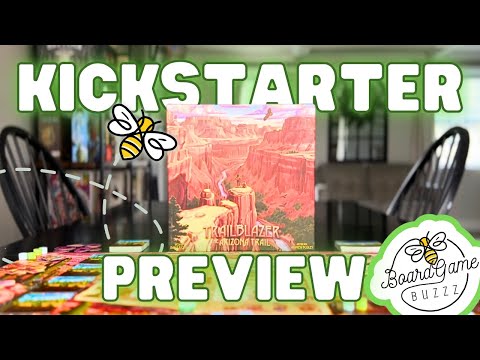
A unanimous standout across reviewers is the artistic achievement behind the box cover. The cover art alone has earned recognition from multiple content creators who assess cover art annually, and for good reason. The rendering of Arizona's landscape, its red rocks, geological drama, and sense of scale, resonates on an emotional level that goes beyond typical board game aesthetics. One reviewer noted that the cover itself prompted a personal reckoning with childhood memories of hiking, so evocative is the visual language. The art is not merely decorative; it justifies owning the game as a physical object worth displaying.
A Refined Evolution of an Established Lineage
Trailblazer: The Arizona Trail improves upon John Muir Trail by deepening the core design rather than merely iterating. Reviewers who played both titles credit the successor with preserving the hiking fantasy while expanding the mechanical toolkit. The expansion in complexity reflects genuine design evolution: more systems interact, more decisions carry weight, and the spatial puzzle gains sophistication. This signals a confident design team willing to challenge an existing fanbase rather than simply cash in on success.
Potential Drawbacks
Substantial Complexity Barrier
The most consistent reservation reviewers express concerns the leap in complexity. Players who bounced off earlier titles in this design lineage worry that Trailblazer may push further into territory that demands significant rules overhead and turn-sequence management. Some note that John Muir Trail already stretched their bandwidth, and the Arizona sequel's added depth may make it a harder sell for certain households. This is not a flaw per se, it reflects intentional design, but it does narrow the game's audience.
Prototype Quality in Early Copies
Reviewers who obtained prototype versions prior to the final release noted that while the prototypes played well mechanically, some physical components showed signs of finalization work still pending. Those willing to live with prototype quirks report minimal friction, but players who prefer pristine retail components may wish to wait for the polished final version.
If You Enjoy Trailblazer: The Arizona Trail
Trailblazer invites comparison to John Muir Trail, its spiritual predecessor. Reviewers consistently recommend playing the earlier title first as a gateway to this sequel, particularly for households uncertain whether the complexity jump justifies the purchase. The relationship is not linear, the Arizona Trail does not require ownership of John Muir Trail, but playing John Muir Trail helps gauge whether the design philosophy resonates with your group.
Fans of Stefan Feld's work will recognize the design DNA in Trailblazer. Games like Bruges, Bora Bora, and Jorvik share a philosophy of interlocking systems and multiple scoring tracks. If those titles energize your table, Trailblazer's combination of hiking fantasy and puzzle-like depth should land strongly. Colorado Trail, the next game in the lineage, is also in development, suggesting this design family continues to grow and evolve.
What Reviewers Are Saying
It felt a lot like a few of the Stephenfeld games that I've played where you really have to chain things together and there's a lot of ways to earn points.
— Where There's A Wilz, There's a Play
something about this cover is just so beautiful and I don't know it's cuz I grew up in uh Utah and I went to Southern Utah very regularly and just saw the Red Rocks I know like this is in Arizona and lots of that kind of carries up into Utah and stuff it reminds me of just growing up and childhood and exploring the Red Rock and going on hike it's beautiful I love it
— Board Game Buzzz
the Arizona Trail it took this game which I feel like the core of it had some really good potential and they just expounded on it and they made it really really good
— Board Game Buzzz