


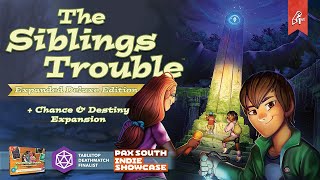



Siblings Trouble: Expanded Deluxe Deep Dive
What the Community Thinks About Siblings Trouble: Expanded Deluxe
Siblings Trouble: Expanded Deluxe is celebrated by reviewers as one of the most accessible and joyful entry points into collaborative storytelling gaming. Tabletop Tolson's Kimberly calls it "a fantastic game for that storytelling RPG experience for families for entry gamers for young people," while Gaming with Edo & Jessica's coverage emphasizes how the expanded edition transforms the original with meaningful new depth. The community consensus is clear: this is a game that welcomes newcomers while offering experienced storytellers the tools to build increasingly complex narratives. Reviewers consistently praise the game for being genuinely fun to play rather than merely mechanically sound, and they highlight its rare ability to work equally well for ages 8 and 80 at the same table.
Core Mechanics That Define Siblings Trouble: Expanded Deluxe
Card-Driven Narrative Choice
The game's foundation is a deck-building mechanism where each player constructs an adventure deck before play begins. From Pencil First Games, designer Edo walks through how this works: players arrange cards (Entrance, Paths, Locations, Big Secrets, and Boss) into a sequence that becomes their shared journey. On each turn, a player flips a card from the deck and reads aloud the scenario it presents: "Hillside cave, the hillside cave is hidden. Describe how it was discovered and opened to enter." The card itself doesn't dictate what happens next; instead, it invites the player to describe their sibling's response. What makes this mechanic so clean is that cards include mechanical triggers (search die symbols, treasure draws, combat encounters) that keep the narrative grounded in concrete game moments while leaving the storytelling entirely open. Treasures carry over between adventures, and bosses appear at predictable moments in the deck, creating a structure that supports improvisation rather than constraining it.
Storytelling as Gameplay
Siblings Trouble treats narrative generation as the primary game action. Rather than rolling dice to resolve a story premise, players describe their character's actions and the results emerge from their narration layered with the card prompts. Kimberly emphasizes that "it's really up to the players to bring the storytelling," and shows how this creates moments where simple card triggers like "a traveler appears" spawn character interactions, bargains, and decisions. Each sibling has unique abilities tied to storytelling choices: one character might use "misdirection" or another might possess a special treasure that modifies outcomes. This is where Siblings Trouble diverges from heavier RPGs: the game doesn't ask players to learn complex rules or character sheets, just to think like their sibling and describe what they see and do. Jessica notes that even players brand-new to storytelling games can succeed because "you get to decide...which of the cards represents who you are in the game."
The Siblings Trouble: Expanded Deluxe Experience
Goonies-Esque Adventure Feeling
Reviewers consistently invoke the same touchstone: the game feels like the opening act of a classic adventure story where kids or siblings discover a hidden world and must work together to survive it. Edo describes it plainly as "goonies-esque fun adventure," and the PAX South footage confirms this: players laugh frequently, build on each other's descriptions, and narrate absurdist moments with pure delight. The game creates a space where encountering a dwarf miner guarding treasure or stumbling into a weird kitchen becomes an opportunity for collaborative comedy, not mechanical optimization. There are no lose states that feel crushing (if all players go home, you simply restart), and the 30-minute runtime keeps the tone light and playful. Even when bosses appear and stakes rise, the narrative lens keeps the experience feeling like storytelling around a campfire rather than a tense optimization puzzle.
Accessible Gateway to Storytelling
For players who have always been curious about tabletop RPGs but intimidated by character sheets or rules, Siblings Trouble functions as a masterclass in why storytelling games work. Jessica highlights the Destiny mode as filling this exact niche: a fifth-player role that acts as a gentle game master, helping hesitant storytellers find their voice. "If you've ever wanted to get into RPGs," Jessica explains, "this is a great way to try it out in a quick setting." Kimberly articulates something deeper: this game addresses a widespread gap in childhood education. Kimberly reflects that storytelling skills are something they are "still working on to this day," and frames Siblings Trouble as the safe, low-stakes space to develop them that Kimberly wishes they'd had growing up. That framing transforms the game from entertainment into a genuine learning tool, one that doesn't feel like work because it's too much fun.
What Makes Siblings Trouble: Expanded Deluxe Stand Out
The Destiny Role: Game Master Without Heavy Lifting
The Expanded Deluxe edition introduces Destiny, a fifth player character who operates like a traditional game master but with a crucial difference: Destiny doesn't run the game or enforce rules. Instead, Destiny plays a deck of 13 tarot-like cards that present story moments, complication, or opportunities, and flips a coin (with sun and moon sides) to determine whether each event unfolds favorably or not. Jessica demonstrates how this works in practice: when a less confident storyteller hesitates on their turn, Destiny can float into the scene, offer hints about what the character might do, and gently guide them back into the narrative without ever leaving character. The genius of this design is that it adds narrative complexity without adding mechanical burden. Kimberly calls it "a really nice complex layer to the game without adding a whole bunch of new mechanics and without adding a lot of complications." For groups with mixed storytelling experience, Destiny transforms a potential pain point (waiting for a shy player to figure out what to say) into a shared moment where everyone contributes to building the story.
Multi-Location Story Arcs and Journey Continues Cards
The Expanded Deluxe edition introduces "Journey Continues" cards that let groups chain multiple adventures together into a single story. Instead of each play session being a standalone 30-minute adventure, players can now travel from the Museum of Mystery to the Hillside Caves to the Ancient Forest, carrying their treasures and character development forward across locations. Bosses can resurface with new context, and players can craft "bigger secrets" that span multiple locations. Jessica explains the appeal: this feature lets groups who want a connected storyline build one, while groups seeking quick standalone adventures still get them. It also dramatically increases replayability; with eight locations and the ability to branch between them, the possibility space expands from a single afternoon to an entire campaign that unfolds over weeks. Reviewers emphasize that this flexibility doesn't add complexity, just options: a single adventure still plays in 30 minutes, but now groups can choose how deep to go.
Potential Drawbacks
Storytelling Can Feel Awkward for Inexperienced Players
Siblings Trouble demands that players be willing to improvise and narrate their character's actions aloud. For players accustomed to silent, mechanical decision-making (drawing cards, resolving dice) or those who feel self-conscious speaking in character, the constant invitation to describe things can feel exposing. Kimberly acknowledges this openly, noting that storytelling skills are something they are "still working on to this day," implying that growth in this area is gradual and sometimes uncomfortable. While the Destiny mode exists precisely to support hesitant players, it requires at least one person at the table to feel confident enough to facilitate, and a group of all-new storytellers might struggle to get the engine started. The game doesn't have "default" dialogue or fail-safes; players must create content on the fly or the turn stalls.
Limited Availability of the Expanded Deluxe Edition
Pencil First Games describes this as "a pretty small run," and creator Edo explicitly notes that there are "not much" copies left in stock. The Expanded Deluxe edition was produced in smaller quantities than mainstream board games, making it harder to find than some alternatives. While the core content from this edition is available via the separate "Chance and Destiny" expansion for owners of the original game, the complete Expanded Deluxe package with updated components may not be readily available for new players seeking the full experience out of the box.
If You Enjoy Siblings Trouble: Expanded Deluxe
Players drawn to Siblings Trouble's blend of narrative freedom and card-driven structure will find similar satisfaction in Liftoff: Get Me Off This Planet, another Pencil First Games title that also received an Expanded Deluxe edition. Like Siblings Trouble, Liftoff emphasizes collaborative decision-making with minimal rulebook overhead and offers a similar goonies-style adventure feel. Both games sit at the intersection of storytelling and traditional board gaming, designed to welcome players who might be curious about narrative-focused games but hesitant about heavy RPG systems. If you enjoy Siblings Trouble's emphasis on fast play and accessible creativity, Liftoff delivers that same philosophy in a different setting.
What Reviewers Are Saying
"This is a fantastic game for that storytelling RPG experience for families, for entry gamers, for young people, and for me I'm gonna put myself in that group because I need the experience."
— Tabletop Tolson
"Destiny is an awesome new character and a game mode that, again, you can learn to play as a game master. If you've ever wanted to get into RPGs, this is a great way to try it out in a quick setting, and it's also awesome if you are playing with some other players who may not be as experienced with storytelling."
— Gaming with Edo & Jessica
"You can play with your friends, your family, your kids, and go on a really quick role-playing adventure that's driven by card play, so you set up a deck of cards, you play through it, and you can just have this sort of goonies-esque fun adventure."
— Gaming with Edo & Jessica