





Race to Berlin Deep Dive
What the Community Thinks About Race to Berlin
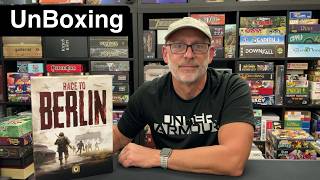
Race to Berlin found real enthusiasm among wargame-focused channels, even though most coverage arrived while the game was still a prototype ahead of its Gamefound crowdfunding campaign. Zilla Blitz gave the game two separate videos, a deep-dive overview of the prototype and a full gameplay walkthrough, calling it an intriguing and fascinating game to play. The Discriminating Gamer ranked it among a list of favorite wargames, stating plainly that it is a great game and that play sessions with a friend were thoroughly enjoyed, though that reviewer also noted having only the prototype copy and looking forward to the final edition. On Rolling Dice & Taking Names, a Portal Games representative joined the hosts to talk through the small print run and the personal story behind publishing the game, while the hosts themselves recalled the particular tension of controlling an opposing German faction during their own session.
Where opinions diverge is on solo play. In the prototype overview, Zilla Blitz rated the game around three and a half out of ten for solitaire suitability and said it really is not designed for solo play, built instead for an opposed two-player experience. Yet in the later gameplay walkthrough, played solo for demonstration purposes, the same reviewer found it surprisingly enjoyable and functional on its own, while still maintaining that the hidden logistics blocks make it shine most as a true two-player contest.
Core Mechanics That Define Race to Berlin
Logistics Blocks and Hidden Information
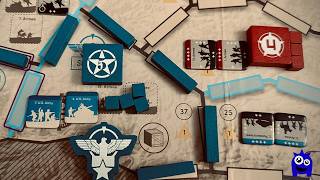
Each side has eight logistics blocks numbered with values from two to five, placed one per zone onto the map at the start of a turn. In a real two-player game these are placed face down so a value is only revealed when a side commits it to an action, which Zilla Blitz described as a lot of guessing and figuring out where an opponent is trying to push and where they are trying to defend. The Discriminating Gamer pointed to this same hidden placement as part of the game's bluffing elements. According to the deep-dive overview, these blocks are not a side detail but the core of the game's depth and replayability, since a player never has enough of them to cover every zone they would like to reinforce.
Front Lines and Combat Resolution
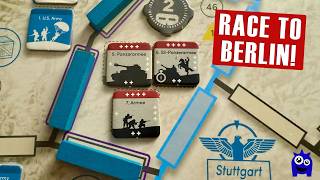
Movement plays out on an area map rather than hexes, and progress is tracked with physical front line markers that visually shift as territory changes hands. Because the supply of these markers is limited, overextending a push can leave a side unable to sustain further advances, something Zilla Blitz called a fascinating dynamic between the frontline markers and logistics. In combat, the attacking and defending strength comes from the logistics block value rather than the unit itself; each side rolls two dice, adds the difference to its logistics value, and modifiers from rivers, terrain, fortresses, and special action cards can shift the result further. Committing two action cubes to a block doubles its strength, while cards can add die roll bonuses or let a losing side counterattack instead of retreating.
The Race to Berlin Experience
The Guessing Game of Two-Player Combat
Both Zilla Blitz videos and The Discriminating Gamer's list entry describe a game that is really about reading an opponent's intentions. Logistics blocks sit on the map as unknown quantities, and each activation forces a decision about how much strength to reveal and commit. The Discriminating Gamer summed up the twist at the heart of this guessing match: each side does not just control its own army, but also controls the German faction standing in its opponent's way, creating constant tension between advancing on one front and using the Germans to slow the other player down.
Playing Solo Versus Playing Head-to-Head
The gameplay walkthrough from Zilla Blitz played out as a demonstration with both sides visible, which the reviewer noted removes the genuine bluffing of a real match but still shows how the turn sequence and combat resolution function. The hosts on Rolling Dice & Taking Names, by contrast, had played the game against each other and recalled how uncertain it felt when the other player's turn came around, never quite sure whether they would use their German units to help themselves or to actively block their opponent. That contrast, between a controlled demonstration and an actual opposed match, runs through the available coverage of the game.
What Makes Race to Berlin Stand Out
Commanding Both Sides of the Front
The dual-faction structure drew specific praise. The Discriminating Gamer explained that the Western Allies player also controls the Eastern Germans, and the Soviet player also controls the Western Germans, so each side must balance advancing its own army with using an enemy faction to hold the other player back. On Rolling Dice & Taking Names, the hosts remembered this exact mechanic as what they liked most about their session, since every turn came with the question of whether to use the opposing Germans defensively or just let them fall back.
An Approachable Rule Book for a War Game
Zilla Blitz rated the game's complexity at three out of ten on a war game scale, noting that the thirty-four page rule book leans heavily on photographed examples of play in its final third, and said there is no reason to let the complexity scare off a wider audience. The same video praised the map's look and the way the front line markers give an immediate visual read on how far each side has advanced. On the interview, Portal Games' representative described how the designer insisted every rule reflect something that actually happened historically, down to issues with fuel and ammunition, which shaped the final rulebook.
Potential Drawbacks
Rules That Take a Few Reads
Zilla Blitz admitted to being only about eighty percent comfortable with the rules even after playing, cautioning viewers not to treat the gameplay video as a reliable tutorial since some rules may have been misapplied. The deep-dive overview made a similar point, saying the combat and movement systems are not complicated but do have subtleties that take a couple of readings to fully click. Both of that reviewer's videos, along with The Discriminating Gamer's list entry, were also based on a prototype copy, so component quality and final presentation were still subject to change at the time of review.
A Small Print Run and Limited Solo Appeal
On Rolling Dice & Taking Names, Portal Games' representative was direct about availability: this edition was crowdfunded during a period of tariff uncertainty for American backers, and the publisher is only printing around five hundred copies, the maximum run it considers viable for a war game of this kind, meaning it will not reach typical retail shelves. The deep-dive overview added a separate limitation on top of that scarcity, rating the game roughly three and a half out of ten for solitaire play and stating outright that it was not really designed for solo use.
If You Enjoy Race to Berlin
None of the available coverage draws a direct comparison between Race to Berlin and another named game, so no recommendation is offered here rather than inventing one.
What Reviewers Are Saying
"This was a really intriguing game. The mechanics, the combination really of these front line markers that you have a finite supply of. So you're trying to not overstretch your front lines as well as the use of these logistics cubes to shift emphasis where you're going to attack, where you're going to try to defend."
— Zilla Blitz
"Race to Berlin is a great game where one of you is the Western Allies, one of you is the Russians, but you're not just playing as those factions. The Western Allies are also playing as the Eastern Germans, and the Russians are also playing as the Western Germans."
— The Discriminating Gamer
"Designer of the game Kushtov is my friend for many, many years, and he was struggling finding a publisher. And I said, Kushtov, I'm doing it for you, we are friends, and don't bother with other publishers. And we did with our whole heart and our care and our talent of my development team."
— Rolling Dice & Taking Names