






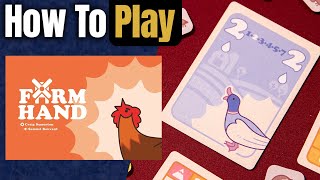





Farm Hand Deep Dive
What the Community Thinks About Farm Hand
Farm Hand has emerged as an unexpected sensation in the trick-taking game community, earning praise for its elegant simplicity and inclusive design. Reviewers consistently highlight the game's ability to bridge the gap between casual players and experienced trick-takers, making it accessible to a remarkably wide audience. The community appreciates how the game delivers engaging strategic choices without overwhelming complexity, allowing both families and hardcore gamers to find satisfaction in the same box. Multiple reviewers have expressed surprise at how well the game works despite its minimalist presentation, with several noting that Farm Hand seems to come from nowhere yet lands with immediate impact. The consensus centers on the game as a modern solution to an old problem: how to create a trick-taking experience that doesn't require players to internalize complex bidding systems or spend half an hour learning the rules.
Core Mechanics That Define Farm Hand
Bidding and Trick Prediction
Farm Hand employs a simultaneous bidding system that forms the foundation of its strategic depth. Before each round's trick-taking begins, players look at their hand and the card backs of opponents to estimate how many tricks they believe they will win. This prediction phase is elegantly simple: players count to three and reveal their bid using fingers, a method that feels both whimsical and fair. What makes the bidding system work so effectively is that players who correctly predict their exact number of tricks win points equal to the round number, while those who miss lose a point for each trick they were off. This single scoring rule creates constant tension between boldness and caution, encouraging players to use the partial information available to them while remaining aware of how much they don't know. The round structure itself evolves throughout the six-round game, with each subsequent round adding more cards to hands and increasing the stakes of successful prediction.
Cancellation and Information Asymmetry
The signature mechanical twist that distinguishes Farm Hand from traditional trick-taking games is the cancellation rule. When two or more cards of the same numerical value are played in a trick, those cards eliminate each other from competition, and the next highest card wins instead. This seemingly simple rule creates fascinating downstream effects, transforming trick-taking from pure card strength comparison into a game of tactical deception and psychological reading. Players must consider not just what card to play, but whether opponents might cancel their card with a matching value, forcing them to recalculate their trick count mid-round. The other defining feature of information architecture is how card backs work: each card displays the suit and shows a range of possible values the card might hold. Players can see exactly which colors their opponents hold, but the specific numbers remain mysterious until cards are played. This semi-transparent information system means that bids are informed guesses rather than either blind gambles or perfect calculations, rewarding players who can read probabilities and notice pattern shifts as cards leave hands.
The Farm Hand Experience
Quick and Engaging Pacing
Farm Hand delivers what reviewers consistently describe as a fast and satisfying gaming experience. The game moves at a crisp pace that keeps all players engaged throughout, avoiding the downtime that plagues longer trick-taking games. A full six-round game completes in roughly fifteen to thirty minutes depending on player count and decision speed, making the game ideal for casual table settings where time is limited. The tight round structure means that no single round feels overly consequential, reducing analysis paralysis while maintaining meaningful choice. Players can jump into Farm Hand without needing extended rules explanations, allowing the game to hit the table quickly and run smoothly, even with players encountering it for the first time. This accessibility is intentional in the design, with each mechanic supporting quick comprehension and rapid execution.
Inclusive Social Dynamics
The game's emphasis on prediction and information reading creates a fundamentally inclusive social dynamic where luck and choice are balanced in ways that keep all players competitive throughout. Because points are awarded for exact prediction rather than trick accumulation, a player can win the game even if they took the fewest tricks, as long as they accurately predicted their own outcome. This inversion of traditional trick-taking scoring removes the crushing feeling of being locked out of victory after a bad early round. The simultaneous bidding eliminates the advantage that forward players typically enjoy in turn order, ensuring that all positions feel equally valid. The animal-themed cards carry a gentle, family-friendly aesthetic that appeals to players regardless of their experience with heavier games, and the compact box size makes the game approachable in a way that larger, more intimidating games cannot be.
What Makes Farm Hand Stand Out
Elegant Accessibility Without Sacrifice
Farm Hand achieves something that many modern games struggle with: creating genuine depth for experienced players while remaining genuinely accessible to newcomers. The game does not simplify its strategic core to accommodate casual audiences; instead, it removes unnecessary chrome and complexity that would obscure that core. Experienced trick-taking players immediately recognize the elegant balance between the semi-open information system and the cancellation rule, understanding how these mechanics invite both psychological play and probability management. Simultaneously, a player encountering trick-taking for the first time can grasp the rules in five minutes and begin making meaningful decisions immediately. This universality of appeal comes from the design respecting the intelligence of all its players rather than patronizing some segments while rewarding others.
Innovation Within Tradition
While Farm Hand works comfortably within the established trick-taking tradition, it introduces the cancellation mechanic in a way that feels fresh without discarding the genre's fundamental satisfactions. The design takes the familiar framework of bidding plus trick-taking and introduces a single system change that cascades into completely different gameplay feel. Players familiar with Wizard, Skull King, and other prediction-based trick-takers find Farm Hand immediately recognizable in its DNA while notably different in execution. The innovation is conservative in presentation but revolutionary in practice, allowing experienced players to approach the game with confidence while discovering unexpected strategic wrinkles as play continues. For newer players, Farm Hand serves as an elegant gateway to trick-taking games, introducing core concepts in manageable doses before they graduate to heavier examples of the genre.
Potential Drawbacks
Limitations in Replayability Depth
Some reviewers note that while Farm Hand excels at what it does, the relatively small card count and fixed round structure mean that the decision space, while well-designed, eventually becomes familiar. With a limited card pool and six predetermined rounds, players who engage with the game frequently may find themselves cycling through similar scenarios and strategic patterns. The game works beautifully as a casual opener or closer to a game night, but some players seeking deeper strategic variation across multiple sessions report that the experience plateaus faster than they might have hoped. Unlike Wizard or other longer trick-taking games that build in expansion content or modular rules, Farm Hand's minimalist approach can feel constraining to players seeking evolving complexity across dozens of plays.
Luck-Dependent Bidding Information
While the semi-open information system works elegantly in theory, execution depends substantially on how accurately players can estimate card distribution based on card backs alone. New players sometimes struggle with the probability assessment required for accurate bidding, leading to rounds where the bidding phase feels random rather than informed. Some players report that even with experience, the gap between perfect information and visible information can feel frustratingly wide, making accurate bidding feel like a lucky guess rather than a calculated risk. Additionally, the final round occasionally sees a player with nearly complete information about remaining cards having such a dramatic advantage that the last bid becomes inevitable rather than a choice. These moments are relatively rare but noticeable enough that they occasionally disrupt the otherwise elegant balance between knowledge and uncertainty.
If You Enjoy Farm Hand
Players drawn to Farm Hand's accessible trick-taking experience should explore Wizard for a more elaborate take on prediction-based trick-taking that shares Farm Hand's core appeal while adding character development and progressive difficulty. Skull King offers similar bidding-plus-tricks gameplay with additional complexity and higher stakes, ideal for players ready to graduate from Farm Hand's streamlined approach. The Crew: The Quest for Planet Nine appeals to Farm Hand fans seeking a cooperative trick-taking experience where prediction takes on collaborative dimensions. For those attracted specifically to the information-asymmetry aspect, The Mind and Insider explore similar territory of reading opponents through limited information, though in different mechanical frameworks. Love Letter captures the same elegant social deduction with minimal rules overhead, while Coup delivers similar decision-making intensity through character powers rather than card tricks. Flip Seven provides comparable speed and accessibility with a push-your-luck core instead of bidding. Trio shares the simultaneous-reveal social gaming feel with a different core mechanic, appealing to players who love the synchronous play structure.
What Reviewers Are Saying
"it's super quick. It's super fun. You can play it with almost anyone. That should be the tagline. It basically it's a card game. It's a trick taking game where you the other players see the color of your card on the back and they then know the range of those cards."
— Board Gaming Ramblings
"In round one, everyone's going to get dealt one card. I can see what color you have, but I don't know the number. So everyone has these and then at the same time everyone will say ei and put out the number of fingers in round one it will be zero or one to how many bits you think you'll win."
— The Dice Tower
"it's a trick-taking game that anyone can play. Okay. So, if you've played games like Flip Seven or even Trio, the idea that you've got a hand of cards and you're trying to win tricks, simple as that, just winning a trick, taking the card. But the fact is that if someone plays the same number card, those cards cancel out."
— Board Game Sanctuary