























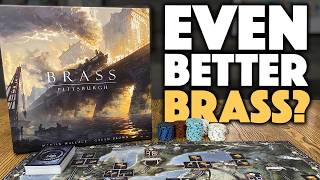





Brass: Pittsburgh Deep Dive
What the Community Thinks About Brass: Pittsburgh
Brass: Pittsburgh is widely celebrated as the natural next evolution in the Brass series, building on the tremendous success of Brass: Birmingham, which holds the number one spot on BoardGameGeek. Reviewers across multiple channels express genuine enthusiasm for how the game refines and expands the proven Brass system. The consensus is clear: this is not merely another Brass variant, but a thoughtfully developed progression that adds meaningful depth while maintaining what makes the system work. Kovray describes coming back to the game specifically to discover more of its systems, while other reviewers who have played extensively across the Brass line describe Pittsburgh as feeling like an even further developed version of the design. Some reviewers remain cautiously optimistic given their existing collections, but most who have played the game come away eager to explore it further.
Core Mechanics That Define Brass: Pittsburgh
Network Building Through Multiple Transport Types
The heart of Brass: Pittsburgh remains the network building that defines the series, but Pittsburgh introduces a critical distinction: players now build both light trains and heavy trains. Light trains, like the canals and light trains of previous Brass games, are temporary and removed at the end of each era. Heavy trains, however, persist across both eras, creating permanence and strategic weight. Building a heavy train requires steel as a resource and unlocks access to powerful bonus tiles as players progress up their individual player boards. This creates a compelling tension: early-game flexibility versus late-game security. The map sprawls across the eastern United States with routes connecting Pittsburgh, New York, Philadelphia, and beyond, and every rail connection produces specified resources printed directly on the track. The care in placement matters profoundly.
Resource Management With Oil, Coke, and Steel
Pittsburgh significantly expands the resource economy beyond the coal and iron of earlier games. Players now juggle iron, coal, steel, coke, and oil, each filling specific roles in building industries and advancing on their player boards. Coke, used in steel production, must often be produced by converting coal, introducing a layered production chain. Oil is extracted through pipeline construction rather than traditional buildings, creating a new link type that grants ongoing income whenever other players use your pipelines to deliver oil. Steel, the most advanced resource, costs more to produce but unlocks access to heavy trains and premium industries. This expanded economy means timing becomes crucial: waiting for another player to produce a resource you need can advance your strategy, but it leaves you vulnerable to being locked out entirely. Cornelius Vanderbilt, represented as "the Commodore," always stands ready to sell resources at a steep premium when market connections fail, providing a safety valve that prevents complete deadlock while maintaining economic tension.
The Brass: Pittsburgh Experience
Pressure and Cleverness in Every Decision
Playing Brass: Pittsburgh creates a distinct emotional arc. Early turns feel like expansion: players build networks, establish industries, and accumulate resources. But as economies tighten and competitors block key routes, the pressure intensifies. The game rewards clever sequencing: spending just enough money to stay ahead in turn order while accomplishing your aims, timing industry development to coincide with resource availability, and sometimes taking out loans strategically to preserve cash for a devastating play later. When a well-planned sequence comes together, when industries flip and generate income at exactly the right moment, or a heavy train placement goes uncontested, the payoff feels genuinely satisfying. Kovray describes the feeling of pulling off an ambitious play as feeling like "an industry titan." The game never feels solved or scripted; each play presents new possibilities because the card hands, player strategies, and market dynamics interact in countless ways.
Exploration and Mastery Across Multiple Plays
A striking theme in reviewer commentary is the desire to return. Players don't simply enjoy individual games; they feel compelled to play again. Kovray describes wanting to come back specifically to discover more of the system, noting there is so much interest and capability contained within the game's cards. The player boards feature branching paths: players can develop along different columns to unlock different industry types and heavy train bonuses, meaning two games can feel quite different in strategic shape. The map doesn't clean up as severely between eras as Birmingham's does; remnants of era one persistence create continuity. This design choice encourages exploration: players want to find what works, test different engine-building paths, and see how various combinations interact with the board state and opponents' moves.
What Makes Brass: Pittsburgh Stand Out
Refined Integration of Theme and Mechanics
The industrial setting of late-19th-century America, the age of Carnegie, Rockefeller, Vanderbilt, and the oil boom, is woven seamlessly into every mechanical choice. Oil pipelines are not an abstract resource flow; they represent the real infrastructure race that defined the era. Steel production, requiring coke as a prerequisite, mirrors actual historical production chains. The Commodore mechanism captures the real control that Vanderbilt and others wielded over shipping and trade. Reviewers praise how the game doesn't just use theme as flavor but grounds every decision in historical plausibility. When you spend money or take a loan, you're managing debt like a real industrialist of the period. When you race to build the first heavy train on a lucrative route, you're securing territory like the real rail barons did. This coherence between theme and system is one of the reasons players stay engaged: they're not just optimizing numbers, but roleplaying a meaningful historical role.
Flexibility Without Dumbing Down Depth
A key design achievement is the introduction of Cornelius Vanderbilt and whiskey bottles, both of which add flexibility without undermining strategic depth. In earlier Brass games, being unable to reach a market or lacking a specific resource could block entire strategies. The Commodore provides an expensive but always-available fallback, preventing dead-end situations while maintaining tension through cost. Whiskey bottles, obtained through certain plays and rail connections, function as wild location cards or can bolster a sale total to unlock premium bonuses. This seemingly small change removes the frustration of being completely locked out while creating new decision trees: is it worth pursuing whiskey tokens, or are they better left for emergencies? The result is a game that feels more generous to new players without becoming easier for experienced ones. Reviewers note that a play can usually be found if the money is there, but finding the right play, at the right time, still requires deep strategic thinking.
Potential Drawbacks
Rules Complexity and the First-Play Barrier
Multiple reviewers acknowledge that Brass: Pittsburgh is more complex than Brass: Lancashire, with more moving parts and interactions to grasp. The designers aimed to fix confusing aspects of Birmingham while adding new mechanics, which inevitably increased the rulebook length and teach time. Oil pipelines, heavy train bonuses, premium sales tiles, income divergence, and the expanded resource economy all demand attention. Reviewers note that Birmingham already requires significant overhead, and Pittsburgh adds another layer on top of it. For groups that play a variety of games, especially those that don't gather for long, heavy euros very often, the investment in learning the system may feel daunting. The first play is likely to move slowly, and appreciating the game's depth may require a second or third play before the rules flow more naturally.
Time Commitment and the Pacing Arc
Brass games are famously long: two to four hours depending on player count and experience. Pittsburgh is no exception. Some players find the early game, era one, can feel directionless until economies solidify and strategic positions become clear. Resource scarcity at the beginning of a turn can create downtime while players calculate options. Committing to a three or four hour game is inherently risky if the experience doesn't click immediately, since that time is invested in something that might not deliver gratification until the final scoring. The density and pace of decisions, while intellectually satisfying to experienced Brass players, may exhaust newer players. The game rewards patience and planning, but not all tables are comfortable with that tempo.
If You Enjoy Brass: Pittsburgh
Reviewers who love Brass: Pittsburgh consistently point to its sister titles in the Brass line. Brass: Birmingham, the current highest-rated board game on BoardGameGeek, shares the foundational card-driven economy system and is an excellent entry point for players who haven't experienced Brass before. Brass: Lancashire, the first modern Brass release, offers a somewhat more streamlined experience. Slightly further afield, Age of Industry provides an alternative for players who want to explore the system's roots in a lighter package. Reviewers also mention Scythe as a comparison point: a mid-weight economic game with strong theme integration and asymmetric player powers that similarly rewards depth and mastery across multiple plays. Players seeking tight economic systems, meaningful player interaction through resource control, and strategic paths that branch in multiple directions will find similar satisfactions in these titles.
What Reviewers Are Saying
"I understand why everybody loves this game and this system so much, because there's just that magic of player interaction that just always feels so dynamic. But it fuels directly into the theme of what you're doing, and the potential and the ways that this game can go is just infinite, really."
— kovray
"After having played this, Birmingham sort of felt like a more developed version of Brass. I think this too feels like an even further developed game, and better for it."
— Watch Review
"There's so many layers to this game. When you're able to make that play where you're able to spend all the money that you possibly have to do that one thing that you did not think you could do, and then all of a sudden you get that income and you're a little bit ahead of everybody else, you just feel like an industry titan at that point."
— kovray