





Magic Maze Tower Deep Dive
What the Community Thinks About Magic Maze Tower
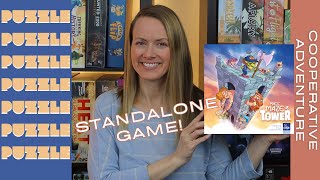
Magic Maze Tower has captured the attention of board game reviewers as a bold reimagining of the original Magic Maze. Rather than follow the same high-pressure real-time formula, Sit Down Games stripped away the sand timer and replaced it with something entirely different: a carefully constructed puzzle game. Reviewers from Tabletop Tolson to Board Game Dad to Meeple University consistently frame Tower as a standalone experience that shares the Magic Maze universe and cooperative spirit but abandons the chaotic rush for methodical problem-solving. The result, they say, is a game that feels less like an escape-room scramble and more like classic logic puzzles such as Rush Hour or the tile-pushing challenges of Lemmings and Chips Challenge.
Core Mechanics That Define Magic Maze Tower
Cooperative Game
All players win or lose as a unit, facing the puzzle together with no points, no elimination, and no competition among the team. Each round, players control five unique characters (four adventurers plus a teleporting Little Sister) to guide them out of a maze. No single player owns a character; instead, the entire team can move any of them, which creates a collective intelligence problem. The goal is simple on the surface: position all five characters on their matching armory spaces and then lead them to their color-coded exits. This requires synchronized thinking and shared commitment to solving the puzzle together.
Limited Communication
Once you begin playing, the game enforces near-total silence. The only permitted communication is a stare. You cannot point, speak strategy, or announce your intentions. Each player holds an orientation tile showing a cardinal direction (north, south, east, or west, depending on player count), and they may only move characters in that single direction. This limitation forces the team to infer intent from body language and piece movement alone. The mechanic creates moments of synchronized clarity when all players understand the next move without saying a word, and moments of frustration when disagreement about the correct path cannot be voiced or resolved through dialogue.
The Magic Maze Tower Experience
Calm, Thoughtful Problem-Solving
Without a timer, there is no pressure to rush. Reviewers consistently note that this absence changes the emotional texture of the game entirely. Tabletop Tolson emphasized that Tower removes the sand-timer stress while preserving the puzzle essence. Players can sit with a difficult board configuration, trace possible solution paths, and think through the consequences of each move. The progression is intentional: early tutorials introduce mechanics one at a time (locked doors, ladders, diagonal movement, character abilities), and the 91 challenge cards grow steadily harder. This paced learning creates an experience closer to a puzzle book than to a game-night scramble.
Silent Coordination and Shared Discovery
Reviewers found a surprising delight in coordinating through glances and piece movements alone. Because communication is forbidden, solving a puzzle becomes an act of collective reading. When the team aligns on a solution path and executes it flawlessly in silence, the satisfaction is profound. Meeple University described this as "social without communication," and Board Gaming Ramblings noted that it can work beautifully as a solo puzzle or with a partner who shares your problem-solving instincts. The silence, rather than isolating, creates moments of unspoken unity.
What Makes Magic Maze Tower Stand Out
91 Progressive Challenges with Depth
The box contains a staggering breadth of puzzles. Each quest card presents a unique configuration with escalating complexity. Early cards teach the game's systems; mid-game cards layer new mechanics (character abilities, special terrain, locks and keys); late-game cards combine multiple mechanics into intricate scenarios where only one solution path works and many others lead to dead ends. Reviewers praised this progression for allowing both new players and veterans to find puzzles at their skill level. Unlike a single puzzle game, Tower offers dozens of hours of progressive challenge.
Colorblind-Friendly Design with Symbol-Based Clarity
Every element in Magic Maze Tower is rendered twice: once in color and once in clear symbolic shorthand. Characters have color names but also icons (sword, bow, axe, staff, crown). Exit doors are color-coded but symbol-coded. Spaces on the board use symbols as well as hue. This dual encoding ensures that players with color blindness can fully participate without accommodation. Tabletop Tolson highlighted this design choice as an example of thoughtful, inclusive game design that should be the norm. The symbols also reduce cognitive load for all players when scanning a crowded board.
Potential Drawbacks
Silent Disagreement Can Be Frustrating
The inability to communicate is by design, but reviewers acknowledged it creates friction. Board Gaming Ramblings noted that this game works best with players who either play solo or are comfortable with silent problem-solving and won't become frustrated when teammates move pieces in unexpected ways. When two players silently disagree about the correct solution path and one makes a move that blocks the other's preferred route, there is no way to hash it out in real time. Some groups will find this tension liberating; others will find it aggravating. Meeple University suggested that the later, harder puzzles can feel "unrecoverable" (one wrong move backs you into a state where you have to restart), and this requires patient, collaborative players.
Complexity and Breadth of Mechanics Can Overwhelm
Although the tutorials introduce mechanics gradually, the total system encompasses a lot: orientation tiles, directional movement, locked doors and keys, ladders, stairs, teleportation, character-specific abilities, and environmental hazards. Early cards keep things simple, but by the mid-game, a single board may require understanding five or six interlocking systems. Players who prefer lighter, simpler games may find the ruleset daunting. The game isn't heavy by modern Eurogame standards, but it is densely interlocking, and learning it requires engagement with the full tutorials before jumping to the main challenges.
If You Enjoy Magic Maze Tower
Start with the original Magic Maze if you haven't played it: Tower is a sibling, not a sequel, and the original offers a very different (real-time) experience. Fans of logic puzzles should explore Rush Hour (a classic tile-sliding puzzle), Lemmings (the video game, which shares Tower's puzzle-progression feel), and Chips Challenge (another grid-based puzzle game). Exit: The Game and similar exit-style puzzles offer a similar "one solution, many dead ends" puzzle experience but in card/prop form. For fans of silent-cooperation mechanics beyond Magic Maze, consider Hanabi, a card game about coordinating through limited information and no direct communication. And for those drawn to the adventure-puzzle hybrid feel, Zelda-style video games and tabletop RPG modules that emphasize environmental problem-solving over combat offer kindred spirits.
What Reviewers Are Saying
"This magic Maze tower reees the game and takes away the pressure of the time the sand timer essentially while players are still cooperatively working together to puzzle out the Escape, uh, it's not the same kind of pressure, so it is very thoroughly considered and holy a different game, and that the game will teach you how to play in the tutorial boards which I'm going to show you in this uh particular video, but it's just really fun and delightful."
— Tabletop Tolson
"This without talking at all. The only communication that is allowed, and this is one of the things I loved about the game, is a stare. So you can just kind of, like, will say though that for a game one to four players it says nine and up on here, and I would agree with that. So if your kids are the right age, I think this is a fantastic logic puzzle that you you can work on together."
— Board Game Dad
"It's a different feeling definitely than magic maze where you can, I mean it's basically, as Taran say, it's a puzzle rather than a time, play cooperative, yes, and there is no Hourglass in this game, you're expected to treat it as an untimed puzzle, that's basically the big differ, like there's no hourglass time pressure, so how do they make it work, I think that works, I mean it definitely works as a solo puzzle as well, you can just sit down and trying to work out how you do it."
— Meeple University