





Elden Ring: Realm of the Grafted King Deep Dive
What the Community Thinks About Elden Ring: Realm of the Grafted King
Elden Ring: Realm of the Grafted King arrives with a split personality. The board game's combat system has earned genuine praise from reviewers for its smart mechanics and multiplayer design, but its exploration mode has proven contentious. Streamforge Games' adaptation of FromSoftware's dark fantasy IP succeeds where it prioritizes tactical depth over simulation; it stumbles where it attempts to replicate the atmospheric tension that defines the video game experience. For players seeking intense, tactical boss encounters, the game delivers. For Elden Ring enthusiasts expecting to recapture the source material's world-exploration wonder, the board game falls short of expectations.
Core Mechanics That Define Elden Ring: Realm of the Grafted King
Grid-Based Lane Combat System
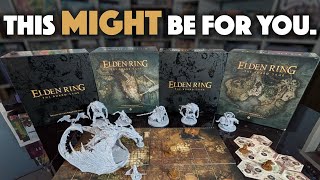
The heart of the game lies in its combat encounters, which unfold across a navigable grid divided into lanes. Players arrange cards representing weapons, shields, and abilities, and attack patterns flow through these lanes in specific sequences. On a player's turn, they select cards to attack, defend, or perform special actions, each with consequences that ripple through the tactical space. Enemies occupy multiple lanes depending on their size, and defeating them requires coordinating attacks across the grid. Larger enemies span multiple spaces and execute complex attack patterns that change based on their position and remaining health. The system introduces critical hits, repositioning maneuvers, and resource management around hand size and action economy. Players describe the combat as intellectually demanding and strategically rewarding, where learning enemy attack sequences and planning several turns ahead creates genuine tension.
Exploration and Scenario Progression
Outside combat, players navigate a scenario-driven exploration system using a deck of tiles and a vault card mechanic. Each scenario directs players through a series of objectives: discover certain areas, retrieve items, or defeat specific foes. As tiles are revealed, events trigger from a scenario book, introducing hardships and story beats. A day-night cycle adds variety to encounters. The system is designed to guide players through narrative moments and create momentum between combat encounters. However, reviewers noted that exploration functions primarily as a framework connecting battles rather than as a source of atmospheric dread. Enemies do not pursue players; discovery lacks the threat and urgency that characterizes the video game. This mechanic works functionally but lacks the emotional weight many expected from a Souls-like adaptation.
The Elden Ring: Realm of the Grafted King Experience
Intense, Epic Boss Encounters
Playing Elden Ring: Realm of the Grafted King creates moments of genuine tension and triumph. When a large boss takes up multiple board spaces and unleashes multi-card attack sequences, the player feels the weight of the encounter. Learning how the boss moves, understanding which attacks are safe opportunities for counter-play, and coordinating with allies to chain devastating combinations produces the sensation of scrappy determination against an imposing foe. These boss battles can stretch across entire play sessions. The grid-based positioning mechanic means combat is never a simple numbers game; players must think about positioning, lane allocation, and the order of their plays. Winning against a difficult boss yields satisfaction proportionate to the fight's complexity.
Methodical Exploration Without Dread
Exploration unfolds as a more deliberate, low-stakes journey through tile-flipping and objective completion. Players move through the world methodically, encountering NPCs and special events, but without the constant threat of sudden danger. The exploration mode serves as pacing and world-building between combat encounters but does not recreate the claustrophobic tension, hidden dangers, or sense of discovery that define the video game. This produces a fundamentally different experience: where the video game makes exploration itself feel like a battle, the board game treats exploration as connective tissue. Reviewers found this a significant departure from the source material's design philosophy.
What Makes Elden Ring: Realm of the Grafted King Stand Out
Multiplayer Combat Design
The game translates well to shared table play in ways the video game's multiplayer modes do not always achieve. When a group of players sits down together to tackle a boss, they are forced into real-time communication, strategizing aloud, and building on each other's ideas. The game's turn structure gives groups time to deliberate without real-time pressure, which deepens the social and collaborative experience. Reviewers specifically praised how multiplayer transforms the game into a cooperative puzzle where player coordination and discussion are central to success. This stands as one of the game's most successful departures from the video game original.
Smart Strategic Grid System
The lane-and-card combat system makes each decision consequential. There are no dummy actions in combat; every card played, every repositioning choice, and every attack order affects the outcome. The system avoids the trap of forcing players to simulate the video game's real-time mechanics by instead creating a deep strategic puzzle. Players appreciate that Steamforged prioritized good board game mechanics over one-to-one video game simulation, resulting in a combat experience that feels tactically fresh rather than derivative.
Potential Drawbacks
Exploration Mode Lacks Atmosphere and Threat
The exploration system does not capture the tense, discovery-driven exploration of the video game. Encounters do not pursue players; there is no persistent threat of stumbling into danger. The day-night cycle and random events create variety but not dread. For players invested in the Elden Ring video game specifically for its world-building, cryptic storytelling, and environmental discovery, the board game's exploration mode will feel hollow. Many reviewers noted that the board game exploration consists largely of fetch quests and tile-flipping without the emotional payoff of true discovery.
Uneven Experience for Non-IP Fans
Players unfamiliar with Elden Ring or the Souls franchise may struggle to feel emotionally invested in the thematic elements. The game does not carry enough world-building in its narrative passages to make the setting compelling for newcomers. While the combat system works mechanically for any player, the game's appeal is heaviest for those already familiar with the IP. Reviewers suggested that players new to Elden Ring should carefully evaluate gameplay videos before investing, as the game's thematic depth alone does not justify its cost.
If You Enjoy Elden Ring: Realm of the Grafted King
Players who love the tactical, turn-based puzzle of combat encounters should explore Monster Hunter World: The Board Game, which similarly translates a video game's boss-hunting loop into a collaborative grid-based system. Both games prioritize learning enemy patterns and coordinating group attacks.
For those drawn to the dark aesthetic and melee combat focus, Dark Souls: The Board Game (Steamforged's earlier adaptation) offers a related experience with similar design sensibilities, though with a different mechanical foundation.
What Reviewers Are Saying
"That combat gets going. I'm all in. I love the intensity of the combat and that grid system. It's just that was a really smart move on their part and how it plays out in multiplayer was yet another smart choice."
— Man vs Meeple
"There's no elements like that in the game, which kind of takes away from the true exploration feeling of discovering things inside the world just like you would in a Souls game. There's something that's missing. The soul of that is missing."
— Man vs Meeple
"The combat to grid system was smarter than I thought. And the way you can play it out with multiple players was smart. That's actually what kept it on my table is getting to these combat moments."
— Man vs Meeple