






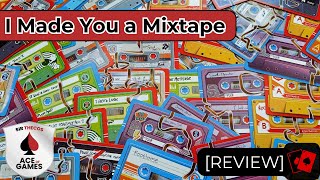
I Made You a Mixtape Deep Dive
What the Community Thinks About I Made You a Mixtape
I Made You a Mixtape has struck a chord with board game reviewers across multiple channels. Sir Thecos, who has reviewed the game multiple times, remains consistent in enthusiasm for both the thematic execution and mechanical design, describing the experience as "charming, thematic, and nostalgic" and noting that it "captures the 90s mixtape feeling wonderfully." Sir Thecos's appreciation extends to how the game sparks genuine social interaction, observing that people "start chatting about the songs they remember, maybe sharing memories, just enjoying that 90s nostalgia together."
Where There's A Wilz, There's a Play's hosts were similarly drawn to the game's nostalgic appeal. Having grown up during the mixtape era, they recognize the thematic authenticity and appreciate the mechanical puzzle beneath the retro packaging. Tom Vasel from The Dice Tower, reviewing the game in the "Look Back" series, awarded it an 8 out of 10, describing it as having "a good look to it" and praising its execution as a "drafting game where you're trying to make a list of songs and balance things and you know, score for different ways."
Core Mechanics That Define I Made You a Mixtape
The Cut-and-Choose Division System
At the heart of I Made You a Mixtape lies the cut-and-choose mechanism, a surprisingly underutilized system that this game implements with precision. Sir Thecos emphasizes that "there aren't too many games that use it well, and this one does." The mechanism works as follows: players draw three cards from the deck and must choose whether to take one or two cards from this pool. If taking two, one must be facedown, creating meaningful risk-versus-reward decisions throughout the game. Because dividers must offer fair splits to other players (lest they face poor selections themselves), this creates an elegant tension between greedy card-hoarding and prudent distribution. The system reinforces the game's central puzzle: are you building a cohesive, balanced mixtape, or sacrificing flow and consistency to starve opponents?
Compound Scoring Across Three Dimensions
I Made You a Mixtape employs three independent scoring categories that combine additively at game's end: balance (how evenly you've distributed songs between side A and B of your cassette), flow (how many of your cards connect to adjacent cards via matching tape-band patterns), and genre consistency (sets of identical genre symbols scattered across your tape). Sir Thecos notes that while this system is "interesting," it "can feel a bit clunky at the end," as tallying genre sets requires cross-referencing a scoring table and counting carefully. The decision space becomes partly about managing these three competing priorities in real time, forcing players to ask whether to chase perfect balance, prioritize connected song sequences, or build coherent genre sets.
The I Made You a Mixtape Experience
Cassette Nostalgia and Memory-Sparked Conversation
What elevates I Made You a Mixtape beyond a mechanical exercise is its thematic authenticity. Sir Thecos, having grown up in the 1980s and 90s, notes that "this theme just hits home for me" and observes that the cassette tape aesthetic is "full of that nostalgic 90s energy with a nice neon touch." Crucially, the game uses real song titles rather than invented ones. As Sir Thecos says, using "real ones" creates "such a clever way to make that nostalgic connection even stronger." The presence of genuine artists and songs (Footloose, The Twist, Jesse's Girl, Town Called Malice, and many others spanning the 80s and 90s) transforms the game into a medium for shared memory. Players begin trading recollections of songs, humming melodies, and discussing where these tracks fit into their own personal histories. The matching Spotify playlist further reinforces this: playing the soundtrack in the background while building your mixtape "really completes the experience," according to Sir Thecos.
A Charming Solo Experience with Character
One of the game's most praised features is its solo mode, which pits you against Otto Ma, an AI opponent with a deliberately comedic design. Sir Thecos describes Otto Ma as looking "just like that typical schoolyard bully, the real jerk," noting that "this is hilarious and adds a fun touch of character to the game." The solo mode is not trivial: Otto Ma plays by a well-defined priority system (favoring balance, then genre sets, then flow), making him a competent opponent who occasionally frustrates players by hoarding the cards they need. The inclusion of a charming solo opponent transforms what could be a solo-mode afterthought into a genuine single-player experience that reviewers actively recommend.
What Makes I Made You a Mixtape Stand Out
Real Song Titles That Anchor the Theme
Most thematic games settle for evocative flavor text or generic card names. I Made You a Mixtape takes a different approach by licensing real track names from the 80s and 90s, carefully arranged to fit the game's genre categories (rock, punk, hip-hop, R&B, pop, etc.). This is not merely window dressing. As Sir Thecos points out, the designers accomplished this "without running into copyright issues since there are no band names, just the song titles." The result is that every card feels like a genuine cultural artifact, and building your mixtape becomes an act of curation that feels authentically nostalgic. Players recognize these songs, have memories tied to them, and eagerly debate which track fits their emerging mix.
Quick Teaching and Fast Play with Surprising Depth
Despite its sophisticated three-axis scoring system, I Made You a Mixtape is deceptively easy to teach. Sir Thecos confirms that "the rules are minimal and easy to teach and you can get playing really quickly," noting that while "it's not a game for complete beginners," the core concept is accessible enough that "you can explain it in just a few minutes and dive right in." This speed masks genuine puzzle-solving underneath. The tension between taking cards opportunistically versus building a coherent tape, combined with the unpredictability of what your opponent will claim, keeps the decision space engaging. For a small-box card game that plays in under 40 minutes, this is an impressive balance between accessibility and mechanical meat.
Potential Drawbacks
Retro Aesthetics Sacrificing Some Readability
The game's commitment to authentic 90s visual design occasionally works against clarity. Sir Thecos acknowledges that "the retro aesthetic is spot-on, but sometimes it gets in the way of readability," elaborating that "the colors and symbols aren't always perfectly clear because there's so much focus on the authentic 90s look." While Sir Thecos notes that "once you get to know the game a little bit better" symbols become recognizable, that learning curve is real. The color coding is dense, with different genre symbols sharing similar hues in an attempt to maintain visual period authenticity. This is a deliberate design trade-off, but it's worth knowing if you plan to teach the game to color-blind players or in poor lighting.
Scoring Tallying and Limited Decision Depth
The game's one mechanical rough edge emerges at its conclusion. Sir Thecos observes that while the scoring system is "interesting," it "can feel a bit clunky at the end" and "takes a while to count up your score, especially for these genre sets." In groups with less experienced players, someone familiar with the rules often needs to manage the final tally, which breaks some of the game's momentum. Beyond scoring logistics, a few reviewers hint that the overall decision space, while solid, could be richer. Sir Thecos mentions wishing the game "went a bit deeper in that regard," suggesting the puzzle of card selection, while engaging, doesn't quite reach the strategic complexity of heavier games. Additionally, the cut-and-choose mechanism, while elegant, does limit the breadth of viable strategies: you are largely forced to optimize within three axes rather than discovering novel approaches.
If You Enjoy I Made You a Mixtape
Games that share I Made You a Mixtape's core appeal tend to emphasize accessible rule sets paired with genuine puzzles and strong thematic integration. Drafting-focused games like 7 Wonders offer similar card-selection tension without the cut-and-choose twist; push-your-luck games such as Quacks of Quedlinburg deliver rapid decision-making with a similar "easy to learn, tricky to master" quality. If the music and nostalgia element resonates with you, games themed around collecting and curating (such as those in the broader "collection building" family) may appeal. Most importantly, if you value table talk, memory-sharing, and a game that doubles as a conversation starter over mechanical depth, I Made You a Mixtape is a rare gem that genuinely delivers on that promise. Its Spotify integration and real-song library ensure that no two plays feel identical, and the charm of Otto Ma's solo opponent keeps the game viable as a solo puzzle.
What Reviewers Are Saying
"That nostalgic feeling combined with the clever song choices makes it such a charming experience, and it can actually lead to a lot of table talk, especially at higher player counts. People start chatting about the songs they remember, maybe sharing memories, just enjoying that 90s nostalgia together."
— Sir Thecos
"I Made You a Mixtape is an I cut or I split you choose card game where players craft a mixtape from a pool of track cards. Then they're scored based on a bunch of factors like how well the tracks flow, how consistent the genre is, and the balance of the side A versus side B because you don't want one side that's better than the other on the cassette."
— Where There's A Wilz, There's a Play
"I Made You a Mixtape from our very own Mike Delisio and Dan Hughes, they put together a nice little drafting game where you're trying to make a list of songs and balance things and you know, score for different ways. I like it, it has a good look to it."
— The Dice Tower