

Shred of Redemption Deep Dive
What the Community Thinks About Shred of Redemption
Shred of Redemption is a 2026 solo puzzle game from Best With 1 Games, part of the solo series associated with Gabe Barrett. Reviewers approach it as a light, quick experience rather than a deep strategy game, and their verdicts are mixed but mostly positive. The strongest agreement concerns the theme and presentation. Mike of One Stop Co-op Shop calls the premise something they have never seen before and praises the art as great, and the same channel's Shelf Life retrospective says the reviewer loved both the art and the theme.
The main point of disagreement is the theme itself. Sir Thecos says they do not care much for the theme, and their praise is directed at the mechanics instead. Reviewers also agree that luck plays a large role. Mike calls it a very luck based game, and Sir Thecos describes it as really swingy. Their final judgments differ in degree. Mike says the game is fun but will not be among their favorites of the year. The Shelf Life reviewer says it was okay for them and that they would probably not have played it themselves. Sir Thecos gave it a C, saying it was just a little too random, while acknowledging that they understand why others enjoy it.
Core Mechanics That Define Shred of Redemption
Vice Dice and Token Matching
The first mechanic centers on a set of vice dice. Each die has faces that represent a sin, and one face, the dominant vice, appears three times on the die, making it the result most likely to be rolled. Mike sets out their dice according to the sins they have committed, noting that the dominant face is not locked in but is the most probable outcome. The goal is to match each die to a virtue token beneath it. Mike points out that not every die face carries every vice, so some dice simply cannot be matched without a power to change them.
Redemption cards and virtue tokens provide the tools for adjusting those dice. Mike describes a card that lets a player exchange two dice sharing a color or vice, and another that rerolls a die or turns it to an opposite side. Because these powers are situational, reviewers note that the outcome of a reroll is often not what the player needs, which makes each decision feel like a gamble on the dice.
Bag Building with Regret Tokens
The second mechanic is the bag. Players add tokens drawn from their redemption cards to a shared bag, along with a set of negative regret tokens. Virtue tokens are then drawn one at a time to build a row of five, and regret tokens that appear in that draw take up space and cannot easily be removed. Mike describes regret tokens as negative tokens that are hard to get rid of, and they explain that a single game can pull out most of them early. Virtue tokens carry their own abilities: each can be used once, flipping to a depleted side, and a second use removes it from the game, while an unused token can instead be discarded for a different effect. Mike notes that these choices make the token economy a constant balancing act between tokens for matching and tokens for trading.
The final step of a game, the final reckoning, adds a last challenge. In Mike's play, a grudge figure appears and forces the player to add a random unused vice die that must also be matched to win. Mike notes this is a meaningful twist that can undo an otherwise clean board.
The Shred of Redemption Experience
A Tense Scramble Against Bad Draws
Much of the feeling of play comes from the uncertainty of the bag. Mike describes a game in which they drew five of the six regret tokens in their opening draw, saying you are never going to be able to deal with all of those. Yet in their winning game they drew very few regrets and then struggled to draw the tokens they needed, which left them scrambling to build useful powers. Sir Thecos experienced the same tension from the other direction, feeling that the game was too random to produce consistent satisfaction. The result is a tense back-and-forth in which players feel they are always one draw away from either a breakthrough or a collapse.
Atonement as a Light, Satisfying Puzzle
Despite the swings, reviewers describe the experience as a short and pleasant puzzle. Mike reports that they can finish a game in around ten minutes when not on camera, and they call it a quick, light experience that can be played almost anywhere. They say winning the game felt satisfying after several plays, and they connect the experience to its theme, comparing their in-game grudge to the ghost of Jacob Marley, nudging a figure toward redemption much as Marley nudges Ebenezer Scrooge. The tension of the bag is what gives that payoff its weight.
What Makes Shred of Redemption Stand Out
A Theme Built Around Redemption
The redemption theme is the feature most often praised. Mike calls the theme fantastic and something they have never seen before, and they describe the art as great. The Shelf Life reviewer also says they loved both the art and the theme, which suggests the presentation is a point where reviewers agree even when they disagree about the mechanics. Mike ties the concept to a familiar story, a corrupt noble trying to atone for past sins, and says the mechanical design reflects that core idea of trying to make amends.
The Final Reckoning
Mike singles out the final reckoning as a cool concept. Rather than ending the game the moment a player matches every die, the final reckoning gives players one more challenge to overcome, representing a last crisis of faith before a character can truly forgive themselves. Mike says they considered keeping as many options and tools as possible in case the final challenge proved difficult, which shows how the concept shapes end-game planning rather than only providing a closing flourish.
Potential Drawbacks
Luck and Swinginess
The most common criticism is randomness. Mike says that, while the mix of redemption cards and random dice makes the game fun, it is a very luck based game in which a reroll may fail to produce the needed face. Sir Thecos finds the game really swingy and says the dice manipulation is not too bad, but that overall they did not have enough fun because the game was a little too random. Reviewers who enjoy the game tend to accept this variance as part of the solitaire-like rhythm, while those who do not find it frustrating.
Prototype Clarity and Reference Burden
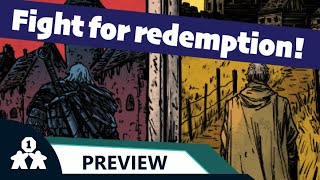
Mike's preview was based on a prototype, and they note that its colors are not as vibrant as they would like. Because much of the game involves matching colors and knowing which card goes with which die, they find the prototype frustrating at times, and they expect the final product to be clearer. They also say that the number of powers on the cards and tokens requires players to keep reference material nearby during early games, which slows down what is otherwise a quick and straightforward game. The Shelf Life reviewer, who did not play the final version, said they had not yet seen the finished product, so both critiques should be read as points about the preview rather than the released game.
If You Enjoy Shred of Redemption
Sir Thecos placed Walking in Kamigawa above Shred of Redemption, saying they had less fun with Shred than they did with Kamigawa. They describe Kamigawa as a solo puzzle in which players build a panorama, noting that it is cute and that a difficult rulebook slowed their first plays. Players who want a solo puzzle with a more forgiving feel than Shred may find Kamigawa a good next step.
Mike compares the game's feel to Klondike-style solitaire, describing it as solitaire-ish, where players work through the motions, win some games, and lose others. Players who enjoy that kind of structured, luck-driven solo puzzling may find Shred of Redemption a natural fit, especially for quick sessions when they want a short game with a memorable theme.
What Reviewers Are Saying
"I think the mix of the redemption cards and the random dice can make things pretty fun. I think the final reckoning is a cool concept to give you one final challenge to overcome."
— Mike, One Stop Co-op Shop
"I loved the art. I loved the theme. The actual gameplay was just fine. Felt a little bit random at times, but I have not played the final game yet."
— One Stop Co-op Shop
"This is not a bad game. I don't care much for the theme to be honest. Also it is like really swingy. But the dice manipulation aspect here isn't too bad."
— Sir Thecos