
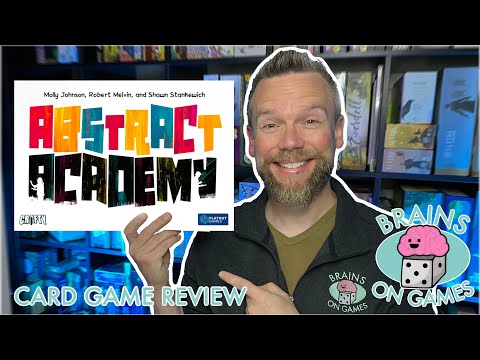







Abstract Academy Deep Dive
What the Community Thinks About Abstract Academy
Abstract Academy presents a striking paradox: a visually elegant game with deceptive tactical depth that challenges players to balance personal ambition with unavoidable interference. Reviewers consistently praise its accessible design and beautiful presentation, though opinions diverge on strategic satisfaction depending on player count and individual preferences for predictability versus luck-driven card draws.
Core Mechanics That Define Abstract Academy
Grid Building and Spatial Reasoning
Players construct a shared canvas by placing cards orthogonally adjacent to one another, gradually forming a 4x4 grid at two players or 5x5 at four players. The genius of this mechanic lies in its uncertainty: no fixed board exists at the start of a round, so the grid expands organically based on player choices. Once any row or column reaches four cards, that axis locks, establishing each player's home row and scoring zone. This creates a fascinating decision point where placing a card in one location might inadvertently shape the board in ways that constrain future opportunities.
Pattern Building and Hidden Victory Conditions
Each card displays four quadrants in combinations of blue, red, and yellow. Success requires identifying color areas and recognizing how contiguous quadrants of the same color form scoring patterns. Players mentally track emerging blocks, paths, and clusters while simultaneously considering what patterns their opponent needs, forcing constant visualization of both sides of an ever-changing canvas. Compounding this puzzle, inspiration cards remain secret to each player, introducing hidden goals that others cannot directly predict. Assignment cards and professor cards are public, creating a tension between working toward shared scoring conditions while also pursuing private objectives. This asymmetry means players must make educated guesses about what their opponents are building toward, adding psychological depth to placement decisions.
The Abstract Academy Experience
Tactical Puzzle Meets Strategic Interaction
Abstract Academy strikes an unusual balance: the turn structure is simple (play one card, draw one), yet every placement carries weight. The shared board means that helpful patterns for oneself often inadvertently help an opponent, forcing players to weigh self-interest against collective board development. Reviewers note this creates genuine dilemmas where the "best" card to play for one's own score may block or enable an opponent's scoring path equally, making every action feel consequential without heavy rules overhead.
Visual and Cognitive Satisfaction
The game delivers immediate aesthetic reward. The cards feature painted artwork that invokes real art styles and artists, and watching a colorful abstract canvas emerge over a round feels genuinely creative despite the competitive context. Players describe the experience as calming yet engaging, where the visual puzzle-solving aspect keeps brains engaged without overwhelming new players.
What Makes Abstract Academy Stand Out
Thematic Coherence Through Art
The use of actual artist names and styles as game elements transforms Abstract Academy from a pure abstract game into one with educational undertones. Professors are real artists, and inspiration cards reference genuine art movements and techniques. This grounding in real art history adds curiosity appeal, particularly for younger players who may investigate the referenced artists and art styles, creating a gateway to broader cultural engagement.
Small Package, Strategic Footprint
Abstract Academy arrives in a compact box that fits on shelves and fits into travel bags, yet unpacks into a game offering genuine tactical considerations. The portability combined with quick setup and play time (approximately 30 minutes) makes it an accessible gateway to deeper strategic thinking without demanding hours of play or shelf space.
Potential Drawbacks
Player Count Limitations
The game plays only two or four players, eliminating three-player groups entirely. This is a hard constraint that may prove a dealbreaker for households with irregular attendance or gaming groups that fluctuate between three and four participants. The asymmetry between two-player and four-player experiences is also notable: at four players, the shared scoring zones create additional complexity and potential frustration when cards placed for one player simultaneously benefit a neighbor.
Luck-Dependent Card Draws
Because players draw cards randomly and cannot draft or select from a pool, strategy remains constrained by what the deck provides. Games where drawn cards fundamentally misalign with that round's scoring objectives can feel anticlimactic, reducing tactical depth and making victories feel less earned. Players seeking full agency over card availability or multiple-round planning may find the randomness limits strategic satisfaction compared to heavier abstract strategy games.
If You Enjoy Abstract Academy
Players drawn to Abstract Academy's light-but-thoughtful approach will appreciate Point Salad, which similarly delivers a quick play time with surprising decision density and a shared-resource puzzle. Both games reward tactical play within a forgiving complexity envelope, making them excellent for players who want meaningful choices without rulebook overhead.
What Reviewers Are Saying
"it's tiny but it packs a punch to the brain"
— kovray
"we've played it at the two-player mode it's quick and simple and fun enough yep"
— Meeple University
"it's quick it's simple it's beautiful you've got real artists and real art styles that might create some curiosity"
— Brains On Games