

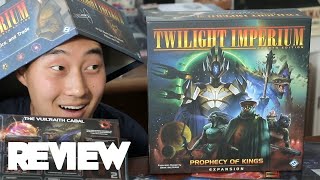



Twilight Imperium: Fourth Edition - Prophecy of Kings Deep Dive
What the Community Thinks About Prophecy of Kings
Prophecy of Kings stands as a defining moment for Twilight Imperium Fourth Edition. Reviewers across the community consistently praise the expansion as a masterpiece that transforms the base game into a more complete experience. Shelfside calls it one of the most bold, well-made expansions in board gaming, while independent reviewers credit it with making TI4 the definitive 4X space opera. The consensus is clear: if you love TI4, Prophecy of Kings is not optional. Yet reviewers also acknowledge a trade-off: the expansion deepens complexity and length, pushing the game beyond what some players want from their TI4 sessions.
Core Mechanics That Define Prophecy of Kings
Seven New Factions and Total Asymmetric Overhaul
The expansion introduces seven brand new alien civilizations to the game, each with radically different play patterns. The Cabal, for example, are described as "space godzilla dragons" that rampage and capture opponent units in combat, building copies of them for free. The Argent Flight, by contrast, vote first in politics and gain fat bonuses from voting. The Titans specialize in planetary defense, spawning PDS units with combat abilities, while the Empyrean allow other players to move through their ships. The Gene Sorcerers, the original rulers of the universe, can take opponent command tokens after winning battles to increase their fleet size and unlock faction-specific commander abilities. Beyond these seven, every single base faction receives new leader cards, mech units, and technology options. Fantasy Flight Games equipped all 24 factions with commanders (usable once per round) and heroes (once per game), cement each faction's asymmetry, and added faction-specific mechs with unique combat abilities.
Exploration, Relics, and Legendary Planets
The expansion brings back the exploration mechanic from Twilight Imperium III, addressing a long-standing gap in the base game's 4X design. Every time a player conquers a new neutral planet, they draw a card from that planet's color deck. These cards can attach to the planet itself, making it stronger, or contribute relic fragments. When a player collects three relic fragments of the same color, they forge a random relic with powerful abilities: giving victory points to whoever holds it, or granting access to action cards from the discard pile. Legendary planets add another layer of negotiation. These special red planets grant permanent abilities when conquered: some act as wormhole hubs connecting to every other wormhole, others provide unique economic benefits. The combination of exploration, relics, and legendary planets creates new strategic depths while increasing the incentive to fight over specific systems.
The Prophecy of Kings Experience
Epic Scale and Massive Decision-Making
Reviewers consistently describe Prophecy of Kings as undeniably epic. The expansion delivers "incredible decision making" and a "massive scale" that elevates the space opera fantasy. With 323 new cards, expanded mechanics, and deeper faction abilities, every action carries weight. The moment of taking a once-per-game hero ability becomes a pivotal memory. Choosing which faction to play and how to unlock their asymmetric leader and hero abilities shapes the entire game narrative.
Political Negotiation on Steroids
The heart of Twilight Imperium has always been table discussion and negotiation. Prophecy of Kings ratchets this up dramatically. More factions mean more distinct negotiating positions. Relics become constant trade-discussion fodder as players barter relic fragments to complete sets. Legendary planets stir conflict pots even further. Alliance cards allow players to share commander abilities with allies, creating tactical synergies and opportunities for clever diplomacy. The new objectives also push players away from safe, stay-in-your-home-base strategies, forcing more aggressive expansion and conflict that fuels negotiation.
What Makes Prophecy of Kings Stand Out
World-Building and Thematic Immersion
Fantasy Flight Games invested heavily in the lore and atmosphere of Prophecy of Kings. The expansion includes a new lore compendium with backstory and art that immerses players in the ancient mythos. The premise: the Krios civilization dug too deep, awakening the Mahakt, the original emperors of the universe. Now other factions rise to challenge this new balance of power. Leaders come with flavor text and artwork that serve as the faces of your armies. Exploration and relic-gathering add mythological depth to your playthroughs. The cumulative effect is a game that feels more momentous and interconnected.
Balance and Accessibility Across 24 Factions
Players noted that some factions in the base game felt weaker than others. Prophecy of Kings addresses this with thoughtful design. Previously underperforming factions like the Arbreck now punch harder thanks to new leaders and mechs. The Arbreck agents let them upgrade ships constantly, and their mechs provide production and planetary shields. This balance work means more factions are viable in competitive play, and it happens without overpowering the strongest options. The power creep is real, but it's constructive: it makes the game playable for all factions while still honoring their thematic asymmetries.
Potential Drawbacks
Component Overload and Board State Complexity
The expansion's massive footprint comes with a cost. Players receive so many new cards, tiles, and tokens that board states become physically imposing. You must track leaders, mechs, new techs, alliance cards, relic fragments, and planet attachments for every faction across the table. One reviewer noted they had to be faulty and mention the jumble of exhaustive leaders and components, warning players to keep close tabs on their board state. The game requires all modules to be played together for balance, so you cannot cherry-pick which new systems to include. This means adopting the full scope of complexity every time you play with the expansion.
Increased Playtime and Intimidation Factor
Prophecy of Kings is longer and more complex than the base game. Games regularly take one to two additional hours beyond a base TI4 session. The constant new complexity, stronger faction abilities, and more negotiation opportunities all extend the table discussion and decision time. For players who value TI4's relative streamlined nature compared to Twilight Imperium III, the expansion can feel like it drifts away from that clean, teachable design. One reviewer admitted that after one playthrough with the expansion, they felt intimidated by all the new layers and worried it might be too rich for their taste. The Titans faction, while thematic, also appears slightly overtuned; they have too many efficient ways to spawn PDS units and cancel hits, making them easier to pilot than other factions.
If You Enjoy Prophecy of Kings
Players and reviewers of Prophecy of Kings typically already love Twilight Imperium Fourth Edition, so the expansion appeals to the core fanbase rather than introducing new audiences. However, if you appreciate Prophecy of Kings for its 4X mechanics and exploration, you may also enjoy Twilight Imperium III: Distant Suns, which inspired the expansion's exploration system. Alternatively, if the political negotiation and asymmetric factions are what captivate you, other heavy negotiation games with faction asymmetry and area control like Civilization or the earlier Twilight Imperium editions offer similar strategic depth. For those who want even more from TI4, revisiting the base game with different faction choices or playing at different player counts (the expansion now supports up to eight players) provides fresh angles.
What Reviewers Are Saying
"Prophecy of Kings is undeniably epic with its incredible decision making, massive scale, and even cooler alien abilities. The nail in the coffin for this expansion solidifying its hype was when Mechatrol Rex was completely relocated to a corner of the map, man this game is longer and intense and makes my brain go slightly haywire with the leaders, technologies, political leveraging."
— Shelfside
"Within the last two games, the hero created a moment that we will never forget in the game, from someone doing something just bonkers. It adds all these new planet tiles, these legendary planets, that when you get them they give you a special ability that you have. And so there's, you know, it used to kind of be, you know, Mechatol Rex was kind of the main one everyone's fighting over, but there's actually fighting going on over these, some of these legendary planets too, because they're pretty powerful."
— Rolls in the Family
"Prophecy of Kings ratchets up the discussion and negotiation in TI4. These relic fragments are constantly in trade discussions to get someone that completion at three, and with there being more interest in those attachment planets to fight over, conflict increases. When you land on a system with three planets, that's the wonder of possibility on what you can really find, and then you gotta adapt to that."
— Shelfside