

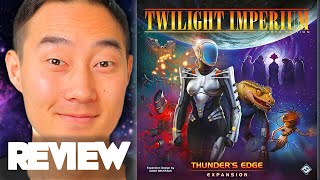




Twilight Imperium: Fourth Edition – Thunder's Edge Deep Dive
What the Community Thinks About Twilight Imperium: Fourth Edition – Thunder's Edge
Thunder's Edge has arrived to widespread acclaim among serious Twilight Imperium players, though reviewers are unified that this expansion targets a specific audience: those deeply invested in TI4 rather than casual players. The consensus is strong that this expansion improves upon Prophecy of Kings in several key respects. Reviewers consistently praise the thoughtful design of the new factions, the elegance of the breakthrough card system, and the way Thunder's Edge expedition injects competitive dynamism into round one, a phase traditionally dominated by predictable opening moves. The Discriminating Gamer calls it the better expansion when forced to choose between Thunder's Edge and Prophecy of Kings. Shelfside grants it "shelf-size certified" status, a designation reserved for expansions that justify their shelf space through depth rather than bloat. Where reviewers diverge is primarily on value at the $130 MSRP and on the accessibility of the Twilight's Fall variant game mode, which some find tedious despite its mechanical promise.
Core Mechanics That Define Twilight Imperium: Fourth Edition – Thunder's Edge
Breakthrough Cards (Multi-Use Cards)
Every faction, whether new or from the base game, now gains a breakthrough card that functions as both an ability and a tech prerequisite. To unlock it, players spend resources throughout the game on the Thunder's Edge expedition, a shared dial that all players contribute to simultaneously. Once unlocked, the breakthrough provides a unique passive or active ability while also counting as two different technologies when researching. This elegantly solves a design problem that plagued earlier TI4 iterations: tech paths can feel locked into rigid patterns. Shelfside notes that the breakthrough mechanic "changes quite a bit without actually introducing that much complexity," a rare achievement in a game system already rich with options. Breakthrough cards are also grounded in faction identity: Last Bastion's breakthrough allows them to pack transport ships with ground troops without penalty, while the Crimson Rebellion starts with theirs already unlocked, reflecting their outsider status.
Asymmetric Player Powers (New Factions)
Thunder's Edge introduces six new factions, each with mechanics that stand apart from the existing roster. The Ral Nell Consortium can miniaturize and transport PDS stations on destroyer hulls, turning what were support vessels into mobile artillery platforms. The Deep Roth Scholarate practices coexistence, placing labs on planets controlled by other players and gaining passive benefits from those partnerships. The Firmament arrives as a two-sheet faction that transforms mid-game into the Obsidian, using plot cards to subtly influence other players and then unleashing a corruption mechanic in the late game. The Crimson Rebellion creates rifts across the board, establishing their own pseudo-wormholes and generating commodities whenever combat occurs nearby. Last Bastion reinforces ground control with a galvanize ability that boosts unit combat rolls after they survive fights. Meeple Mountain observes that "the new factions play really uniquely and interestingly, they stand on their own. They're not just copies of other things." Reviewers specifically highlight the attention to destroyer units, a typically weak class in TI4 that now receives meaningful mechanical support across multiple new factions.
The Twilight Imperium: Fourth Edition – Thunder's Edge Experience
Early-Game Competition and Negotiation
The Thunder's Edge expedition transforms the opening round from a predictable sequence of settlers claiming adjacent planets into a competitive race with stakes that unfold across the entire game. By paying resources in various forms (secret objectives, trade goods, planetary exhaustion, political influence), players place tokens on the dial. The player who completes it gets to place Thunder's Edge itself anywhere on the board as a powerful five-resource planet. This single mechanic injects negotiation and player interaction into a phase that many TI4 games can feel solitary. Reviewers describe a heightened sense of table engagement where players must constantly evaluate whether to contribute tokens toward a legendary world or hoard resources for other strategies.
Late-Game Scope and Political Manipulation
The expansion doubles down on what many TI4 fans love most: space combat alongside political maneuvering. The coexistence mechanic allows multiple factions to occupy the same planet without triggering war, opening new coalition strategies and leverage points during negotiations. The Fracture system, a pocket dimension that spawns on a die roll, offers a secondary board with relics and valuable real estate, allowing alliances to shift as players hunt for bonuses or deny them to rivals. The overall experience reinforces TI4 as a game where treaties matter as much as firepower, and where a well-timed action card can reshape the entire game state.
What Makes Twilight Imperium: Fourth Edition – Thunder's Edge Stand Out
Faction Design That Breaks the Mold
The six new factions resist the trap that caught some Prophecy of Kings additions: they do not feel like minor tweaks to existing archetypes. The Firmament, in particular, earned praise for its thematic coherence and mechanical audacity. Starting as a benevolent collective that gains power by helping other players reach their secret objectives, it can pivot into the Obsidian, an eldritch conspiracy that punishes those very allies. This transformation happens on the player's schedule, rewarding timing and position awareness. Shelfside calls the Obsidian faction one of the most interesting and unique factions they have seen in TI4 to date. The Ral Nell Consortium's destroyer-focused kit genuinely makes that unit class desirable in ways it rarely has been, rewarding fleet diversity.
Mechanical Elegance Without Bloat
Thunder's Edge could have dumped a dozen new subsystems into TI4, each requiring its own reference sheet. Instead, the expansion adds new mechanics through a lens of restraint. Breakthrough cards slot into every faction without rewriting their core identity. The Fracture system is optional; games play fine without it spawning. The Galactic Events module offers modular asymmetry. The expansion respects the 480-minute playtime ceiling by adding depth rather than duration. This design philosophy earned consistent praise from reviewers, who noted that TI4 can already feel overwhelming; Thunder's Edge enhances rather than compounds that feeling.
Potential Drawbacks
Price Point and Component Quality
At $130 MSRP, Thunder's Edge costs as much as or more than many full standalone games. Shelfside points out that Fantasy Flight Games could have justified a 10 out of 10 score at $100 or $110. Additionally, component quality has noticeably declined compared to prior expansions: cardboard tiles are millimeter thinner and feel less rugged, and cards require sleeving where they previously held up to unsleeved play. These production cuts feel at odds with the premium price point.
Twilight's Fall Can Feel Tedious
The Twilight's Fall variant game mode replaces TI4's core tech system with a drafting-focused splice mechanism, allowing players to build custom factions on the fly. While mechanically sound, the draft phase can drag, particularly when all players are learning the card pool. Reviewers found the concept compelling but the execution sometimes laborious, especially in the opening splice where players must evaluate hundreds of new cards. The Discriminating Gamer notes that "the splicing and the drafting took a while... the game kind of slowed down when we got to the splicing elements."
If You Enjoy Twilight Imperium: Fourth Edition – Thunder's Edge
Thunder's Edge enthusiasts should explore Twilight Imperium: Prophecy of Kings for further strategic depth, though reviewers suggest Thunder's Edge may be the stronger entry point for players between the two. Those drawn to the negotiation and treaty mechanics will find similar satisfaction in games like Cosmic Encounter (asymmetric alien powers with dynamic alliances) or Diplomacy (pure negotiation across a fractured board). For players who enjoy the political chaos and space opera scale, the original Twilight Imperium: Third Edition remains a remarkable design that shares TI4's fundamental appeal, even if it plays longer and with more fiddly components. The base Twilight Imperium: Fourth Edition itself continues to reward deep play, with Thunder's Edge functioning as an enhancement rather than a prerequisite.
What Reviewers Are Saying
The new factions play really uniquely and interestingly, they stand on their own. They're not just copies of other things. At least two of them specifically use their destroyers as a primary piece, a focal point of their faction strategy.
— Meeple Mountain
The breakthrough changes quite a bit without actually introducing that much complexity. And now you don't even need P to get the faction updates.
— Shelfside
I'm looking forward to playing the Twilight Twilight Fall again. I really am. I had a lot of fun with it, and I think it it there's a lot of game there to still explore. And then just in the regular Thunder's Edge expansion, there's a lot of stuff there to explore. Like I said, I didn't get a chance to play with some of some of the stuff there in the games I played. So, I'm I I'm glad I've got it. I'm going to continue to play with it. Um, and honestly, I think generally speaking, it does build on some of the ideas and concepts from Prophecy of Kings, but but personally, I think I like this as an expansion better than Prophecy of Kings.
— The Discriminating Gamer