








Out of Sorts Deep Dive
What the Community Thinks About Out of Sorts
Out of Sorts has generated genuine enthusiasm from the board game community, with reviewers praising it as an innovative take on cooperative deduction. Kovray, a prominent reviewer, called it the standout game of Gen Con, underscoring its potential impact on the hobby. While some reviewers approach it with caution due to its real-time nature and memory demands, those who have played it consistently describe it as a memorable, engaging experience that feels both accessible and surprisingly deep for its twenty-minute playtime.
Core Mechanics That Define Out of Sorts
Pattern Recognition and Deductive Memory
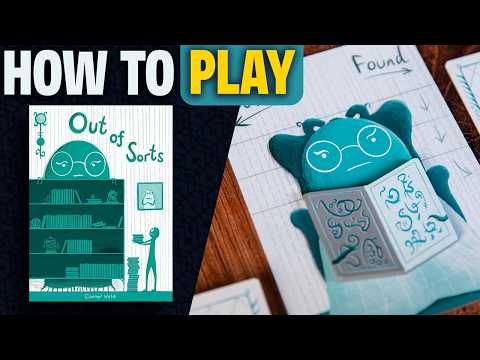
Out of Sorts is fundamentally a pattern-recognition game. One player assumes the role of the Sorter, who organizes abstract alien symbols into a classification system that only they can see. The other players, the Finders, must collectively develop and then reliably remember the invisible sorting logic. As the game progresses, the Finders face a System Check phase where they must recall the exact relative positions of previously found books in the Sorter's hand. This mechanic, remembering an unspoken code, becomes the core challenge. Designer Connor Wake and publisher Always Awake Games layer in a twenty-minute time limit and increasing complexity as more books enter the system, raising the stakes for accurate memory.
Real-Time Simultaneous Action
Out of Sorts demands real-time engagement from all players. The Finders simultaneously search their hands for books matching face-down index cards, all while the clock runs. The Sorter coordinates traffic, receives suggested placements from the group, and organizes books in their hand without revealing the contents. This simultaneous action, with players talking over each other, searching at the same pace, and improvising categories on the fly, creates a chaotic, energetic experience that stands apart from turn-based deduction games.
The Out of Sorts Experience
Collaborative Problem-Solving Under Pressure
Reviewers consistently highlight the cooperative energy that drives Out of Sorts. You and your fellow Finders are inventing a classification system together from scratch, which feels genuinely collaborative. The pressure to invent, communicate, and remember a shared mental model while the timer ticks creates memorable moments of group problem-solving. Kovray described this experience as fantastic and memorable enough to rank it as the standout game of Gen Con.
Shared Creative Ownership
The game excels at making each group's solution feel unique. One group might organize symbols by size, another by emotional intensity, a third by complexity. Reviewers note that watching this system emerge and then testing whether everyone truly internalized it creates satisfying tension. You are not solving a puzzle designed by the publisher; you are discovering a pattern you invented together.
What Makes Out of Sorts Stand Out
Innovation in the Real-Time Deduction Space
Most cooperative deduction games play in turn order or take place over a long evening. Out of Sorts compresses the experience into twenty minutes and demands simultaneous real-time action, a combination that reviewers found rare and engaging. The simultaneous play means no one is waiting for their turn; everyone is always searching, communicating, or organizing. This keeps the energy high and the engagement consistent.
Accessibility Paired with Surprising Depth
Out of Sorts teaches quickly and plays fast, yet offers genuine strategic and mnemonic depth. The rule set is straightforward enough that new players grasp it within a round or two, but the System Check phase, where you must reconstruct the order of books in the Sorter's hand, reveals just how much skill, communication, and memory work is required. This balance of simple rules and emergent complexity has proven appealing to both casual and experienced players.
Potential Drawbacks
Real-Time Pressure Not for Everyone
The real-time simultaneous play that defines Out of Sorts can be a barrier for players who prefer methodical, turn-based gameplay or those who find overlapping communication stressful. Reviewers noted that the game demands quick thinking and comfort with mild chaos. If your group dislikes real-time games or finds simultaneous action overwhelming, Out of Sorts may frustrate rather than delight.
Success Hinges on Group Synergy and Communication
Like many cooperative games, Out of Sorts depends heavily on the group's ability to communicate, establish shared language, and build consensus quickly. If your group struggles to reach agreement or one player dominates the system-building process, the collaborative magic can evaporate. Reviewers emphasized that the game is better with a group that genuinely clicks and wants to problem-solve together.
If You Enjoy Out of Sorts
Fans of Out of Sorts should explore other cooperative deduction games that blend real-time action with memory challenges. Games emphasizing non-verbal communication and collaborative invention of rules will appeal to the same audience. Additionally, players who love the pressure of a ticking clock combined with group problem-solving will find kindred experiences in other real-time cooperative titles. The game's emphasis on creating your own logic system also suggests appeal to players who enjoy pattern-building and tableau-construction games where the solutions emerge from group consensus rather than predetermined paths.
What Reviewers Are Saying
"It's my top game of Gen Con. It is fantastic. It's one of those memory games but like cooperative working together."
— Cardboard Couple
"This game is about discovering an alien language and cooperative working together to sort to create like a Dewy Decimal System for it."
— Cardboard Couple
"You basically have like a bunch of symbols and you're trying to create your own type of code kind of with it. I would definitely be interested in sitting down and actually playing a full game."
— Board Game Buzz