




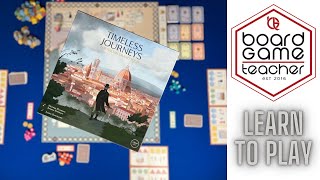

Timeless Journeys: The Italian Grand Tour Deep Dive
What the Community Thinks About Timeless Journeys: The Italian Grand Tour
Reviewers describe Timeless Journeys: The Italian Grand Tour as a smart, approachable game that holds more depth than its tabletop footprint suggests. The 2026 title from Lirius Games supports one to five players and runs about 70 minutes, and the coverage keeps returning to its setting, a tour of Italian cities in the eighteenth and nineteenth centuries where players meet famous travelers, collect souvenirs and write letters home. MVM came to the game because one of its co-designers also worked on Darwin's Journey, which MVM named their game of the year a couple of years back. That lineage shapes how the game is discussed: a design that can be introduced to newer players while still satisfying hobbyists who want something meatier.
The general mood is that the game plays faster and lighter than it looks on the board. MVM said players from different levels can pick it up and finish quickly, and Board Gaming Ramblings estimated a two-player session at about 40 minutes without filming. Reviewers praise the way the many scoring routes give each session a different shape, and MVM said the strategy a player commits to is what pays off. Sir Thecos, previewing the game ahead of Spiel, was drawn mainly by the Italian theme and the idea of the game as a personal travel journal.
Core Mechanics That Define Timeless Journeys: The Italian Grand Tour
Chained Action Cards
The central system is the action chain. Each card belongs to a category such as travel, exploration, conversation, inspiration or festivities, and when you play a card, the earlier cards of that same category in your play area can be activated again. Watch Review notes that the chain can be resolved in any order and that a player may opt out of any card's action. MVM describes the same idea as the heart of the design, letting a player travel, explore, then travel again in a sequence of their choosing. The reward is the sense of building a combo over the round, which MVM called very rewarding.
Hand Limits and Market Purchases
The second engine is hand management. Players can hold no more than eight cards, and surplus cards must be discarded at the end of each round, a constraint that Board Gaming Ramblings found painful late in their session. Purchasing is tied to variety: MVM explained that playing cards of several categories opens access to better market options, and the free advanced action card handed out at the start of the card phase depends on how many different types a player played. Board Gaming Ramblings also leaned on the market to chase end-of-game points, which makes the buying step a planning tool rather than a simple shopping trip.
The Timeless Journeys: The Italian Grand Tour Experience
A Travel Journal That Fills Up
Sir Thecos framed the premise as a perfect personal travel journal, and the game makes that literal. Players collect exploration tiles, idea tokens and friendship tiles, then slot them into journal pages that score at the end. MVM described the writing action as a reflective moment, where a player thinks about what they have seen and learned before committing an idea to a page. Letters to friends add a further layer, since a player can write to someone they visited earlier to unlock a benefit, which keeps the theme of a grand tour alive from turn to turn.
Quick Turns With Tight Coins
The pace is brisk. MVM and Board Gaming Ramblings both stress how quickly a turn can move, especially when a player chains many actions at once. Money is the constraint that keeps each choice honest. Board Gaming Ramblings kept asking where the next coin would come from, and MVM warned that travel down the route costs real money in a game that is not heavy on resources. The result is a tight sprint in which each stop on the tour feels deliberate rather than automatic.
What Makes Timeless Journeys: The Italian Grand Tour Stand Out
Famous Travelers With Their Own Agendas
MVM singled out the famous travelers as the most distinctive part of the design. Each figure carries a scoring condition and a benefit tied to the city where they stand, and they move between rounds according to their itineraries. MVM walked through examples such as Lady Blessing, whose points depend on how close a player stands to her, and Charles Dickens, who lets a player in his city take an extra action for a coin. Board Gaming Ramblings built its two-player plan around keeping pace with figures such as Lord Byron and Mary Shelley, which shows how the movement of these figures shapes the entire session.
Endgame Scoring That Changes Each Game
The final scoring is where reviewers see the most variety. MVM explained that the endgame rewards exploration tiles, journal pages and cards with set-based bonuses, so players can aim for different combinations. Board Gaming Ramblings said the scoring tiles change how the game is played and admitted that their second session felt very different from the first, with some tiles safe to ignore. MVM also believed the game had once been on crowdfunding and said the designers went back to the work and expanded the variability, so the version now on the market holds more routes than earlier coverage showed.
Potential Drawbacks
Money Is Scarce and Catching Up Costs
The tight economy is the most repeated caution. MVM noted that the game is not heavy on resources and that moving further down the route costs a lot of money, so a player who falls behind has to plan card play carefully to catch up. Board Gaming Ramblings ran into this directly, holding plenty of coins but few resources, and admitted that an early greedy route for points left them behind. Some players will find the squeeze frustrating, while others will read it as the central tension that gives the game its shape.
Rules Questions and Prototype Components
The complexity of the interactions gave reviewers pause. MVM called the conversation action probably the most complex in the game, and Board Gaming Ramblings spent parts of their session settling questions about whether a card's actions must be finished before another card is started, and whether a friend could be placed in a city where another friend already stood. Watch Review was careful to note that its footage showed a prototype, so components and some details may still change before release. Reviewers generally agree the core system is learnable, but the first session may need a few rule lookups.
If You Enjoy Timeless Journeys: The Italian Grand Tour
MVM drew the most direct comparison to Darwin's Journey, the title that shares a co-designer with this game. MVM described both as smart designs that feel accessible to newcomers while still satisfying more experienced players, and that same balance of approachable rules and satisfying depth is what makes Darwin's Journey a natural next step. Players who enjoy the chaining of cards, the travel theme and the tension of a tight economy with a rewarding endgame should find it an easy recommendation.
What Reviewers Are Saying
"I think it's smart enough where it's going to be one of those games where people from different levels can break this game out and they can get it done quick because this game is going to be quicker than you think. And everybody I've played it with has been like, man, that was quick."
— MVM
"I played very differently now than the other time we played I think these are really cool because it really changes how you play the game."
— Board Gaming Ramblings
"But I do want to check it out because of the Italian theme. It's like one of my most favorite countries."
— Sir Thecos