



The Last Gamble: The Ardennes Offensive Deep Dive
What the Community Thinks About The Last Gamble: The Ardennes Offensive
Coverage of The Last Gamble: The Ardennes Offensive currently comes from a single wargame channel, Zilla Blitz. Its overview of the Compass Games title treats the game first as a historical simulation of the 1944 German offensive in the Ardennes, and only second as a playable board game. The reviewer credits designer Danny Parker with a long-running study of the battle, and describes the design as a magnum opus that brings that knowledge to the table.
Enthusiasm is tempered by a clear warning about cost. The reviewer praises how thoroughly the historical context is built into the rules, yet sees a steep learning curve and an execution burden that will test players who expect a lighter evening. A later monthly update from the same channel shows the tension from the table. The reviewer set up the game for a first learning session and described it as one of the most historically infused titles encountered, while expecting a long period of familiarization.
The consensus that emerges is positive on substance and cautious on access. Because the view comes from one experienced wargamer, it reflects a single perspective rather than a broad range of opinions, and readers should weigh it that way.
Core Mechanics That Define The Last Gamble: The Ardennes Offensive
Combined Arms and Armor Superiority
Combat turns on armor and combined arms. Zilla Blitz walks through a brigade-size armored counter and explains that its left side carries an armor class rating, because the type of armor matters: some armor types gain advantages or suffer disadvantages against others. The armor superiority table then decides whether the Allied side, the German side, or the defender holds the edge in a given fight. The reviewer also highlights the broader idea of combining armor with infantry and artillery so that battles are fought as coordinated combined arms actions rather than as isolated stacks.
Turn Structure, Fuel, and Weather
Time is divided into two 8-hour day turns and a 16-hour night turn, covering the full 24-hour cycle. Fuel is one of the reviewer's main examples of the battle's logic. Fuel and fuel capture are modeled, and the player aids include German fuel capture, fuel shortage, and fuel dump demolition tables. Weather adds another layer, with the main game using traditional weather and an optional uncertain weather table available for players who want more variability. Stacking is capped at two regiment or brigade equivalents per hex, with battalions counting as one-third of a brigade. The reviewer expects that limit to keep movement through the Arden manageable, since large stacks are unlikely to form.
The Last Gamble: The Ardennes Offensive Experience
A Student of the Battle
Playing this game feels like working through a historical problem with the source material close at hand. The reviewer describes rules that arrive with historical context already attached, so each mechanic explains why it exists before it explains how it works. The designer notes and scenario histories reinforce the sense that the game is meant to be read as well as played. Zilla Blitz also points to Danny Parker's companion volume, The Battle of the Bulge, as a natural pairing for players who want to go further into the history.
Dense but Supported Solitaire Play
The experience is heavy, but the support is heavy too. The reviewer describes a large stack of player aids, including combat results, combat modification charts, air operations tables, and scenario-specific notes, and calls the level of support something never seen before in a game. Solitaire play is possible and the reviewer rates it fairly high, since the rules do not prevent a player from running both sides, even though no automated opponent is provided. The result is a tactical pace in which each turn asks the player to manage many systems at once, with the reference material there to keep the process on track.
What Makes The Last Gamble: The Ardennes Offensive Stand Out
Documentation Woven Into the Rules
The historical documentation is the feature the reviewer returns to most often. The package includes a rulebook, a separate game booklet with scenarios and designer notes, and a historical study. Zilla Blitz says the game connects historical context to its rules in a way the reviewer had not seen in another title. The scenario set spans a long campaign game, a shorter scenario on its own smaller map, and variants that alter German and Allied plans, including a scenario that explores a German attack launched on December 10 instead of December 16.
Maps and Terrain Art
The three maps draw praise for their artwork and research. The reviewer describes the artwork as crisp and clear, with small villages rendered in detail, and singles out the color palette for conveying both the forested terrain of the Ardennes and the snowy landscape of the winter campaign. The main map is assembled from large sections and has a modest footprint for a game of this size, although players will need extra table space for the order of battle cards laid out beside it.
Potential Drawbacks
Learning and Execution Cost
The reviewer's central concern is the cost of entry. The core rules run to about 50 pages, with roughly another 15 pages of optional rules and tables after them, and the layout is text-heavy with limited graphics. Zilla Blitz rates the complexity at seven and a half out of ten and warns that the game takes real investment to play accurately, with many sub rules and edge cases to absorb. Some of the best play examples are placed on the player aids rather than in the rulebook, which means early sessions involve a fair amount of searching.
Footprint and Time Commitment
Time and table space are the second concern. The reviewer cites campaign scenarios that can take 18 to 36 hours, with shorter scenarios taking roughly 3 to 8 hours. The map footprint is manageable on its own, but the order of battle cards and the many player aids need room of their own. Zilla Blitz frames these demands as the price of studying the battle in depth, which makes the game a poor fit for casual or single-evening play.
If You Enjoy The Last Gamble: The Ardennes Offensive
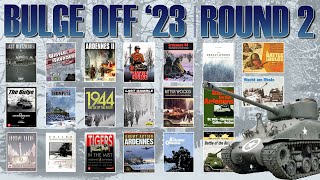
Players who enjoy The Last Gamble: The Ardennes Offensive's study-first design and its historical documentation will find a natural next stop in the Bulge Off Series, the channel's own tournament of Battle of the Bulge games, where the reviewer compares a wide range of titles covering the same campaign. For a Battle of the Bulge game with a smaller footprint and a lighter entry point, Winter Thunder offers a campaign-scale treatment of the battle in a more compact package, which suits players who want the theme without the full setup burden.
What Reviewers Are Saying
"This is a game for someone who really wants to study the battle in detail who wants to be a student of the battle because everything that you read about sets the historical context as to why this rule is in the game and there is quite a bit of detail here."
— Zilla Blitz
"I will say the text here and the writing in the rule book for the sections that I've read so far very clear very thorough very precise. It gives me confidence that you know although there is a lot here that you can use the rule book reliably to execute gameplay."
— Zilla Blitz
"This will be my first learning game with this one so excited to check this one out. One of the most historically infused games that I've ever run across so I'm very curious to see how this plays."
— Zilla Blitz