



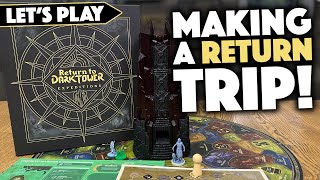

Return to Dark Tower: Expeditions Deep Dive
What the Community Thinks About Return to Dark Tower: Expeditions
Reviewers agree that Return to Dark Tower: Expeditions is a harder, more demanding expansion rather than a reinvention of the base game. Board Game Critique sums it up as Return to Dark Tower on hard mode with an exploration garnish, and recommends it mainly to players who have mastered the original and find it too forgiving. The same review praises the production quality and the clarity of the new iconography, but warns that the price is a real consideration, especially for groups that do not play often.
The Watch Review play session confirms that the expansion is an analog add-on. It introduces no new digital components and no new app elements, so the expansion relies on the existing app-driven tower and its events. Both reviews describe the same core change: the expedition track and the torments give the co-op a constant sense of competing demands, where the base game often lets a group focus on one goal at a time.
Reviewers diverge mainly on how enjoyable the added load feels in practice. Board Game Critique reports that pacing can stall when players debate every expedition step, and that turns only become snappier once a group learns when to bail on a risky move. Watch Review shows the same learning curve, with rules questions and long deliberations slowing the early turns. Both reviews treat that friction as part of the expansion's appeal for experienced players, while acknowledging that it may frustrate newcomers.
Core Mechanics That Define Return to Dark Tower: Expeditions
Push Your Luck
Expeditions turns the base game's movement into a press-your-luck decision. Players spend movement to advance an expedition marker along a route, flip face-down rewards, and then choose whether to keep pushing or pull back. Board Game Critique describes the result as press your luck with a side of stomach knots: one push produced a major reward that removed a global torment, while another pushed one step too far and started a skull avalanche on the tower.
The risk is sharpened by the rules for costs and returns. Watch Review explains that route costs must be paid from the shared expedition supply rather than from a hero's own board, and that the marker must return to its starting location before rewards are collected. A push that looks profitable can therefore leave the group short of supplies, with rewards still unclaimed. Board Game Critique adds that the same tension appears on the main map, where a player may have to choose between pushing an expedition and saving a village threatened by skulls.
Modular Board
Expeditions adds separate expedition boards that work as side journeys beside the main map. Board Game Critique describes them as mini boards running alongside the primary map, and notes that the four expedition boards produce different loops and events, which helped make no two sessions feel identical. The layout also changes with player decisions. Watch Review shows a Lotus Workshop token placed at the intersection of three map lines, where the neighboring areas then act as a building that allows the free version of building actions. Where a group puts that token reshapes how heroes move and reinforce for the rest of the game.
The electronic tower remains the anchor of this layout. Watch Review shows the app-driven tower stirring and rotating to bring new skulls onto the board, and a glyph on the tower can point at a hero and require spirit before that hero's banner action. Board Game Critique reports that the app did not need an update to support the expansion, so the tower integrates with the expedition boards without any version change.
The Return to Dark Tower: Expeditions Experience
Escalating Pressure
The dominant feeling reviewers describe is a steady, rising pressure. Board Game Critique says the torments start active from the first round, and that the global torments can block core actions such as removing corruption at sanctuaries. The review argues that the base game's comfortable co-op mood shifts into something more urgent, where the group may feel it could lose within a few rounds if it does not secure a lucky expedition result. Watch Review reports a similar mood, with a global torment forcing reinforce before heroic action and the group working around it for much of a session.
Juggling Competing Priorities
The second feeling is the satisfaction of balancing several demands at once. Board Game Critique states that the win condition stays the same, with the main quest and the adversary still the goal, but players must manage skull placement, quest progress, and expedition gains together. The review says that a session in which the group balanced all three felt incredibly satisfying. Watch Review shows the same juggling in practice, with players weighing whether a warrior should join the expedition or stay with the army, whether to spend spirit for extra movement, and which treasures to keep for later quests.
What Makes Return to Dark Tower: Expeditions Stand Out
Torments as Modular Difficulty
The torment system is the feature reviewers praise most consistently. Board Game Critique describes lesser torments that affect level two and three foes, greater torments that tag level four foes and the adversary, and global torments that affect every hero. Because the torments are modular, the difficulty can be tuned at setup, and the expedition rewards are the main way to remove them. Board Game Critique calls this meaningful difficulty scaling and says it stops veterans from coasting once they have mastered the base game.
The Grizzled Mariner and Its Ship
Among the new heroes, the Grizzled Mariner receives the most positive comment. Board Game Critique explains that the mariner's banner action moves the ship up to three spaces, and that the ship lets the hero act as if in two places at once, with heroic actions possible at either location. The review calls the Mariner the standout in terms of feeling different in actual play. Watch Review uses the ship to cover a distant ruin while the hero reinforces at home, and describes the second position as a tactical puzzle that rewards careful planning.
Potential Drawbacks
A Steep Difficulty Spike
The most common caution concerns the jump in difficulty. Board Game Critique describes first attempts as carnage and says that a group that loved the base game as it was may find the expansion feels like moving from a jog to a sprint with ankle weights. Watch Review reports lost warriors, failed quests, and an adversary battle that required careful use of advantages and corruption. Both reviews suggest that the difficulty is intentional, but they also recommend that new players learn the base game first.
Planning Overhead and Slower Turns
Reviewers also raise concerns about added decision load. Board Game Critique reports a five-minute debate over a single step of expedition movement, and warns that groups prone to analysis paralysis may see turn times balloon. Watch Review shows the same effect in a slower, more deliberate session, with the hosts pausing to check the rulebook after a battle resolved in an unexpected way. Both reviews note that the overhead eases as players internalize the risk thresholds, but that the early games can be slow.
If You Enjoy Return to Dark Tower: Expeditions
Board Game Critique offers three clearly reasoned comparisons for readers deciding what to play next.
- Return to Dark Tower (the base game): The review calls the original still the best entry point into the system, and recommends it before the expansion for anyone new to the series. Expeditions builds directly on its tower, heroes, and co-op structure.
- Spirit Island: The review describes Spirit Island as brain-burn co-op without an app, a title for players who want tough cooperative decisions with a steep difficulty curve. It is the most direct recommendation for groups who enjoy the pressure Expeditions adds.
- Pandemic Legacy: The review points to Pandemic Legacy for evolving difficulty. Like the expansion's torments, it changes the challenge over time, which suits players who want the threat to grow across sessions.
What Reviewers Are Saying
"Expeditions forces you to actually engage with those sideboards. In the base game, you can sometimes ignore a new system. Here, if you don't push expeditions, the torments suffocate you."
— Board Game Critique
"Comparing to the base game, Expeditions turns the comfy co-op into a pressure cooker. The base game's we've got this vibe becomes we might die in two rounds if we don't pull a miracle on the expedition track."
— Board Game Critique
"The Mariner ship is the standout in terms of feeling different in actual play. The big addition is torments, modular difficulty nasties that start active."
— Board Game Critique