




Zero to Hero Deep Dive
What the Community Thinks About Zero to Hero
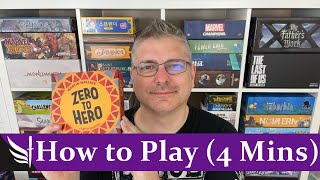
Zero to Hero has captured the attention of reviewers who appreciate its bold reinterpretation of trick-taking. Rob from Just the Rogue ranked it as their fourth-favorite game released in 2025, praising the way it puts a fun spin on traditional trick-taking by introducing meaningful moments where players actually want to lose a trick. Board Gaming Ramblings' Su called it an immediate keeper, drawn to the clean tile design and the engaging push-pull of trick selection, while co-host Johannes acknowledged its charm but viewed it as primarily a solid trick-taker with a gimmicky zero-to-hero twist that rarely comes into play. The verdict from the community is clear: Zero to Hero succeeds most when played as a clever trick-taking game where scoring dynamics create genuine tension, and less so when banking on its comeback mechanic as a game-changer.
Core Mechanics That Define Zero to Hero
Trick-Taking
At its heart, Zero to Hero is a tile-based trick-taking game published by Wallace Designs. The core trick-taking system inverts player expectations by determining winners not by who played the single highest tile, but by which suit totals the highest value. This means a player leading with a blue 10 can still lose the trick if their opponents combine their tiles in another suit to reach a higher total. Within the winning suit, the player holding the highest individual tile captures the round. This layered approach to trick resolution forces players to make complex calculations mid-trick, using visible color information to predict outcomes they cannot see.
Compound Scoring
The scoring system embraces contradiction. Every hand deals a new scoring tile that dictates whether winning a trick awards points or penalties. Some rounds reward first place generously while punishing second place; others flip the incentive structure entirely. This creates a second strategic layer where players must actively weigh whether pursuing a trick aligns with the current round's scoring rule. The tension builds because players know their opponents' tile colors but not their values, forcing decisions based on incomplete information and the constant recalculation of risk.
The Zero to Hero Experience
Dramatic Swings and Suspense
The game thrives on momentum shifts. A player can enter a hand ahead and finish behind, or limp along with minimal points only to suddenly climb closer to victory. The shifting lead creates genuine tension at the table, with each trick potentially realigning the score in unexpected ways. Reviewers noted that the endgame delivers a rewarding sense of suspense as players jockey for position across multiple hands, never feeling locked out even if they have fallen behind.
Strategic Yet Approachable
Zero to Hero walks a careful line between accessibility and depth. Rob praised the clear rules presentation and the strong twist on familiar trick-taking conventions, making it easy to teach but giving experienced players room to outthink their opponents. The tile-based design, combined with visible suit information and hidden tile values, creates a sweet spot where casual players grasp the fundamentals quickly while strategic thinkers hunt for card-counting and probability advantage.
What Makes Zero to Hero Stand Out
Flexible Victory Conditions
The dynamic scoring tile system means there is no single path to victory. Some players may prioritize winning tricks in one hand while deliberately seeking second place in another. This flexibility encourages diverse strategies and keeps games from settling into predictable patterns. Su from Board Gaming Ramblings highlighted this dynamic, noting how the mix of negative and positive point opportunities keeps tension alive across the entire game, allowing multiple strategies to coexist at the table.
Elegant Tile Design and Tie Resolution
The triangular tiles are not merely functional but contribute to the game's visual charm. Their unique shape makes them satisfying to handle and easy to parse at a glance. Equally important is the game's handling of ties. Rather than breaking ties to crown a single winner, Zero to Hero allows multiple players to claim first or second place simultaneously, with all tied players receiving the full reward. This inclusive design prevents the frustration of losing on a technicality and reinforces the idea that the game celebrates multiple paths to success.
Potential Drawbacks
The Comeback Mechanic Rarely Materializes
The zero-to-hero instant win condition, which gives the game its name, is more thematic promise than practical threat. To trigger it, a player must start a hand with exactly zero points and then earn five points during that single hand, all while opponents actively work to prevent exactly this outcome. Rob observed that this instant win feels simultaneously exciting and mathematically unlikely: players begin with five points and must be extraordinarily unlucky or poor to reach zero, then extraordinarily fortunate to recover while under direct opposition. As a result, the mechanic functions more as an elegant narrative flourish than a viable path to victory, which may frustrate players expecting the zero-to-hero arc to be a regular feature of the game.
Hidden Information Creates Edge-Case Complexity
Because players see the colors of opponent tiles but not their values, certain board states generate ambiguous outcomes around ties and non-leading suits. New players can struggle with rules around what happens when two suits tie for the highest total, or when a player holds a lone two in a suit (which wins the trick outright). These edge cases, while clarified in the rulebook, require careful teaching and can slow play if players are unsure of resolution. Additionally, tracking and manipulating scoring tokens demands attention; miscounting at table speed is an easy trap.
If You Enjoy Zero to Hero
If Zero to Hero resonates with you, seek out other trick-taking games that experiment with scoring. While reviewers did not name specific comparisons in their discussions of this game, the transcripts establish that Zero to Hero occupies the middle ground between traditional trick-taking depth and streamlined accessibility. Its blend of inverted mechanics and dynamic scoring aligns it with other games that ask players to sometimes lose on purpose, making it a strong fit for anyone drawn to trick-taking mechanics with a modern twist. Look for games where partial information and multi-layered decisions create tension without demanding heavy rules overhead.
What Reviewers Are Saying
"This is a game for three to five players that plays in about 45 minutes, is designed by Martin Wallace and is published by Wallace Designs. This is a trick-taking game where the winning suit is the one with the highest total value of tiles played in that trick."
— Just the Rogue
"The trick taking game where coming second might actually win you the round. And going from zero points to five points could win you the whole thing."
— JestaThaRogue
"It's a call from me and a keep from me because it's fun and you're playing with tiles. I like the tile shaped in this game. You get these little triangles and I like the core concept of how you win tricks, but I think the Zero to Hero it's a weird game because you don't do that a lot of times. It's just a cool bit, but that's not the thing in the game that is cool. It's just regular trick-taker."
— Board Gaming Ramblings