





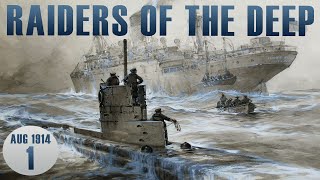
Raiders of the Deep: U-boats of the Great War Deep Dive
What the Community Thinks About Raiders of the Deep: U-boats of the Great War
Raiders of the Deep draws players into an extended historical narrative that unfolds over many patrols rather than delivering a quick gaming session. Zilla Blitz, a dedicated solo player who has piloted U-boat U9, the "Toyful Fish," through multiple campaign runs spanning 1914 to 1916, describes the game as a compelling fusion of tactical puzzle-solving and narrative progression. Across numerous actual-play recordings, the crew earns promotions, the submarine accumulates battle scars and repairs, and the commander earns medals reflecting service history. Die rolls are never fudged; whatever emerges is played through, creating moments of triumph (sinking a heavily-armored merchant after a long pursuit) and frustration (rolling snake eyes and striking a mine). The overall sentiment is respect for the game's depth: it is not easy, it punishes poor decisions and bad luck equally, and it rewards careful tactical planning within the constraints of early-war submarine technology.
Core Mechanics That Define Raiders of the Deep: U-boats of the Great War
Cruiser Rules and Boarding Engagement
Early in World War I, German U-boats operated under the Cruiser Rules, a real historical constraint that forbade attacking unescorted merchant vessels without first giving them a chance to abandon ship. Compass Games designer Ian Cooper translates this into a multi-phase tactical mini-game that often becomes the centerpiece of a patrol: signal the vessel to heave to, fire a deck gun warning shot if signals fail, threaten to strike its colors with non-vital shots, then board the abandoned vessel as a prize worth double tonnage. Escorts may randomly appear between phases, forcing the submarine to abort and dive to avoid detection and ramming. Because of this added complexity, players often employ a fan-made mod called Reavers of the Sea, created by Border Reaver on Board Game Geek, which adds boarding parties, crew casualties, and the threat of imprisonment for breaking cruiser rules. Zilla Blitz notes that this mod heightens the tension and narrative drama of the encounter, making the mechanical flow feel grounded in historical stakes.
Resource Management Through Torpedo Allocation
The submarine begins patrols with exactly six torpedoes loaded into three tube banks: superior G6 torpedoes forward, slightly weaker C6 torpedoes aft, and low-reliability C35-91 torpedoes held in reserve for close-range engagements. Each type carries a different dud rate that improves over the course of the war, and the player must decide which weapons to expend at each target. Decoy encounters, Q-ships (British merchant vessels disguised as military vessels), and frustrating escorts force allocation decisions under uncertainty, while the 3.7 mm deck gun offers unlimited but minimal-damage ammunition. One patrol log describing a lengthy effort to sink a single large freighter using nothing but deck gun rounds captures the tension between resource scarcity and damage output: the submarine has the firepower to engage, but not enough punch to finish targets efficiently.
The Raiders of the Deep: U-boats of the Great War Experience
Constant Tension From Unseen Threats
Raiders of the Deep delivers tension that builds not from real-time pressure but from the implications of random rolls. Each dive into a patrol zone risks mines in transit waters, escorts that force ramming attacks, and detection rolls that determine whether the submarine survives an engagement unscathed. Ramming itself emerges as a historically authentic threat, noted as one of the primary ways U-boats were actually sunk in World War I. After firing torpedoes in daylight, the detection roll becomes a make-or-break moment: a modified result of seven or less means safe escape, anything higher triggers a ramming attack that can end the patrol in failure or death, resolved purely by die result with no narrative softening. The later introduction of depth charges, a historical event tied to campaign progression, transforms the threat landscape and dramatically shifts patrol strategy and risk assessment.
Immersion Through Long-Form Campaign Progression
Rather than delivering isolated scenarios, Raiders of the Deep creates immersion through cumulative narrative. The player generates a named commander with a random backstory, assembles a crew from named officers (many contributed by Patreon supporters), and tracks promotions across months of campaign time. Each patrol happens at a specific calendar date in a specific region (British Isles, Mediterranean, North Atlantic), and the historical context shifts accordingly: cruiser rules phase in and out, Q-ships begin appearing at specific dates, and depth charges and newer U-boat types arrive at historical inflection points. The submarine accumulates battle scars, with hull damage extending refit times and damaged dive planes requiring repair rolls, while successful patrols earn commanders medals and promote crew from trained to veteran to elite. Over ten or more patrols, a personal history emerges, and the player becomes invested in whether this particular U9 survives long enough to see a more capable boat replace the aging U5 class.
What Makes Raiders of the Deep: U-boats of the Great War Stand Out
Historical Accuracy Embedded in Game Systems
Compass Games has grounded the mechanics in actual World War I naval doctrine and events. The Cruiser Rules are not flavor text; they are a playable system that exists for a specific historical period and phases out when unrestricted submarine warfare is declared. The target rosters list actual ships sunk by U-boats each historical month, complete with tonnage, and tactics like ramming, Q-ships, and boarding parties for prizes all carry historical weight. Patrol difficulty depends on location (the Mediterranean is target-rich but safe, the English Channel is dangerous and barren, the British Isles offer a sweet spot) reflecting the actual strategic geography of WWI submarine warfare, and even the crew advancement tables reference realistic career paths and honors.
Meaningful Decision-Making Within Systemic Constraints
Despite being a solitaire game driven by die rolls, Raiders of the Deep consistently presents decisions that matter: whether to pursue capture (doubling value but risking crew casualties and exposure) or simply sink a target, whether to chase a fleeing unarmed vessel or abort and conserve fuel and torpedoes, whether to close in for higher hit probability or hold at range to reduce detection risk, and whether to fire the best torpedoes now or conserve them for a more valuable target later. The campaign structure amplifies this, since decisions made patrols ago compound as accumulated tonnage, crew status, and boat condition shape current options. These decisions occur within real uncertainty, but the player retains agency over risk allocation and strategic priority.
Potential Drawbacks
Complexity of Cruiser Rules and Modular Components
The cruiser rules constitute a significant learning curve. The base game provides the core signaling-to-strike-colors framework, but the popular Reavers of the Sea fan mod introduces additional sub-phases (crew injuries during boarding actions, imprisonment risk, opposed boarding rolls). Zilla Blitz must stop multiple times across the first patrol to re-read the interaction between base game and mod, and the combination of signaling, deck gun warning, strike colors, abandon ship, and boarding party options creates a flow that a new player will likely need to consult the rulebook to internalize. The game is modular in feel, with cruiser rule phases, random event tables, encounter multiplier mechanics, and campaign-level crew advancement operating as semi-independent systems, and while this creates depth, it also raises the cognitive load of tracking interactions in early patrols.
Weak Early-Game Submarine and Frustrating Dud Rates
The U5 class submarine used in early campaigns is deliberately underpowered: the 3.7 mm deck gun inflicts minimal damage, and the torpedo payload is limited to six rounds. In multiple patrols, the player expends all available ammunition without sinking a target, or achieves hits only to have torpedoes register as duds due to high dud rates on the cheaper C35-91 and C6 models. One sequence sees the player fire over a dozen rounds of deck gun ammunition against a single large freighter without achieving damage, then suffer three torpedo duds against another vessel, resulting in wasted ammunition and a foregone opportunity. The frustration is historically grounded (early-war submarines truly were underpowered, and torpedo reliability was a known problem), but it creates stretches where the player's tactical options feel exhausted while the target remains afloat. The arrival of upgraded U-boat types mid-campaign partially alleviates this.
If You Enjoy Raiders of the Deep: U-boats of the Great War
Raiders of the Deep is designed specifically to appeal to players seeking solitaire wargames with substantial rules depth and campaign progression. The game's niche is narrow: World War I submarine enthusiasts, history-focused board gamers, and players who value long-form campaign narratives over quick-play sessions will find the most value. If you appreciate solitaire games that balance historical authenticity with meaningful decision-making, where player skill interacts with die-roll randomness in ways that feel consequential rather than arbitrary, this game rewards that interest. The active modding community around the Reavers of the Sea enhancement suggests the game has inspired players to deepen and personalize the core experience, and dedicated fans recommend beginning with a single patrol to learn the system before committing to a full campaign run.
What Reviewers Are Saying
"We will have to be extraordinarily careful now going forward because we do not want to get sunk by one of these new fangled technology things."
— Zilla Blitz
"The designer himself mentions that the British Isles is probably that sweet spot between danger and reward so I kind of wanted to make sure that we ended up in here and if you do start in August 1914 that's the only place the flotilla are originally operating in in the war."
— Zilla Blitz
"This was actually one of the common ways that U-boats were sunk in World War I."
— Zilla Blitz