




Food Truck Race Deep Dive
What the Community Thinks About Food Truck Race
Food Truck Race is receiving enthusiastic praise from the board game community, particularly from Where There's A Wilz, There's a Play, the primary channel covering this game. Reviewers consistently celebrate the game for capturing the authentic experience of running a food truck while delivering engaging, fast-paced gameplay. Ian and Stacy, the channel's hosts, have highlighted the game's strong thematic design, compelling resource management, and the delightful chaos of real-time simultaneous action. Multiple playthroughs have reinforced their initial positive impressions, with the game earning a permanent spot in their collection and garnering requests for expanded coverage.
The reviewers appreciate how Food Truck Race balances approachability with meaningful decision-making. While the game's real-time elements and rule complexity can initially feel overwhelming, particularly in two-player variants, players find the overall experience rewarding once they grasp the core loop. The community consensus treats this as a successful Kickstarter campaign with strong fundamentals and clear expansion potential.
Core Mechanics That Define Food Truck Race
Resource Management
At its heart, Food Truck Race is a resource management game where players must carefully balance a limited starting capital of $5 to build a profitable food truck business. Players acquire groceries at the farmers market, but each ingredient purchase reduces their available funds. This scarcity creates meaningful tension: every dollar spent on produce is a dollar not spent on truck upgrades, and every upgrade purchased is a decision that forecloses other strategic options. Reviewers emphasize that the shopping phase forces genuine planning, as players must decide whether to invest early in equipment that will increase their cooking capacity or preserve cash for flexible ingredient purchases during the game.
The resource management extends beyond mere spending. Players must track their ingredient inventory carefully, deciding which groceries to stock and when to use storage upgrades to hold additional items. This system rewards players who think several turns ahead, considering not just what they need to serve their current customers but what orders might arrive in the near future.
Real-Time Action and Simultaneous Play
Food Truck Race employs real-time dice rolling and simultaneous action to create a chaotic, energetic atmosphere that mirrors the actual experience of a food truck operation. When the dice are rolled, both players immediately begin gathering their indicated ingredients, preparing dishes, and plating orders at the same time. This simultaneous play eliminates downtime and creates a sense of urgency that reviewers found thematically appropriate and mechanically engaging.
The simultaneous elements are balanced by a turn structure that gives the active player exclusive advantages: only the player who rolled the dice can purchase upgrades or organize their truck in that turn phase. This hybrid approach prevents one player from completely dominating while maintaining the high-energy feel that makes the game memorable. In two-player games, an additional non-playable chef turn keeps the game's pace brisk between human turns.
The Food Truck Race Experience
Chaotic Competitive Cooking
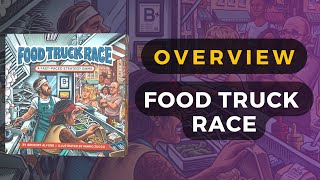
Reviewers consistently describe Food Truck Race as delivering a chaotic, competitive cooking experience that feels authentic to the food service industry. The game's artwork by Mario Zuka reinforces this immersion, with each food truck featuring its own distinctive visual identity and themed menu. Players are not simply moving tokens around a board; they are managing themed food trucks, each with different recipes requiring different ingredient combinations. This theming transforms routine actions into a cohesive narrative: players are not collecting abstract resources but gathering specific ingredients to fulfill orders from actual customers.
The hangry customer mechanic amplifies this atmosphere. At the end of each round, customers who have not been served rotate to adjacent food trucks. A particularly impatient customer can be passed from player to player, representing the pressure and frustration of dealing with unsatisfied clients. This mechanic creates memorable moments and adds a humorous, competitive edge to the game.
Satisfying Tactical Puzzles
Beyond the real-time action, Food Truck Race provides satisfying spatial and logistical puzzles. Players must arrange their truck's prep stations and serving areas efficiently, deciding whether to prioritize storage capacity for ingredients or preparation speed. Organizing the truck becomes a tactical decision: moving ingredients between storage and prep zones allows flexibility, but it consumes limited turns. This micromanagement layer appeals to players who enjoy the planning and optimization aspects of worker placement games without the downtime of traditional turn-based mechanics.
What Makes Food Truck Race Stand Out
Strong Thematic Integration
Food Truck Race succeeds where many thematic games fail: the mechanical systems authentically reinforce the theme rather than feeling bolted on. The different food trucks each have unique ingredient requirements, forcing players to adapt their strategies based on their truck type. This variation prevents the game from becoming formulaic. Reviewers noted that even the artwork on components (from customer illustrations showing their patience levels to ingredient tokens depicting actual foods) serves the theme. The game's art direction makes players care about their trucks and customers on an emotional level, transforming what could be a dry optimization puzzle into an engaging narrative about small business management.
High Replayability Through Modular Design
With four different food trucks, each with distinct menus and ingredient requirements, and twenty-eight upgrade tiles from which only six are selected each game, Food Truck Race promises substantial replayability. The game does not simply shuffle randomly; the choice of upgrades meaningfully changes available strategies. A truck without storage upgrades plays fundamentally differently from one with abundant preparation space. Combined with eighty order cards drawn throughout the game, reviewers found that no two games felt identical, encouraging multiple plays to explore different truck-strategy combinations.
Potential Drawbacks
Complexity and Clarity in Rules
The simultaneous real-time action, while energetic and engaging, introduces rule complexity that can confuse new players. The two-player variant includes a non-playable chef turn structure that reviewers found occasionally confusing, particularly around turn sequencing and when specific actions become available. The step-by-step turn phases in real-time simultaneous play require careful attention, and rules clarifications occasionally became necessary during playthroughs. Reviewers noted that once the rules clicked, gameplay flowed smoothly, but the learning curve is notably steeper than many casual-friendly games.
Order Card Imbalance and Setup Complexity
Some reviewers expressed mild criticism about the order cards themselves, suggesting that certain big orders feel less substantial than their position in the deck implies. Additionally, the setup can be fiddly. Players must organize ingredients, choose upgrade tiles, arrange their trucks, and establish turn sequences before the first dice roll. Reviewers recommended spending time organizing components in separate bags or containers to streamline setup for future plays, suggesting that organization is important for the game's table presence and accessibility.
If You Enjoy Food Truck Race
Players who appreciate Food Truck Race's real-time action and resource management will find similar satisfaction in Fit to Print, a time-pressured tile-placement game where players race to organize newspaper layouts. For those drawn to the cooking theme, Sushi Go! offers rapid-fire card drafting around a culinary theme, though with less depth. The emphasis on themed trucks and economic management suggests interest in games like Flamecraft, which features crafting and resource generation with whimsical components. Those who value high replayability through modular setup and variable player powers should explore Tiny Towns, another excellent design from experienced board game creators that rewards strategic planning within tight spatial constraints.
What Reviewers Are Saying
"I really like this whole food truck where you're prepping stuff or you're getting your food here in the bottom and then you're prepping it up here and you can upgrade because that feels like what you would do if you owned a food truck."
— Where There's A Wilz, There's a Play
"I really like this game, Food Truck Race. You have your own little food truck that you have to go shopping for. You have to cook. You have to keep your customers happy. Um, you have to be able to fill the orders in a timely manner before they get hangry at you."
— Where There's A Wilz, There's a Play
"Well, there's three things that are put out on the board. And then there's a lot of stuff that comes up during the game that kind of stalls what you can do. So, you are purchasing things to go into your food truck to help you store other food or to make your food truck more successful, like a microwave maybe or more space, more prep space for your ingredients."
— Where There's A Wilz, There's a Play