


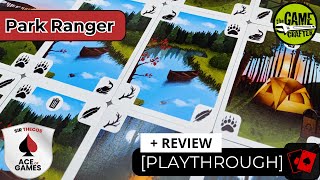


Park Ranger Deep Dive
What the Community Thinks About Park Ranger
Reviewers describe Park Ranger as a compact solo card puzzle that is quick to learn and rewards careful planning. The most detailed assessment comes from Sir Thecos, who plays a full game on camera and concludes that "All in all, Park Ranger is like a neat and satisfying solo puzzle game." That same reviewer warns that the game "can become a real brain burner, especially in your first few plays," and that earning a high score or a top rank at the end is difficult. The reviewer frames these difficulties as part of the appeal rather than as flaws, and treats a strong score as something that takes repeated play to reach.
Tabletop Tokki comes at the game from a lighter, first-impressions angle. In a monthly roundup of new plays, the reviewer calls Park Ranger "a delightful little solo treat" and says it stood out in a crowded field of card games with park and nature themes. A separate unboxing video from the same channel, Tabletop Tokki, introduces the premise and the scoring goals before any play takes place. Both Tabletop Tokki videos treat the game as a welcome addition to a solo collection, while Sir Thecos supplies the analysis of how the puzzle actually plays out. The main point of difference across the reviews is depth: the playthrough explores tradeoffs and difficulty in detail, while the Tabletop Tokki videos capture the initial appeal.
Core Mechanics That Define Park Ranger
Card Placement on a 4x4 Grid
The game's central action is placing cards into a shared grid. The first card starts the layout, and every card after that must sit orthogonally adjacent to a card already on the table. After each placement, the player draws a replacement card, and the process continues until the deck runs out and the 16-card grid is complete. Sir Thecos stresses that this is where most of the decisions happen: a reviewer must weigh where a card helps a scoring pattern against where it might create a penalty. The reviewer notes that looking ahead at the next card is a useful habit, because it reveals which placements are safe and which will cause problems later.
Pattern Recognition
Scoring depends on reading the symbols where cards meet. Pairs of matching symbols along the outer edge score a small amount, while a group of four cards meeting at a shared corner scores more when all four symbols are the same or all four are different. Sir Thecos describes building birds, fish, feathers, and water symbols into these groups as the main way to score, and explains that a poorly aligned card can leave a corner stuck with no useful combinations. The same pattern logic extends to the season goals. Forming a group or pair of birds with a trash bin present, for example, earns a fixed bonus, which means the reviewer has to recognize the right arrangement across the grid rather than just maximize one symbol.
The Park Ranger Experience
A Quiet, Satisfying Solo Puzzle
Both reviews describe the core feeling as a focused, solitary puzzle. Sir Thecos says the appeal comes from the "puzzly goodness" that the reviewer enjoys in solo games, and describes the session as a steady sequence of small decisions in which each new card changes the options for the rest of the grid. There is little downtime, since each turn is one placement and one draw, and the game ends quickly. That combination of brevity and tension is what the reviewer means by a satisfying solo experience.
A Gentle Park-Stewardship Theme
The theme casts the player as a newly hired ranger balancing wildlife, visitors, and cleanliness. Tabletop Tokki reads the rules text on the box aloud, noting the duties of protecting wildlife, educating visitors about responsible camping, and keeping the park clean. Sir Thecos describes the campfires, tents, lakes, and trash bins as the physical details that drive the scoring, so the theme and the rules reinforce each other. The reviewers do not describe the theme as heavy or dramatic. Instead, they treat the park setting as a pleasant backdrop for a compact puzzle.
What Makes Park Ranger Stand Out
Quick Setup and Rules Printed on the Sleeve
Sir Thecos points out that the full rules are printed on the sleeve, with no online rulebook or QR code required, and that the setup takes only a few moments: choose one of the double-sided season goals, shuffle the deck with the correct symbols facing up, and draw two cards to start. The reviewer estimates the game plays in 10 to 15 minutes once familiar with it. Sir Thecos draws a direct comparison to the approachability of Buttonshy games, citing simple rules, quick setup, and short play time as shared traits.
Season Cards That Change the Puzzle
Reviewers consistently point to the four season goal cards as the feature that keeps the game fresh. Each season sets different scoring objectives, such as cleaning up the park or forming specific animal groups, and Sir Thecos notes that the core puzzle does not change much from one game to the next. The reviewer argues that the season cards "do a really good job of shaking things up and adding some variety to how the puzzle unfolds." Because the card order also changes from game to game, Sir Thecos describes the game as offering several different puzzles across a single season and across repeated sessions.
Potential Drawbacks
A Core Puzzle That Stays Familiar
The most consistent reservation concerns variety. Sir Thecos acknowledges that the underlying puzzle is similar in each game, and that players are often solving a closely related problem from one session to the next. The season cards and the shuffle soften this, but a player who wants a fundamentally different experience each time may find the game repetitive over a long stretch. Tabletop Tokki's first-impression framing is more positive on this point, emphasizing the game's appeal as a short solo option rather than as a deep, long-running system.
A Steep Learning Curve and Demanding Scores
Sir Thecos warns that the first few sessions can be mentally taxing, as players work out which symbols to pursue, how the trash flipping interacts with the grid, and when a placement will trigger a penalty. The reviewer also notes that the penalties for placing fire towers next to each other or for campfires that are not beside lakes can quietly erode a score. Reaching the top ranks on the scoring table requires sustained planning, and the reviewer notes that a very high score is not typical. Players who value a relaxed, low-stakes solo game should expect the early sessions to take real concentration.
If You Enjoy Park Ranger
Sir Thecos explicitly compares Park Ranger to Buttonshy games. The comparison rests on approachability, simple rules, quick setup, and a short playing time, combined with a puzzle that still feels engaging and rewarding. Players who appreciate that combination should look at the Buttonshy catalog. Tabletop Tokki singles out A Dragon's Gift from Buttonshy as one of the designer's strongest recent releases, describing it as one of the favorite Buttonshy titles the reviewer played last year. Both reviews suggest that Buttonshy's streamlined design philosophy is the closest match for the satisfaction Park Ranger delivers.
What Reviewers Are Saying
"The core puzzle itself doesn't change drastically from play to play, and you're often solving a fairly similar problem each time. That said, these four season cards do a really good job of shaking things up and adding some variety to how the puzzle unfolds."
— Sir Thecos
"While there are a lot of card games these days that have similar themes of parks and nature, I will say that Park Ranger was a delightful little solo treat that really stood out for me."
— Tabletop Tokki
"I also like it when solo games aren't necessarily just beat your own score, so you have something to shoot for."
— Tabletop Tokki