
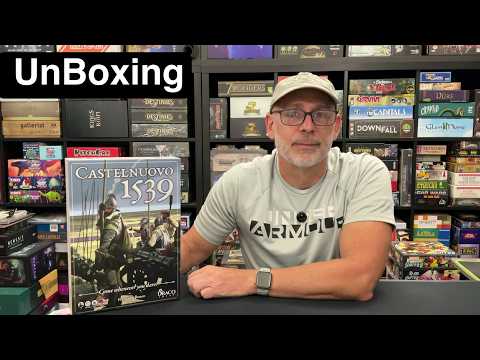






Castelnuovo 1539: Come Whenever You Dare! Deep Dive
What the Community Thinks About Castelnuovo 1539: Come Whenever You Dare!
Castelnuovo 1539 emerged from early playtesting with strong enthusiasm from the wargaming community. Reviewers found a game that manages the difficult balance of making a siege engaging for both the attacker and the defender, even when the historical outcome is already written. The game is still in prototype stages in some reviewers' hands, with final components showing marked improvements over earlier versions, particularly in map colors and component production. This is a card-driven, block-based historical wargame that respects the legacy of the 1539 Ottoman siege while delivering compelling modern gameplay.
Core Mechanics That Define Castelnuovo 1539: Come Whenever You Dare!
Asymmetric Mechanics
Castelnuovo 1539 gives Spanish and Ottoman players fundamentally different rule sets, action sequences, and strategic objectives. The Ottomans actively choose whether each round is a siege turn, generating four cards, or an assault turn, generating seven cards. This choice costs them, as assault declarations inflict casualties on their own forces to simulate the intensity of direct assault. The Spanish, by contrast, operate as a defending force with limited unit quantities but their own powerful special cards like the kamisado attack, which allows infiltration assaults with bonuses to hit. Neither side plays under the same framework, creating asymmetry that rewards learning each role individually. Reviewers noted this design choice was intentional and excellent: the Spanish player has a genuinely active defensive role, not a passive one waiting for defeat.
Combat: Dice
Combat resolution uses a robust dice mechanic where hit values depend on unit type, positioning, and card play. Infantry generally hit on fives and sixes, but pikemen gain advantages against mounted cavalry, and unit strength directly affects the number of dice rolled. Leaders provide combat bonuses, fortifications grant defensive advantages, and terrain modifies hit numbers. Combat cards can be played face-down before the exchange to add special effects (fire devices, defensive works). The resolution order follows historical logic: pikemen attack first against cavalry if present, then cavalry if no pikemen are visible, then arquebusiers and specialized units, finally remaining forces attack simultaneously. This nested system creates tactical layers where careful unit positioning and identification of opponent force composition becomes a puzzle before the dice ever roll.
The Castelnuovo 1539: Come Whenever You Dare! Experience
Siege Tension and Historical Inevitability
The game captures the thematic weight of a doomed defense. Spanish players know they will lose their fort, but the goal is to inflict enough Ottoman casualties to make victory hollow. This inverted victory condition creates a unique emotional arc: the Spanish player is not trying to win the battle, but to make the Ottomans pay for their victory. One reviewer noted this framing brings genuine satisfaction: watching the Spanish hold out longer and bloodier than expected becomes its own reward. The historical siege at Castelnuovo lasted roughly one month, and the rulebook weaves the actual history throughout, with rules sections followed by historical context explaining why those mechanics exist. For players interested in learning about the conflict while they play, this integration of history directly into the rules provides educational value without slowing gameplay.
Active Defense and Tactical Counterplay
The Spanish must attack aggressively to prevail; pure defensive play leads to slow erosion and defeat. This design choice was deliberate and is a standout feature. The Spanish have cards like the kamisado (a night infiltration attack) that allow for devastating surprise strikes if timed right. They can bombard approaching forces, repair damaged walls, and use counterattack cards to punish Ottoman assaults. The game feels tense because both sides have meaningful turn-to-turn decisions: the Ottomans must decide each round whether to push harder (and lose more troops in the process), and the Spanish must pick moments to counterattack knowing their units are outnumbered. Reviewers who played both sides noted that the Spanish role is genuinely fun despite the historical certainty of defeat.
What Makes Castelnuovo 1539: Come Whenever You Dare! Stand Out
Block-Based Siege Warfare
Castelnuovo 1539 reimagines siege mechanics within a block-wargame framework. Walls, bastions, artillery positions, and trenches are all tangible on the board and affect movement and combat. The two-player hidden information (blocks show strength only to their owner) adds fog of war and mystery: you do not know the exact composition or health of approaching Ottoman forces. This creates a puzzle: are they cavalry or pikemen? Are they at full strength or depleted? This tension enriches the tactical layer in ways many block wargames do not achieve. Reviewers specifically noted that the variety of siege elements (walls, trenches, bastions, artillery bombardment) feels fresh and new compared to generic block-wargame territory.
Historical Rulebook Integration
The rulebook is 32 to 42 pages (varying by edition) and employs a relatively rare design: each rule receives context. A rule about walls might be followed by a paragraph explaining the actual history of the Castelnuovo fortifications and their role in the Ottoman Hapsburg conflict. This approach creates immersion and helps players understand not just the mechanics but the historical reasons behind them. Reviewers praised the writing clarity and the care taken to weave actual history alongside gameplay, making learning engaging and the final product feel historically grounded rather than mechanically arbitrary.
Potential Drawbacks
Extensive Component Preparation
Castelnuovo 1539 ships with dozens of wooden blocks requiring stickers. One reviewer spent approximately one hour applying stickers before the game was playable, and noted some misalignment stress after that experience. For players who prefer to open and play without preparation time, this is a barrier. The stickers are high quality and the final blocks look excellent, but the initial time investment is real. Additionally, the game is two-player only, which limits its audience compared to games that scale to three, four, or more players.
The Game as a One-Off Rather than Evergreen
Although playtesting feedback was positive, one reviewer noted that Castelnuovo 1539 is likely best experienced as part of a rotation of wargames rather than a game played repeatedly in succession. The asymmetric roles and historical set-up mean that subsequent plays will feel similar. Deployment of Ottoman reinforcements and Spanish casualties will vary by card draw, but the fundamental experience (Spanish defending, Ottomans attacking, both knowing the outcome) stays constant. This is not a flaw if you enjoy exploring individual wargames deeply before rotating to others, but it is worth noting for players seeking high replayability in a single title.
If You Enjoy Castelnuovo 1539: Come Whenever You Dare!
Castelnuovo 1539 is for two-player wargame enthusiasts who appreciate historical settings, asymmetric gameplay, and block-based hidden information. If you enjoy tight two-player conflict games with clear mechanical variety between sides, or if you want a wargame that respects history while keeping it thematic rather than overly complex, this is an excellent fit. The game rewards players who enjoy learning the specific strengths and constraints of one faction deeply rather than bouncing between roles each session. Reviewers mentioned no direct comparable titles but noted that fans of siege-based wargames, block-warfare games, and historical two-player conflict games will find fresh and engaging mechanics here.
What Reviewers Are Saying
"This Spanish force that I don't know, arrogance, confidence, like whatever it was, was like, 'No, bring it on.' Then get smashed. I I don't know. Hubris being punished. I kind of enjoy it, though. I guess it's kind of dark cuz all those troops died, too. But, you know, whatever. I I like the the history of it. I actually liked reading through the historical notes that's in the rule book. It was kind of cool to learn something about that. I also appreciate you can't change history. The Spanish are going to lose, period. And I really, really like that."
— Hungry Gamer
"As the Spanish player, I was wondering, you know, you're on the defensive, you're surrounded, do you have anything to do? And the answer is absolutely a resounding yes. The Spanish player must attack. They must attack aggressively but very selectively in order to win this game."
— Zilla Blitz
"I really appreciate the history they've embedded in the rules. A particular rule will often have a paragraph explaining the history of the battle nearby, which gives so much more context to the rule itself."
— Zilla Blitz