




Flails & Citadels Deep Dive
What the Community Thinks About Flails & Citadels
Flails & Citadels is a grimdark solo card adventure from War Claw Games that reviewers present as a standalone expansion to Doom Pilgrim, the publisher's base game. Tabletop Tokki describes it as a standalone expansion for Doom Pilgrim that adds all new cards and an all new story. The Dungeon Dive calls it a brand new expansion that is also a standalone game, and says it can be combined with the rest of the Doom Pilgrim line. Owners of the base game get a fresh deck and storyline, and the reviews suggest the new title can be approached on its own.
Reviewers agree on the core appeal: a bleak fantasy world with strong art and a story that builds as the player goes. Tabletop Tokki stresses how easy the game is to enter as a solo experience, even though RPG-style play is not always that channel's preference. The Dungeon Dive reads the new release as pushing the Doom Pilgrim line toward a more standard adventure game with light solo RPG elements. The two channels differ in emphasis. Tabletop Tokki focuses on how card states and past decisions produce different outcomes in each session, while The Dungeon Dive focuses on the doomed-pilgrim premise and the atmosphere that makes each run feel distinct.
Core Mechanics That Define Flails & Citadels
Narrative Choice
Each card presents a short passage of in-fiction text, and the player selects one of several responses. Each response carries its own consequences, which can include a wound, a psychic drop such as dismay, regret, or depression, or a gain such as gold, an item, a title, or a companion. Tabletop Tokki's playthrough shows that outcomes often depend on what the character already carries. A title such as Lord, a horse, hero badges, or monster trophies can open or close later options, so the player frequently checks a card's requirements against their own record before committing. Decisions also compound. A ring that proves a fake noble title held only in cold regions shaped which later passages were open.
Deck Manipulation
Flails & Citadels is built around triaging a small deck. Each turn the player lays out the top three cards and decides what happens to each one: one is discarded and removed from the game, one goes into a future pile that may return later, and one is engaged now and becomes the past. Tabletop Tokki describes how the rules shape this flow. Cards placed in the future are later reoriented to the bottom of the deck, and a curse changes the draw so that the player takes a card from the bottom every third turn instead of choosing from the top three. Because the player controls which cards appear and when, the deck becomes a partly predictable resource rather than a purely random draw. Reviewers did not describe acquiring new cards from a shared market, so this is better understood as card triage than deck building.
The Flails & Citadels Experience
Grim, Darkly Comic Dread
Reviewers describe a tone that leans into bleakness while still finding the absurd in it. Tabletop Tokki's session includes a witch gathering that turns grotesque, a cursed helm that demands the death of an innocent, and a forest spirit's dance that ends in a wound, and the commentary treats these moments with dry amusement. The Dungeon Dive emphasizes the mood and artwork of the series, describing it as dark, weird, and twisted. The result is a feeling that the world is hostile and strange at once, which suits players who enjoy unsettling stories.
Attrition and Failure
The game keeps pressure on the player through a running tally of harm. Tabletop Tokki tracks wounds, diseases, curses, and psychic drops against loss thresholds, and the playthrough shows how close a run can come to collapse. At one point the character reaches a total of dismay plus two and is very close to death, and a companion is left behind in a dark fort. Reviewers frame the tension of counting toward those limits as the emotional engine of each session, and the typical outcome is a survivable but battered ending.
What Makes Flails & Citadels Stand Out
Accessible Solo Storytelling
Tabletop Tokki says the game lets players jump right in. Setup requires only knowing the loss conditions and removing cards according to the chosen difficulty, and other win or loss conditions surface naturally as the story progresses. That channel praises the story as unique and easy to enter as a solo experience, and notes that the game tracks the story as it is played, so the record of choices becomes the narrative. The Dungeon Dive sees the expansion as moving the line toward a standard adventure game with light solo RPG elements, which points to an appeal for players who want story progression on the table.
Art, World, and Replayability
Reviewers single out the art and the world. Tabletop Tokki calls the aesthetic and artwork very well done and describes a specific flavor of theme and art that is a primary component of the game. Replayability comes from the way card outcomes depend on past choices, current items, money, and the situations a player has already encountered. Tabletop Tokki notes that even when the same card appears across different playthroughs, the results can differ. The Dungeon Dive, discussing the base game, values the same combination of art, writing, and world that gives the line its identity.
Potential Drawbacks
Dark, Mature Content
The themes are heavy, and the tone is a central part of the experience rather than an accent. Tabletop Tokki's playthrough includes a scene that reveals a violated and murdered young woman, along with other cruelty played for grim effect. That channel acknowledges a personal preference for darker fantasy aesthetics, but it also notes that RPG-style play is not necessarily its cup of tea. Players who dislike grim material or mature subject matter should expect those elements to shape most of the story.
Bookkeeping and Tracking Burden
The game asks players to track a lot at once, including wounds, diseases, curses, psychic drop totals, gold, titles, trophies, and the placement of cards in the future, past, and bottom-of-deck piles. Tabletop Tokki stops repeatedly to write notes, catches cards that were placed in the wrong pile, and at one point is unsure where a loss was recorded. That tracking is part of the appeal for players who like to build a story as they go, but it can slow play for anyone who prefers lighter record keeping.
If You Enjoy Flails & Citadels
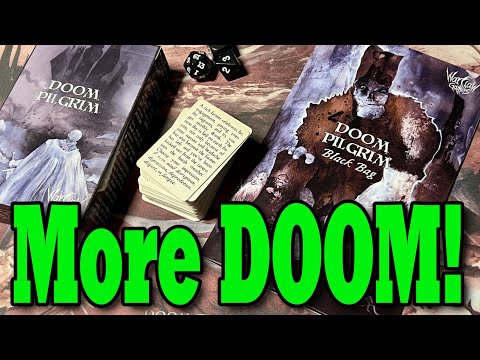
Doom Pilgrim is the base game that Flails & Citadels builds on, and reviewers position the new release as a standalone expansion to it. In the base game, the player lays out three cards, chooses one to encounter, and works through a deck while managing dooms, diseases, and curses. The Dungeon Dive describes the base game as a game in which the player watches a doomed character's last days unfold, which is the same premise that drives Flails & Citadels. Tabletop Tokki recommends the base game alongside the expansion, and the channel has also covered Doom Pilgrim Pocket, a smaller version of the base game for players who want a more compact format. Tabletop Tokki mentions plans for a pocket version of Flails & Citadels as well, though that is described only as a future possibility. Players who want to see where the line's modular ideas began can look at the Black Bag expansion, which The Dungeon Dive reviewed as the earlier release that seeded the new standalone title.
What Reviewers Are Saying
"I think that the unique story here and how accessible and easy it is to get into, especially as a solo experience, is really great. I have enjoyed all of my playthroughs of Doom Pilgrim and Flails and Citadels thoroughly."
— Tabletop Tokki
"This isn't a choice-based game. This is a game to play out your character's doomed. You know they're doomed. It's in the name. You are a doomed pilgrim."
— The Dungeon Dive
"Let me tell you this, it's one you're not going to want to miss because our story took some very interesting twists and turns in that playthrough."
— Tabletop Tokki