



Storybook Saga Deep Dive
What the Community Thinks About Storybook Saga
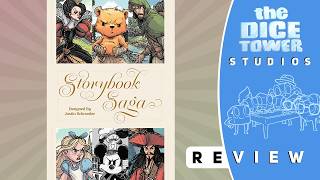
Reviewers who have covered Storybook Saga land mostly on the positive side, although none present it as a flawless design. Zee Garcia at The Dice Tower gave the solo game an eight out of 10 and said it is one they keep bringing back to the table, mainly because new villains and new combinations of characters keep appearing. The same reviewer repeated that verdict in the Week in Review segment of The Dice Tower, calling it charming and a great, interesting solo game even while noting problems with rulebook clarity.
The reviewer at One Stop Co-op Shop is more restrained. Mike, reviewing it in the Shelf Life series, described it as a combat game with beloved characters from literature, and said it felt a little less random than the baseball dice game it resembles. Mike still did not love it and placed it below the top titles in Gabe Barrett's solo game of the month series, while describing it as a good time.
The main point of divergence is enthusiasm rather than substance. Both reviewers agree that the dice-driven combat works and that the theme is a strength. They differ in how much the experience wins them over, and the reviewers who liked it most tended to praise its replay value and its push-your-luck tension.
Core Mechanics That Define Storybook Saga
Dice Placement
Storybook Saga is built around rolling dice and assigning them to characters. During the heroes' phase, the player rolls one die at a time and places each result on a hero, and each character defines what a useful placement looks like. Zee Garcia described one hero who deals one damage for every total of 10 across the dice assigned to her, another who needs pairs or straights to deal hits, and an Alice-style character who triggers a wild effect whenever two dice total seven. Dice are therefore placed according to the pattern each character wants, not simply by face value.
Targeting adds another layer. Some heroes force the player to roll a targeting die, while others let the player choose the villain directly. Zee noted that Mowgli, when active, lets every hero choose its target, which counters the randomness of other characters. Villains also roll their own dice during their phase, so the player must plan for both sides of the table.
Push-Your-Luck Commitment
The second core mechanic is push-your-luck, which emerges from committing dice before their results are known. Zee Garcia called the rolling one die at a time a great push-your-luck feel, and the Week in Review segment of The Dice Tower notes that a player does not know whether a straight will appear when the villains' dice are first rolled. The clearest example in the video is Snow White, who takes every die placed on her and deals one hit per die only if no doubles appear. Doubles put her to sleep, so the player decides whether to commit one more die when the risk is visible. Zee also described a hero who needs five straight dice for two damage and noted that a player has to commit to that plan early to pull it off.
The Storybook Saga Experience
Fairy-Tale Mash-Up Charm
Reviewers respond strongly to the mixing of characters from different stories. Zee Garcia said they love the mixture of fairy tales, and noted that the game can pair a villain such as the Wicked Witch of the West with a character like Mickey Mouse. Because replacement characters are drawn during play, the lineup often drifts toward matching the villain, which gives the player some control over the story they are building. Zee described the result as congruent enough that the mixing never feels jarring, and Mike described the game as a combat experience built around literary characters, which reinforces the same sense of playful familiarity.
Rising Tension Across Three Battles
The structure of the game produces a steady build toward a climax. Players fight three battles of increasing difficulty, first against minions and then against a big bad that is brought in with two minions for the final fight. Between battles, heroes can level up, bonus tokens and cards can modify dice, and the villain's health and attacks become more dangerous. Zee Garcia described the feeling of the rolling as a great rising tension, and the progression toward the final battle is one of the main reasons Zee keeps returning to the game.
What Makes Storybook Saga Stand Out
Theme, Art, and Graphic Design
The presentation earns consistent praise. Zee Garcia called the look and theme very well done, said the graphic design is pretty good, and described the whole package as captivating. Reviewers singled out the vibe as much as the mechanics, and that presentation is a large part of why the game stands out in the solo category. Zee's Week in Review segment also called it charming and thematic, reinforcing the impression that the art and theme do much of the work of drawing players in.
Variety of Abilities and Villain Behavior
Zee Garcia highlighted the number of interesting abilities and effects in the game, and the many ways villains attack and heroes respond. Each big bad is tied to a location and comes with its own attack pattern, and companion cards add a further bonus that can modify dice rolls. Heroes can also be flipped face down when they take enough damage and then contribute a die with no ability, which adds a consequence to every fight. Zee described the result as plenty of interesting interactions, and expects a different experience depending on which villains and companions are in the box.
Potential Drawbacks
Unclear Interactions and Rulebook Clarity
The most consistent criticism concerns how some effects interact. Zee Garcia said that some interactions are not as clear as they would like, and that certain edge cases are not explicitly explained in the rulebook. Zee also described moments where it was hard to decide which effect should resolve first. Zee framed these issues as expected for a smaller publisher and a single designer, but the Week in Review segment of The Dice Tower still lists rulebook clarity as a real weakness.
No Player Aid or Icon Key
Zee Garcia also noted that the copy reviewed did not include a player aid. Because the turn has many phases, Zee would have liked a reference card that could sit on the table so the rulebook does not need to stay open. Zee added that the shorthand icons on the cards could have been explained on the back of that aid. Neither point breaks the game, but both affect how quickly new players can learn it.
If You Enjoy Storybook Saga
Zee Garcia compared Storybook Saga to Lorcana the dice game, describing a shared feel of fairy-tale characters, abilities, and dice-driven play. Players who enjoy Lorcana's collection of storybook characters may find the same appeal in Storybook Saga's cast of heroes and villains.
For a similar solo experience built around dice, Zee Garcia reviewed Val Piatra in the Week in Review segment of The Dice Tower and called it a charming, thematic, and engaging solo game from a smaller publisher. Players who like the solo dice challenge of Storybook Saga may find that game a useful next step.
Mike at One Stop Co-op Shop compared Storybook Saga to a baseball dice game, which Mike described as more random. Players who want a looser, more chaotic dice placement game may prefer that comparison, while players who want more control over their rolls will likely appreciate Storybook Saga's assigned dice and character abilities.
What Reviewers Are Saying
"To me, this game kind of in some ways feels like Lorcana the dice game. And that's a good thing. I enjoy that very much."
— Zee Garcia, The Dice Tower
"The rolling one die at a time is very interesting. It has a great rising tension and it has a great push your luck feel to it. Really enjoy that."
— Zee Garcia, The Dice Tower
"It's basically a combat game with beloved characters of literature of the past. I still didn't love this one, but it's a good time and I do like it more than the baseball one."
— Mike, One Stop Co-op Shop