





Armed Conflict Deep Dive
What the Community Thinks About Armed Conflict
Armed Conflict from Bockholm Games has captured the attention of wargaming enthusiasts as a refreshing modernization of classic hex-and-counter warfare. Reviewers consistently describe it as an elegant system that manages to be easy to learn yet tactically rich, with fresh mechanics that break away from traditional wargame conventions. The consensus reflects genuine enthusiasm: players are drawn to its streamlined approach to modern conflict simulation and its dynamic alliance system that creates unpredictable political maneuvering alongside military action.
Core Mechanics That Define Armed Conflict
Hexagon Grid
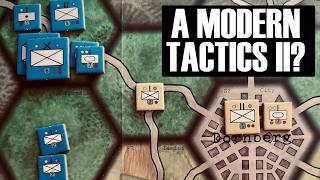
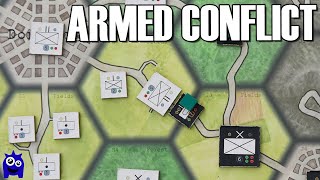
Armed Conflict utilizes oversized hexagonal grid spaces (approximately 2.5 inches across) that fundamentally shape how the game plays. These large hexes function almost as mini-regions rather than simple movement squares, creating a unique spatial dynamic where multiple units can occupy a single hex without stacking limitations. The hexagon grid eliminates the awkwardness of diagonal movement found in square-based systems and provides a more natural distance approximation. Reviewers emphasize that the scale of these hexes contributes to the game's distinctive feel, making tactical positioning and encirclement opportunities a central strategic concern.
Combat: Dice
Combat resolution in Armed Conflict relies on a dice-based system where attacks succeed by rolling above a defending unit's armor value. Attackers roll red 12-sided dice or green 10-sided dice depending on their unit type and attack method (direct ground assault or indirect fire). Each hit reduces a unit by one step; brigades degrade to battalions, battalions to companies. This cascading degradation creates a realistic attrition system where damaged units remain on the board in reduced form. The elegance of the system lies in its simplicity: each attack requires a single success roll, yet the mechanics spawn diverse tactical decisions about which units to target and whether to risk continued assaults.
The Armed Conflict Experience
Tactical Encirclement and Breakthrough
Armed Conflict generates an intense feeling of maneuvering for advantage along contested fronts. The threat of encirclement is permanent and devastating: surrounded units are immediately eliminated without requiring combat resolution. This mechanic encourages players to maintain defensive buffers behind their front lines and constantly probe for gaps through which armor can exploit breakthroughs. Reviewers describe memorable moments of pushing units deep behind enemy lines or desperately racing to seal a developing gap before an opponent's armor pours through. The psychological pressure of encirclement threat shapes every turn's decision-making.
Elegant Simplicity Enabling Depth
What surprises many players is how much tactical complexity emerges from a modest rule set. Reviewers note that a modest allocation of resource cubes per turn, combined with restrictions on simultaneous movement and attack by the same unit, creates a constant stream of interesting trade-off decisions. Players must continuously weigh whether to move units into position or commit resources to immediate action. The game's rule set is intentionally lean, yet the interactions between resource allocation, terrain, unit composition, and alliance dynamics generate surprising new tactical pathways with each game. This combination of accessibility and depth gives Armed Conflict the feel of a game that rewards both newcomers and experienced wargamers.
What Makes Armed Conflict Stand Out
Fresh Mechanical Innovation
Armed Conflict's resource cube allocation system and the marriage of logistics with tactical combat represent a departure from conventional wargame design. Rather than movement point pools or zone-of-control mechanics, the game uses cubes placed each turn to designate which units move, attack, or both. This creates a resource scarcity that forces meaningful decisions: every resource spent on one unit forecloses options elsewhere. Reviewers consistently highlight the freshness of this approach, noting they have not seen these particular mechanics resolved in quite this way before. The movement system, which permits unlimited motion along roads but restricts cross-country movement based on unit type and terrain, adds another layer of tactical consideration that feels both intuitive and strategically significant.
Dynamic Alliance Formation
The game's alliance system creates political tension that evolves during play. Rather than assigning sides at the start, alliances form organically as players attack one another. The first attack declares intentions and assigns alliances; subsequent players choose which side to join. In multiplayer games, this generates genuine uncertainty about friend and foe until deep into the first round. Reviewers describe this as a creative element that adds narrative texture to each game, making alliances feel strategic rather than predetermined. Different alliance configurations lead to dramatically different battle configurations and team dynamics, encouraging replays to experience new political scenarios.
Potential Drawbacks
Prototype Status and Production Refinement
Early reviews acknowledge that the prototype components reviewed are not representative of final production quality. The designer noted that counterproduction will be refined before release, and final maps will include two boards (the prototype has one). While the gameplay itself remains elegant regardless of component quality, reviewers temper their observations by noting that final production values may enhance or adjust the experience. Some potential concerns about long-term replayability with limited maps and expansions were raised, though reviewers expressed confidence that the core system is solid enough to support future expansions.
Gameplay Variability with Player Count
Reviewers discovered that the feel of Armed Conflict shifts significantly depending on player count and how alliances align. In one four-player game where the two alliances faced off across a narrow map edge, gameplay morphed into something resembling First World War trench warfare, with congested lines and artillery-dominated combat. With different player counts or map configurations, the experience can feel quite different. This variability is not necessarily negative, but reviewers noted it creates uncertainty about how the game will play out before alliances form, and some gaming groups may find certain alliance configurations less engaging than others.
If You Enjoy Armed Conflict
Players who love Armed Conflict should explore Tactics 2 and Blitzkrieg, the classic Avalon Hill games that inspired it thematically. Both systems share the same fictional warfare setting and symmetrical force composition approach, though Armed Conflict's mechanics are substantially more streamlined and modern. For those seeking other accessible wargames with innovative movement and combat systems, Blitz Creek offers similar modernization of classic design sensibilities. Armed Conflict feels positioned as a spiritual successor to those 1970s classics, updated with contemporary game design philosophy and production standards.
What Reviewers Are Saying
"Elegant is a word that comes to mind. The combat system, the movement system, the way the units rebuild, everything feels incredibly well thought out, and it's a very simple, elegant system that I've not seen done in a game before. This feels not only elegant in terms of just a very limited and simple rule set to create a very dynamic combat environment, but it's also very creative and fresh."
— Zilla Blitz
"The game looks fine. It looks okay. It's got a good map. It's got good counters, everything like that. I just wasn't expecting the gameplay to be so innovative and clever and fresh. It really just exceeded my expectations."
— Zilla Blitz
"The game rules are very fresh and innovative. Movement, combat, everything's like, 'Oh, that's clever.' And it has one of these games where I feel like the gameplay, because it's a modest rule set with a high leverage, so they use a minimum amount of rules to create a lot of different interesting decisions."
— Zilla Blitz