








Relicblade Deep Dive
What the Community Thinks About Relicblade
Relicblade stands out in the crowded miniatures landscape as a testament to what solo designer passion can create. Reviewers consistently highlight the game's accessibility paired with surprising depth, positioning it as an entry point for players curious about tactical skirmish gaming but hesitant about the complexity of larger systems. The game earns particular praise for its clever design, high-quality production, and the sheer scope of work one person has invested into crafting every element, from miniature sculpts to rulebook layout to campaign scenarios.
What makes Relicblade memorable is not just that it works, but that it works exceptionally well at doing exactly what it sets out to do: deliver fast, engaging tactical combat without unnecessary overhead. Players describe the experience as approachable yet tactical, simple yet varied, and above all, a lot of fun.
Core Mechanics That Define Relicblade
Grid Movement
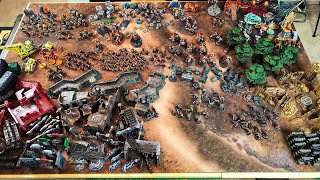
Relicblade uses grid-based movement, allowing players to move heroes and soldiers across a board marked with regular squares. This system keeps distance calculations straightforward and threat ranges intuitive, shifting design tension away from measurement minutiae and into tactical decision-making. Players can combine the grid system with modular terrain pieces and custom playmats, creating visually rich battlefields that remain mechanically clear. The grid squares on terrain mats provide enough precision for play, though reviewers note that achieving perfect alignment is less critical than getting the game to the table and started.
Combat: Dice
Combat in Relicblade centers on rolling dice to resolve attacks and defenses, with the dice themselves serving dual duty: they determine both damage and movement for the turn. Players chuck dice and allocate the results to move their units and power their attacks, creating a cascade of tactical choices from a single roll. This mechanic delivers the cinematic unpredictability miniature skirmish players crave: a well-planned assault can falter on bad luck, and underdogs can steal wins through fortune, while keeping turn resolution brisk and engaging.
The Relicblade Experience
Fast and Approachable
Reviewers consistently describe Relicblade as a "beer and pretzel skirmish game," emphasizing speed and accessibility. Games move quickly: the full ruleset is lean enough that new players grasp the core loop in minutes, yet the depth of choice in each turn keeps experienced players engaged. The game works on a 3-foot-by-3-foot table, making it feasible for players without dedicated gaming space. Scenarios from the campaign book guide play and add narrative arc, though reviewers suggest that later scenarios offer a richer experience than the introductory skirmishes.
Surprising Depth
Despite being straightforward to learn, Relicblade rewards repeated play and careful positioning. Each scenario introduces new challenges and terrain configurations, and the variety in hero and soldier abilities ensures that no two games feel identical. Players report genuine excitement about exploring the campaign system and playing through multiple scenarios, indicating that the simplicity of the rules does not translate to shallow gameplay. The system manages to be tactically engaging while remaining quick enough to finish a scenario in under an hour.
What Makes Relicblade Stand Out
Solo-Creator Craftsmanship
Sean Sutter of Metal King Studios is the driving force behind Relicblade, sculpting the miniatures, creating the artwork, designing the entire ruleset, laying out the book, and managing production. What is remarkable is not just that one person does all this work, but that the quality never wavers across disciplines. Reviewers marvel at the polish of every element: the care evident in sculpts, the clarity of the rulebook, the coherent vision threading through component design and game mechanics. This singular creative voice results in a game that feels unified and intentional in ways that larger-company products sometimes struggle to achieve. The game has recently expanded to include plastic miniature options alongside the metal casting, suggesting the creative momentum behind Relicblade is accelerating.
High-Quality Metal Miniatures
Relicblade's miniatures are cast in metal, a medium often dismissed as difficult to assemble and paint. Yet reviewers praise them as "really nice metal miniatures," noting that most models come in just one or two pieces, streamlining assembly and avoiding the frustration common in busier kits. The sculpts are clean and characterful, capturing fantasy skirmish aesthetics with personality. Combined with modular terrain pieces that complement the game's grid system, Relicblade offers a complete visual package that plays well with custom playmats and terrain collections. The compatibility between the game and third-party terrain solutions extends the table possibilities for veteran skirmish players.
Potential Drawbacks
Grid Precision on Custom Terrain
Players using Relicblade with custom terrain mats and printed grid squares report that achieving pixel-perfect alignment between the game grid and the visual squares on the mat is challenging. Reviewers note that while the squares are "perfect enough" for play, the mismatch can occasionally create visual friction: a piece positioned in what appears to be one square may actually occupy another according to measurement. This is a minor usability issue that does not break the game but does require players to accept some slop between aesthetic expectation and mechanical reality. It is a trade-off inherent to overlaying grid rules onto organic terrain design.
Anime Aesthetic and Niche Appeal
Relicblade's visual design leans toward fantasy heroism with stylized proportions and bright character art that may not resonate with all players. Reviewers seeking grimdark or realistic military aesthetics in their miniatures skirmish games may find Relicblade's aesthetic off-putting or too whimsical for their preferred tone. The game's thematic orientation is not for everyone; players drawn to moody gothic fantasy or historical recreation may look elsewhere. This is not a flaw so much as a reminder that games with strong aesthetic vision will appeal deeply to some and leave others unmoved.
If You Enjoy Relicblade
Relicblade shares DNA with other swift, elegant miniatures games. Players seeking similar experiences might explore X-Wing, which pairs accessible mechanics with high-quality components and clear, engaging gameplay. Both games prioritize speed and decision-density over rulebook depth, allowing players to focus on tactical positioning rather than cross-referencing charts. More broadly, players who love Relicblade typically gravitate toward tactical miniature skirmish games that favor rapid play and narrative campaign progression over competitive balance spreadsheets. The genre offers many options, but Relicblade remains a standout for its accessibility and the unity of vision behind every component.
What Reviewers Are Saying
"it's one of my top favorite skirmish games ever regardless of whether it was indie or not. And that's why I really wanted to highlight here cuz I think it's an actually excellent game, excellent system."
— Drive Thru Games
"Relic blade is this Skirmish game I call it a beer and pretzel Skirmish it's very quick very fast I really like the dice combat of it"
— Hungry Gamer
"I know that he sculpts them does all the illustrations pretty sure he does the book layout obviously designs the game"
— Tabletop Minions