



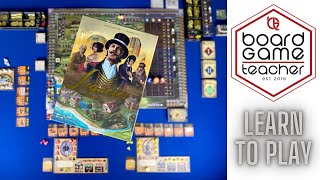


Legacies Deep Dive
What the Community Thinks About Legacies
Legacies attracts admiration for its conceptual boldness and mechanical intricacy, but honest assessments from reviewers reveal a game that divides players over whether its complexity delivers proportional engagement. Board Gaming Ramblings, a channel known for thoughtful curation decisions, ultimately culled Legacies from their collection despite acknowledging its interesting design, concluding that it demanded more cognitive overhead than the gameplay justified. This is not a game reviewers dismiss casually; rather, it is one they respect but cannot commit to playing when other designs scratch similar itches more efficiently.
Core Mechanics That Define Legacies
Multi-Use Card Actions
At the heart of Legacies is a system of versatile player cards that define strategic options each turn. A single card can be used for building relationships with historical figures, making investments in industries, pursuing opportunities, exploring cities, collecting resources, or acquiring heirlooms. This flexibility reflects how Brookspun Games wanted players to feel the weight of meaningful choices: every card is a decision point where context and future plans collide. The card-based action economy forces prioritization and creates natural tension between competing objectives.
Character Relationships with Generational Decay
Legacies structures character interactions as relationship tokens that occupy specific tracks on the board. When a player plays a card depicting a character, they place a relationship token on that character's track and collect the benefit tied to their position. The mechanical innovation lies in what happens between turns: each generation, all relationship tokens advance along their tracks, and tokens that fall off the end return to their owners. This means relationships naturally weaken over time, forcing players to reinvest in characters or let bonds cool. The system creates a recurring puzzle where managing relationship momentum becomes as important as forming new connections.
The Legacies Experience
Intellectually Demanding and High Friction
Playing Legacies means tracking multiple interlocking subsystems simultaneously: a hand of cards, available actions, character relationship states, industry investment positions, and an evolving board state across six generations. Board Gaming Ramblings captured this friction directly, saying that Legacies was too much work for the fun it delivered, acknowledging the game's conceptual coolness while admitting the rules density and fiddliness created overhead that outweighed the payoff. This is not a casual complaint; it reflects a real gap between the game's ambition and the actual play experience.
Convoluted Decision Points Without Natural Flow
The system's intricacy sometimes works against itself. Board Gaming Ramblings described the game as a little convoluted, suggesting that while each mechanic makes sense in isolation, their interaction creates unnecessary friction. Players find themselves repeatedly working out what a given card can actually do for them, managing small interactions rather than executing fluid turns. The heavy euro experience some players seek becomes laborious rather than absorbing.
What Makes Legacies Stand Out
Genuine Thematic Resonance with Legacy Building
The decision to structure the game around successive generations is not mere thematic window dressing; it drives mechanical meaning. Choices in early rounds ripple forward, heirlooms accumulate across a dynasty, and the generational structure enforces the sense of literally building a legacy across time. This is bolder than most economic games attempt, and reviewers respect the ambition, even when the execution does not land for them personally.
Rich, Multi Layered Card Economy
The card system's versatility is a genuine achievement. Rather than locking cards into single functions, Legacies asks players to recontextualize the same tool for different purposes depending on the situation. This creates potential for clever sequencing and reward optimization, appealing to players who enjoy extracting efficiency from constrained options. The system rewards mastery, even if that mastery requires significant rules investment.
Potential Drawbacks
High Cognitive Load Without Proportional Enjoyment
Board Gaming Ramblings' primary criticism was direct and honest: the mental effort required to track and optimize across Legacies' interconnected systems does not consistently deliver satisfying gameplay moments. The game works as designed, but the work-to-reward ratio tilts unfavorably for many experienced players. With limited table time, choosing Legacies means sacrificing plays of games that deliver similar strategic depth with less friction.
Rules Density That Discourages Repeated Plays
The "convoluted" descriptor reflects not just complexity but accessibility. Each new player must internalize a significant ruleset, and even taught games involve frequent reference checks. Board Gaming Ramblings noted they did not see themselves reaching for Legacies again; the return-to-play hurdle is simply too high. For a game about generational legacy, the irony is sharp: players do not feel compelled to let it build a legacy in their own collections.
If You Enjoy Legacies
Legacies appeals to a specific player profile: those who savor heavy economic engines, appreciate multi-generational campaign structures, and have the patience to optimize across intersecting systems. Players drawn to Brass, for its investment depth and cascading economic effects, Food Chain Magnate, for its generational scope and personal empire-building, or Kanban, for its relentless system optimization, may find Legacies' blend of relationship building and generational progression worthwhile, provided they accept the rules overhead as part of the experience rather than a flaw.
What Reviewers Are Saying
"It's Legacies. I really like Legacies, but it is in the same category where I also because you didn't like it as much. Nope."
— Board Gaming Ramblings
"I don't know who will I play it with. And when I get the chance, like if Martin is coming over during the day to play something, I'm not going to choose this. I'm going to choose classics that he hasn't gotten to play like are that are some of my favorite games."
— Board Gaming Ramblings
"Legacies was for me too much work for the fun I had. It is a little convoluted. It's it's a it's a cool game, but it's not my kind of game."
— Board Gaming Ramblings