






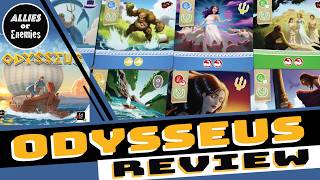

Odysseus Deep Dive
What the Community Thinks About Odysseus
Odysseus is a one to five player tableau builder from Gigamic, designed by Johannes Goupy and Matthew Verdier, that follows the famous voyage of Ulysses. The reviewers agree on its core identity: it is a quick, light game with enough decisions to keep a table engaged. The Allies or Enemies channel describes it as a super quick and light game that suits fans of tableau building and of the Odyssey alike. The Carfrey couple, who first noticed it in a UKGE preview and later played it at Essen Spiel 2026, named it the top game they played at the show.
Agreement is strong on pace and surprise. Carfrey expected something heavier than the box suggested and was impressed that a five player game ran about 25 minutes. Allies or Enemies made a similar point from a two player perspective, saying the rules can be taught in a couple of minutes. The one area of softer praise concerns theme. Allies or Enemies were candid that the Odyssey connection is light, though they noted that the cards show the trials Ulysses faces and that they appreciated the tie-ins as fans of the book. Carfrey's enthusiasm came more from the game's play than from its story.
Core Mechanics That Define Odysseus
Drafting From the Boat
The central mechanic is a card draft from a shared boat. According to Allies or Enemies, a turn begins by taking one card from the outside edge of either side of the boat, moving your cube along any tracks the card indicates, collecting any tokens it provides, and then placing the card in its matching spot on your double-layered player board. The boat refills once it is empty, and the cycle repeats until the second emptying ends the scoring. The reviewers treat the draft as the game's main lever. Whatever you take determines what your opponents can choose from, and the upside-down cards near the middle of the boat award an owl to whoever claims them, which makes the final draws especially contested.
Set Collection for Gold and Epic Tiles
The second core system is set collection, which feeds the scoring. Allies or Enemies explain that players gain gold tiles by spending owls or by completing sets of colored cards, and they gain epic tiles by completing sets of symbols. Those tiles, along with cards sitting on tracks where the cube has met the difficulty level, make up the final score. The reviewers describe the central puzzle as balancing three things at once: advancing tracks, placing cards onto the tracks you have advanced, and collecting the highest value tiles. Carfrey echoed the appeal of this layered decision making, pointing to combos that can happen during play.
The Odysseus Experience
A Quick, Light Puzzle
Playing Odysseus feels like a brisk turn-by-turn puzzle rather than a long voyage. Each turn is intentionally simple, which is why the reviewers emphasize how easily newcomers can learn it. The pace stays steady from start to finish, and Carfrey noted that the game's brevity held up even at five players. The feel is closer to a filler with a little more thought packed in, and the reviewers consistently framed the appeal as the satisfaction of solving that small puzzle in a short sitting.
Reading the Table Around the Boat
The second feeling is the tension around the shared boat. Because every player draws from the same supply, each choice affects what remains for the others, so attention never fully drifts away from the table. Allies or Enemies singled out the closing cards in the boat as the moment where stakes rise, since the owl attached to them can buy scoring tiles. The reviewers also suggested that the feel may change with player count. Allies or Enemies expected the boat to refill more often at higher counts and wondered whether drafting might become more directly aimed at opponents, even though their own games were at two players.
What Makes Odysseus Stand Out
Components and Player Boards
Allies or Enemies praised the production in direct terms. The cards look nice and are clear, and the player boards are double-layered with a place for everything. The rulebook also includes a short Cole's Notes style summary of the Odyssey on its back, which the reviewers found fun and useful. Athena's owls and the central boat were singled out as thoughtful touches that give the table a clear focal point, even though the theme is not woven deeply into the rules.
Teachability and Scaling
The reviewers highlight how quickly a table can learn and play Odysseus. Allies or Enemies argued that new players should be able to pick it up easily, and they expected player count to change the game mainly through the number of boat refills rather than through a major shift in rules. Carfrey's five player session ran about 25 minutes, which they described as really impressive, and they reported that the game still offered good strategic decisions and combo opportunities at that count.
Potential Drawbacks
A Light Touch on Theme
Allies or Enemies were direct that the theme is not deeply integrated into the mechanics. While the trials on the cards, the boat as a focal point, and Athena's owls all nod to the story, the reviewers said the theme isn't intrinsic to the game. Players who want a narrative in which the journey shapes every decision may find the tie-ins thin. The reviewers were clear, however, that this is a matter of expectation rather than a flaw for players who simply want a light tableau builder.
Modest Interaction and Strategy Depth
Allies or Enemies said there are only a few opportunities for strategy, with the draft choice standing out as the biggest. They played only at two players and did not expect player count to have a large effect beyond the boat refills. Readers who want heavy head-to-head interaction or a deep strategic puzzle may find Odysseus leaning toward parallel optimization. Carfrey's enthusiasm at five players suggests the combos and drafting choices still generate interest, but the reviewers are not presenting it as a confrontational game.
If You Enjoy Odysseus
The only comparison game raised in these videos is Acropolis. Carfrey noticed that the Odysseus cover looks a lot like Acropolis, and that visual resemblance was part of what drew their attention. The reviewers did not make a mechanical comparison between the two titles, so readers should expect differences in theme and scoring. Players who enjoy the box art, components, and quick tableau-style board play that the reviewers praise in Odysseus may still find Acropolis a natural next step to explore, particularly since Carfrey expressed confidence in Gigamic's track record with games of this kind.
What Reviewers Are Saying
"There are a few opportunities for strategy, however, the biggest one being which cards you take from the boat, as whatever you take will dictate what is available for your opponents. Which is even more important when you get close to those upside-down cards in the middle, because whoever gets those will also get an owl, which can buy those scoring tiles."
— Allies or Enemies
"I played Odysseus which was also quick and snappy. And it was like I thought it was going to be heavier, but it's actually only like a 25-minute game at like five players which is really impressive. But there's some good strategic decisions and like comboing that can happen in the game which was a lot of fun."
— Carfrey
"I feel like Gigamic usually does really good games with these types of games. So I'm excited. I want to see it. I want to demo it and tell you more about it."
— Carfrey