





Super Team Deep Dive
What the Community Thinks About Super Team
Super Team has generated genuine enthusiasm among reviewers, who consistently highlight its deceptive depth and refined execution. The game appeals particularly to players accustomed to wargaming, tactical board games, and abstract strategy. Zilla Blitz, who published multiple videos on the game, emerges as the primary community voice, praising both its mechanical elegance and narrative appeal. Reviewers describe a game that initially appears straightforward but rewards careful planning and tactical thinking in equal measure.
Core Mechanics That Define Super Team
Card-Driven Actions with Tactical Positioning
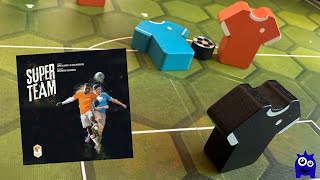
At its heart, Super Team uses a card-driven system where players draw four cards into hand each turn and may play one to three of them to accomplish football actions. Designed by Amir Salamati and Ali Za Porasad and published by Roomiz Games, the game allows cards to be played in two modes: either as basic actions (moving a player, passing, shooting, dribbling, or tackling) or as advanced tactical combinations when specific positional or board state conditions are met. The breakthrough moment comes when reviewers realize that the real engine of the game is not the individual card plays but the orchestration of plays across a turn. Setting up a through-pass followed by a forward movement followed by a shot becomes not a random sequence but a carefully choreographed dance. When an advanced tactic succeeds, it unlocks bonus actions: moving additional players and earning morale tokens. This creates a powerful incentive to build combinations rather than solve problems in isolation. The hex-based pitch gives movement concrete spatial meaning, making every square count.
Morale and Fatigue Resource Management
Super Team models the physical and psychological toll of a 90-minute match through two interrelated systems. When teams execute advanced tactics successfully, they gain morale tokens, which function as a currency: spending morale tokens adds bonuses to subsequent skill rolls, re-activates exhausted players, or activates coach cards. However, executing advanced tactics also carries a cost: a fatigue card enters your hand. Fatigue cards are severely limiting. They only permit basic moves for a single player and no advanced tactics. The tension between wanting to execute powerful tactical maneuvers and accepting fatigue as a consequence becomes the pulse of the game. Reviewers describe this as elegant: it forces coaches to budget their ambition against the clock. Playing aggressively early may give you a morale advantage and board control, but by the second half your exhausted players become liabilities. It feels like real football, where fatigue-related mistakes happen in the 70th minute.
The Super Team Experience
Reviewers consistently describe Super Team as a chess match played out on a football pitch. One Brains on Games reviewer notes that turns are "tense and dramatic, hanging on the edge of each die roll." The game rewards planning and forethought: you are constantly asking where your players need to be three moves from now, whether your captain can slip through a gap, and whether the risk of committing to an advanced tactic is worth the morale payoff. The other dominant feeling is the satisfaction of a well-executed combination. Zilla Blitz describes the moment when a chain of plays comes together perfectly, with a perfectly-timed captain card enabling a goal-scoring opportunity that would not have existed without the preceding setup. The reviewer notes this felt "clever," repeated five times in succession. There is a wargaming sensibility to it all: hex movement, card-driven play, the hidden selection of where a goalkeeper commits to defend a shot. Yet it is unmistakably about football. The artwork reinforces this (watercolor soccer players, sideline clipboards), and reviewers note that the game captures something true about football tactics: you are managing space, timing, and momentum, not just rolling dice.
What Makes Super Team Stand Out
Refined Mechanical Balance
Reviewers praise the overall design maturity of Super Team. Zilla Blitz describes it as a game that "has had a ton of thought put into it to create both a believable football game as well as an elegant, streamlined gameplay." Despite a 26-page rulebook, the rules are consistently called "crystal clear" and "straightforward," indicating that complexity is present but well-organized. The game teaches in stages: basic movement and passing are simple; advanced tactics and captain abilities add depth without creating a new ruleset. The optional rules (injury time, extra time, offside, injury rules) mean players can calibrate the experience to their appetite for realism. The balance between chance (die rolls) and player agency (card selection, positioning, morale management) is tight enough that losing feels like you made a real mistake, not that the dice betrayed you. A game can be learned and played smoothly in a single sitting, but mastery requires understanding card synergies, optimal captain placement, and second-order effects of fatigue timing.
Asymmetry Through Teams and Captains
Super Team ships with six clubs, each with unique advanced tactics, and six unique captains, each with special abilities. This creates meaningful asymmetry without overwhelming new players. A captain's ability might let you shoot and ignore an interfering defender, or swap places with an opponent to bypass a defensive line. These are not game-changers; they are tools that make sense in context. A player familiar with the basic game can immediately understand what a captain card does because it is a skill move with a bonus, not a wholly new action. The combinations of club, captain, and coaching tactics (the cubes you distribute at the start of each half to emphasize passing, shooting, keeping, etc.) yield "endless combinations" and "fairly unique feel" to each match according to reviewers. This combats the potential staleness of a two-player game, because even if you are playing the same opponent repeatedly, you will experience different teams.
Potential Drawbacks
Iconography Learning Curve and Visual Clarity
Brains on Games reviewer notes that while the card artwork (modeled after coach playbooks) is thematic and charming, "the iconography was a little bit tough for some of the players that I played with to kind of wrap their head around." The icons representing skill types (pass, shoot, dribble, tackle, move) are not immediately self-evident and require reference to the rulebook during early plays. The prototype nature of many reviewer copies may mean final production improves this, but first-time players should expect a ten- to fifteen-minute readjustment period where someone keeps asking "what does that symbol mean again?" This is not a deal-breaker, but it is a speed bump in an otherwise smooth teach.
Low-Scoring Can Feel Grinding
Because every shot is contested and players must be carefully positioned to have a reasonable chance of scoring, matches are low-scoring. A 1-0 or 2-1 final scoreline is a tense, hard-fought result rather than a foregone conclusion. Brains on Games notes this may be "a downside for some players" who expect frequent goal-scoring drama. The game is deliberately not an action-packed arcade experience; it is a tactical exercise. If you want constant back-and-forth scoring and a high-flying scoreboard, this is not your game. If you want the feeling of a tightly-contested football match decided by a single clever play or an opponent's mistake, Super Team delivers.
If You Enjoy Super Team
Super Team occupies a unique intersection between traditional wargaming and sports board games. Fans of hex-based tactical games (from Tactics 2 to modern wargame systems) will recognize the familiar spatial reasoning and action economy. Reviewers who play Football Manager (the PC soccer management simulation) will appreciate the strategic depth and the emphasis on team composition and tactical setup. The game shares DNA with design-heavy abstract games like Chess and Go in that matches are decided by positioning and foresight rather than dice luck alone. Players who enjoy card-driven wargames, particularly those that emphasize combos and card synergies, will find much to explore. The solo and cooperative modes expand its reach beyond competitive head-to-head play. And for fans of sports simulations who tire of actual football watching, Super Team offers a distilled, tactically-pure version of the sport.
What Reviewers Are Saying
"This feels to me like a game that's had a lot of thought put into it, both with how many players are on the pitch. The plays and what you're trying to do and the thinking and passing the ball back make sense with the way you're building up morale tokens."
— Zilla Blitz
"There is a very, I think, a chess-like feel to things that I think will really please gamers who like to think in their games. Having said all that, the rules don't feel burdensome either. I'll give the game a 2 and a half out of 10 on the complexity scale. I think once you play a game or two, things are going to start to go very smoothly."
— Zilla Blitz
"It's thematic, intense, and it's like a chess match where you're trying to position everything just so so that you're more likely to score that goal or be able to recover if you fail to make that die roll."
— Dr. Brian McDonald, Brains On Games