




Feelin' Cute Deep Dive
What the Community Thinks About Feelin' Cute
Reviewers agree that Feelin' Cute is easy to bring to a mixed table. Grant Lyon in particular points to its reach beyond regular gamers, saying it works with people who claim they do not like games or find them too complicated. The appeal Lyon describes rests on the debate the game creates rather than on rules depth or strategy.
The Board Game Garden approaches it from a different angle. Jenna received a promotional copy in a Canada Plays goodie bag, praised the cards for their cute animals, and admitted they did not really know what to do with it after looking it over. Their reaction is mostly about presentation and the title, so the detailed case for the game comes from Lyon.
kovray showed a copy in a convention goodie bag while unboxing, but neither reviewer played it or offered an assessment on camera. The favorable verdict therefore rests mainly on Grant Lyon's in-depth review, with the other two videos providing first impressions and a sense of the theme.
Core Mechanics That Define Feelin' Cute
Relative Cuteness Ranking
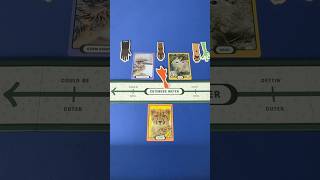
The central loop asks the table to place animals on a scale of cuteness. According to Grant Lyon, the active player reveals one image card and decides whether it is more or less cute than the images already shown. Everyone else guesses where that card belongs by putting their paw down. When the active player reveals where they had placed it, a match earns a point. The Board Game Garden describes the cards as lined up in a row, which matches this structure: each new card is judged against the ones already on the table.
Blob Fish Tokens and the Game End
Missed guesses carry a cost. If nobody matches the active player, the group flips a blob fish token, and the game ends once three of those tokens have been flipped. Lyon's summary makes clear that mistakes, rather than a fixed number of rounds, determine how long a session runs. That gives the ranking loop a built-in clock that keeps the table moving without a separate timer.
The Feelin' Cute Experience
Playful Disagreement
Grant Lyon's video is loud with reaction, and the disagreement is the point. Lyon describes the moment someone ranks a wolf above a sea turtle and the rest of the group pushes back, calling the resulting arguments the most fun aspect of the game. On camera the reviewers shout when a placement lands and laugh when their rankings scatter in different directions. The feeling is closer to friendly sparring over taste than to a quiet guessing game.
Rising Pressure
The difficulty climbs as a session goes on. Lyon notes that as more images enter play, it becomes harder and harder to guess where a new card ranks. Early rounds feel light, while later rounds bring real tension as each new card has to fit into a line that is already crowded with comparisons.
What Makes Feelin' Cute Stand Out
Approachable for Non-Gamers
Lyon presents the game as a way to bring people into the hobby. Each turn involves one card and one paw placement, so the rules stay short enough that players who would normally pass on a board game can take part right away. That low barrier is why the review focuses on group play rather than on strategy.
Adorable Theme and Components
Both reviewers return to how the game looks. Lyon reacts to the cards with "It's super adorable, man," while the Board Game Garden praises the animal art and calls the title a really cute name for a game. The theme is central to the experience rather than a layer added on top of the rules, since the animals are what players are judging.
Potential Drawbacks
Difficulty Can Outpace Some Groups
Lyon frames the growing challenge as part of the fun, but it has a flip side. As images accumulate, the guesses depend more on intuition than on reasoning from earlier rounds. Groups that prefer a clear sense of control may find the later rounds frustrating, even though the reviewer treats the rising difficulty as a source of tension.
Thin Coverage of the Game in Practice
Jenna's first impression was that they did not know what the game asked players to do, and kovray did not play it during their convention trip. Outside Lyon's detailed review, the reviewers saw the game briefly or only as a promotional copy, so the picture of how it plays across a full session is less complete than the praise suggests.
If You Enjoy Feelin' Cute
None of the reviewers named a direct comparison title for Feelin' Cute, so no close match can be credited to them. The closest connection in the transcripts is social rather than mechanical. Jenna described Pick Your Poison as a would-you-rather party game where players answer anonymously, and said they could get down with it. Players who enjoy Feelin' Cute's group disagreement over subjective judgments may find a similar kick in Pick Your Poison, although no reviewer drew that connection directly.
What Reviewers Are Saying
"Feeling cute is the type of game you can play with people who say things like, 'Well, I don't really like games.' Or people who say like, 'Games are too complicated.' Not this one."
— Grant Lyon
"The most fun aspect of this game is the arguments it creates when you disagree with someone else's cuteness ranking."
— Grant Lyon
"It looks really cute. It just has a bunch of really cute animals on the cards and they're like in a line. I don't really know what you have to do with it, but feeling cute, I think, is a really cute name for a game."
— Jenna, The Board Game Garden