



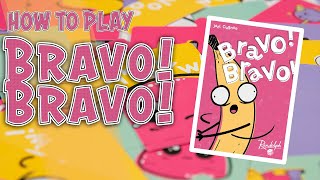
Bravo! Bravo! Deep Dive
What the Community Thinks About Bravo! Bravo!
Bravo! Bravo! is a short party game published by Randolph in which the whole table speaks and acts as one voice. Only two reviews are available, and they approach the game from different directions. The kovray channel, run by a couple that loves to play board games, presents a complete how-to-play walkthrough. Ryan and Bethany Board Game Reviews features a young reviewer, Ela, who places the game at number ten on their list of favorite games and explains why their family enjoys it.
The two videos agree on the core appeal. Both treat the game as a group activity where the fun comes from everyone reacting together. Ela's verdict is direct: they like it because it is a good family game, and it makes their family laugh when they play together. The kovray walkthrough is more neutral, but it builds the entire rulebook around one idea, that the table must react at the same moment. Neither review raises serious complaints, so the community picture is consistently positive but still thin.
Core Mechanics That Define Bravo! Bravo!
Simultaneous Reaction Call and Response
The central system is a call and response loop. Cards are split between two face-up piles, and the active player flips a card onto one side of the deck, with turns alternating to the opposite pile. After each flip, every player must react at once: they say the sound and or perform the gesture for the newly flipped card, then do the same for the face-up card on the other side. Some characters are identified by a spoken word that needs a matching gesture, while others are identified by the character name alone. The kovray walkthrough, designed by Joel Gene and published by Randolph, stresses that this is the most important rule in the game.
The penalty structure makes the loop tense. A player who mumbles, gets the sound wrong, or reacts later than the others commits a fault, and must take a card from the points deck. Each card taken is worth one point, and the player with the fewest points or cards at the end wins. Because the penalty lands on individuals, the game rewards the table that stays in sync rather than the one that reacts fastest.
Team Mode
Kovray also documents a team variant. Two teams flip cards onto opposite sides of the deck, then draw cards one by one and add them to their own side. Each team must perform the words and actions for its entire side, and the first team to commit a fault loses the round. The first team to win two rounds wins the game. The variant shifts the goal from avoiding cards to surviving the longest with as many cards as possible, which changes how pressure is spread across the group.
The Bravo! Bravo! Experience
Shared Laughter
Ela describes the game as a family game that brings out laughter, and that is the feeling they return to most often. The experience is less about individual cleverness and more about watching everyone attempt the same action at the same time. Their description suggests a room full of people reacting, slipping, and laughing at one another, which is the atmosphere they associate with playing it together.
Pressure to Match Timing
The kovray walkthrough makes the other side of the experience clear. Every flipped card creates a small moment of pressure, because a single late reaction is enough to take a fault. Players are encouraged to avoid faults and to be the player holding the fewest cards when the deck runs out. That combination of quick reactions and light penalties gives the game a brisk, nervous rhythm that differs from the relaxed pace Ela describes.
What Makes Bravo! Bravo! Stand Out
A Setup Built From the Table
Kovray highlights that the deck is not fixed. Players sort the cards by character into face-up piles, then as a group choose three more character decks to play alongside the banana cards. The group also agrees on a sound and gesture table so that everyone knows what to say and do for every character in play before the first card is flipped. This shared setup means each table ends up with its own combination of characters.
Twists That Escalate the Game
Kovray notes that the winning player scratches off any twist card of their choice, and that the twist will make the game more difficult and absurd. The reviewer deliberately withholds the twists to avoid spoiling them. A separate confetti banana card adds another layer: when it is drawn, everyone does nothing, and the active player may change the sound or gesture for any character in the game. The change then carries into the next turn, unless someone changes it again.
Potential Drawbacks
Timing Errors Carry a Real Cost
Ela notes that if anyone says the word too late or says it wrong, they receive a penalty. For players who prefer a relaxed game, that cost can feel harsh when a single mistake takes a card while the rest of the table moves on. The rules are simple, but the game depends on everyone being ready at the same moment, so a slow or hesitant player can disrupt the flow for the whole group.
Difficulty Grows With the Twists
The twist cards are presented as the reward for winning, but they also raise the difficulty and the absurdity of the game. Kovray describes them as a way to make the game harder on purpose. Groups that want a stable, predictable experience may prefer to leave the twists out, and the walkthrough does not show how much difference they make in practice.
If You Enjoy Bravo! Bravo!
Players who enjoy Bravo! Bravo!'s shared family laughter will find a similar feeling in Love Letter, a card game that Ela says they play all the time with their dad. Its small, quick hands keep the whole table engaged, much as the flipping cards do here. Readers who want a larger game for a bigger family table may enjoy Ticket to Ride Legacy: Legends of the West, which Ela describes as a bigger version of Ticket to Ride that they like to play with their family. Both titles come from the same family-table context that reviewers associate with Bravo! Bravo!.
What Reviewers Are Saying
"This is the most important rule of the game. All players must altogether say the sound and or do the gesture of the newly flipped card followed by the face up card on the other side of the deck."
— kovray
"When a fault is taken the player takes a card from the deck of points one card equals one point."
— kovray
"I really like it cuz it's a good family game. It just makes my family laugh when we play together."
— Ela, Ryan and Bethany Board Game Reviews