




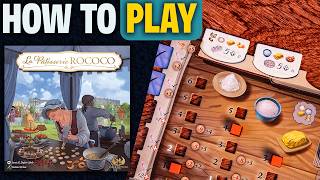
La Pâtisserie Rococo Deep Dive
What the Community Thinks About La Pâtisserie Rococo
Coverage of La Pâtisserie Rococo is limited, and the two available reviews come at it from different directions. The Card Board Crew channel, hosted by Ilya and Tyler, teaches the game from start to finish at the table. Their video is a full rules walkthrough, and it treats the game as a serious economic engine that rewards players who plan several turns ahead. Tantrum House takes a much lighter approach. Its video is a crowdfunding roundup that introduces the game alongside other titles arriving on Kickstarter and Game Found, and it frames La Pâtisserie Rococo as a more approachable product.
The two channels agree on the basic identity of the game. Both describe a pastry shop competition set at a Versailles garden festival, and both place it in the lineage of Eagle-Gryphon Games' earlier Rococo Deluxe. Tantrum House speaks most directly to that connection, telling viewers who enjoy the original that this new title is worth a look. Card Board Crew does not offer a verdict, so the community picture rests mostly on how the game is structured and on the decision points it creates.
Core Mechanics That Define La Pâtisserie Rococo
Staff Selection and the Staff Deck
The engine of the game is its staff system, which Card Board Crew explains in detail. Each round, players secretly choose four staff cards from their unused deck. When that deck runs dry, they take the remaining cards, flip the discard pile into a new deck, and keep selecting until they have four. Two more staff are then drafted from baking trays, where the starting player and the player to their right each deal cards and pass them in alternating directions. The result is a hand of five cards for the perform actions phase, and that hand determines what each player can do that round. Card Board Crew describes the sequence with care because the choices made in the staff phase limit everything that follows.
Staff come in two types, pastry chefs and assistants, and the split shapes every turn. Gold actions can only be performed by a pastry chef, silver actions only by an assistant, and blue actions by either. Card Board Crew emphasizes that the restrictions are firm but not absolute: a bonus action can override them, which means that a well-timed bonus can let a player do something their staff type would normally forbid.
Presentation Tables and Majority Scoring
The second mechanic that stands out is the presentation system. When a player presents a pastry instead of selling it, the pastry is placed on one of five presentation tables on the main board, and the player places an ownership marker on it. The prestige printed on the pastry is not scored immediately. Instead, each table awards points at the end of the game to the players with the most and second most pastries there, with ties broken by proximity to the table bonus tile. Card Board Crew presents this as the point where the game's economic and positional decisions meet, since a pastry can be sold for a quick return or held back for majority points later.
The La Pâtisserie Rococo Experience
A Compact, Structured Round Rhythm
Card Board Crew makes clear that the game follows a strict clock. The game lasts exactly four rounds, and every round moves through preparation, staff selection, actions, and income in the same order. Tantrum House reinforces the brisk pace by describing the game as a streamlined version of the original, built for an evening rather than a full afternoon. Players who enjoy a tidy loop of setup, planning, and resolution will find that the rhythm is consistent from the first round to the last.
Careful Planning Under Limited Hands
The feeling at the table, as Card Board Crew presents it, is one of constant choice under limits. Each player only ever has five staff cards in a round, and the action sequence runs until everyone has played their cards. Because the hand is small, every card matters, and the reminder to keep the reference sheet nearby suggests that the game asks players to hold a lot of icon meaning in mind while they make those choices. The experience is less about one dramatic turn and more about steady, deliberate planning.
What Makes La Pâtisserie Rococo Stand Out
A Streamlined Take on a Known Design
Tantrum House sees the most distinctive quality of La Pâtisserie Rococo in its relationship to Roco Deluxe. The channel describes the new game as using the deck building mechanisms of the original while streamlining the gameplay into a family-friendly session, and it positions the title for players who want the Rococo theme with less friction. That framing makes the game easy to recommend to viewers who already know the earlier release.
Staff Drafting That Creates Real Trade-Offs
The baking tray draft is the feature Card Board Crew describes most carefully. Players draft staff in a way that involves both picking and passing, so each choice shapes what the next player receives. Combined with the pastry chef and assistant restrictions, the draft ensures that a player's hand is never simply the best cards available to them, and that tension is central to how the game feels from one round to the next.
Potential Drawbacks
Dependence on the Reference Sheet
Card Board Crew repeatedly points viewers toward the reference sheet, noting that much of the iconography and many specific card abilities are explained there. For players who prefer to learn by reading the card in front of them, this can mean a heavier onboarding process. The walkthrough shows that the rules are coherent, but the reliance on icons and reference material is the part of the experience that new players will need to plan for.
Inconsistent Playtime Estimates
The two reviews do not agree on how long a session takes. Tantrum House lists a playing time of about 60 to 150 minutes and then describes the game as a familyfriendly 90 minutes. Card Board Crew also frames the game around a fixed four-round structure without making time a headline concern. Groups deciding whether the game fits their evening should expect the length to depend heavily on how quickly they handle the staff phase and the bonus actions.
If You Enjoy La Pâtisserie Rococo
Players who enjoy La Pâtisserie Rococo's deck building engine and its streamlined presentation of the Rococo theme will find the most natural next step in Roco Deluxe, the original design that Tantrum House names as the basis for this game. Tantrum House frames the connection as a direct one, so viewers who want to compare the two can start there. Because Card Board Crew and Tantrum House both place La Pâtisserie Rococo in that lineage, the older title is the clearest reference point available in the community coverage.
What Reviewers Are Saying
"Pastry chefs cannot normally acquire ingredients or buy goods, while assistants cannot normally decorate or hire staff. However, if a bonus action specifically lets you do something, that bonus action can override those normal restrictions."
— Ilya, Card Board Crew
"The game lasts exactly four rounds and each round has four phases: preparation, select staff, perform actions, and gain income."
— Card Board Crew
"If you are a fan of the original R Coco Deluxe you may want to check out this new game."
— Psychic Larry, Tantrum House