



Small Fjords Deep Dive
What the Community Thinks About Small Fjords
Small Fjords is a compact two-player edition of the modern classic Fjords by Franz-Benno Delonge, published by Grail Games. It adds solo rules and fits into a small box. The reviews available so far come from two channels. Board Game Sanctuary covers it in a list of two-player games, and the host, Danny, is enthusiastic. kovray takes a different approach: the channel is a couple teaching the rules on camera, so its video is instructional rather than a verdict.
The points of agreement are clear. Both sources treat the game as a short tile-laying puzzle with real decisions, and both accept the design as a faithful condensed version of the larger game. Board Game Sanctuary describes the rules as "deceptively simple to learn," and it says the decisions "really shine through multiple plays." The Board Game Sanctuary host also plays it in best-of-three rounds, where each complete game counts as one round. Because kovray's video is a teaching guide, the community view of Small Fjords is currently shaped more by Board Game Sanctuary's praise than by a balanced comparison of opinions.
Core Mechanics That Define Small Fjords
Tile Placement
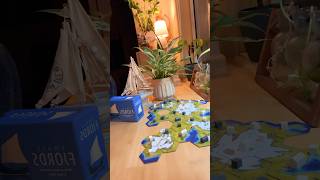
The game opens with an exploration phase in which players take turns adding landscape tiles to a shared play area. kovray explains that each new tile must touch at least two existing tiles and that its terrain must match the edges it meets. A tile also cannot create a second separate landmass. Danny compares the layout to Carcassonne, where each placement continues the landscape. The twist is that tiles are drawn from a face-down pile or taken from the face-up tiles, and a tile that cannot legally be placed is discarded and replaced. kovray notes that a player must place a tile every turn, so a player can end up discarding more than one tile in a single turn.
Area Control
The second phase is the settlement phase, where Vikings claim the plains. Players place Vikings on empty plains tiles that are adjacent to one of their long houses or Vikings, and every tile must connect back to the tiles already placed. Danny describes how this creates a contest for space: placing a Viking can block a dead end from the other player, and two players working in the same narrow corridors keep blocking each other. They draw a direct comparison to Blue Lagoon, where players spread out and try to gain majority, but they say Small Fjords "just does it in such a compact manner." When neither player can place a Viking, the turn is skipped, and the phase ends when both players have skipped. The player with the most Vikings wins, and kovray notes that a tie goes to the player who went second in the settlement phase.
The Small Fjords Experience
Tense Positional Jockeying
The feel of Small Fjords is closer to a tense chess-like contest than a relaxed tile game. Danny describes a "two and fro" rhythm as the fjord grows, with each placement reshaping what the opponent can reach. Every move carries a question about where to build next: where to put the next tile so it helps you and not your opponent, and whether a long house placed now will still matter once the map is complete. Danny finds that the tension stays high throughout, which they sum up by saying the game is "short, sharp and really straight to the point."
A Quick Puzzle With Lasting Depth
Both channels stress that the game plays fast. Board Game Sanctuary reports that a game takes about fifteen minutes, and kovray lists the setup and the phases as a quick sequence of steps. The depth shows up later. Board Game Sanctuary says the layers "really shine through multiple plays," which suggests that the satisfaction grows as players learn the timing of long houses and the shape of the settlement phase. For reviewers who enjoy a short game that rewards repeated play, this combination of speed and layered decisions is the main appeal.
What Makes Small Fjords Stand Out
The Long House Timing Decision
Reviewers return most often to the decision of when to place a long house. Each player has only four, and placing one on a freshly played tile is a commitment. Danny asks the central question directly: is the spot where the tile was just placed going to help the fjord grow, or is it better to wait until more of the map is visible? kovray confirms that once a long house is placed it cannot be moved or removed, and that any long house left unplaced at the end of the exploration phase is lost. This makes the timing decision feel consequential from the first turn.
A Full Game in a Small Box
Danny points out that the original Fjords looks like a simple game in a very large box, which is why it had never convinced them to buy it. They describe Small Fjords as the answer to that concern, saying the small edition fits "in this tiny box" and calling it a way of "condensing these big box games down into small packages." kovray explains that the solo variant keeps the same setup, with one tile allowed in reserve at a time and a Viking required around each long house.
Potential Drawbacks
Limited Availability So Far
The most practical concern is access. kovray says at the end of its video that the game is coming to crowdfunding, which means that most players cannot yet buy a copy in a shop. The coverage itself is also limited, with only a small number of reviews available, so the community's view of the game is still forming.
Depth That Arrives After Several Plays
Because the rules are simple, the game's strategic depth is something players discover over time. Board Game Sanctuary says the layers "really shine through multiple plays," which means a first game may feel more like a quick puzzle than a deep contest. Players who prefer an immediate, obvious strategy may need a few games before the long house timing and the blocking routes feel rewarding.
If You Enjoy Small Fjords
Players who enjoy the tile-placement structure of Small Fjords will find a familiar foundation in Carcassonne, which Danny references when they describe the landscape-building step. Players who enjoy Small Fjords's blocking and majority contest will find a similar satisfaction in Blue Lagoon, the game Danny says it resembles most closely in the way players spread out to gain majority. For players who want another compact two-player title that Danny recommends from their own collection, Small Fields is the game they say they love, and it sits in the same short, two-player space.
What Reviewers Are Saying
"While the rules in this game seem deceptively simple to learn, the layers and the decisions that you make really shine through multiple plays."
— Board Game Sanctuary
"And the twist here is do I put my long house out now or do I wait till I see more of the map before deploying my long house?"
— Danny, Board Game Sanctuary
"there can only ever be one tile present in the reserve so you must place that tile before having the option to set another tile aside."
— kovray