






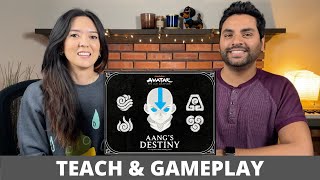
Avatar: The Last Airbender - Aang's Destiny Deep Dive
What the Community Thinks About Avatar: The Last Airbender - Aang's Destiny
Avatar: The Last Airbender - Aang's Destiny has emerged as a standout cooperative deck-building game that reviewers consistently praise for improving upon its predecessors. The Op's implementation manages to feel both polished and story-driven, a balance that doesn't always come easily to deck builders. Watch It Played provided the foundational rules overview, while Ryan and Bethany Board Game Reviews and Pair of Dice Paradise engaged in detailed analysis of how this game compares to other cooperative deck-builders. Before You Play and The Brothers Murph rounded out the coverage with practical playthroughs and collection commentary. Across all these sources, the consensus points to a game that honors its source material while delivering genuinely improved mechanics compared to Harry Potter: Hogwarts Battle, The Op's earlier system implementation.
The overarching theme in reviewer commentary centers on how well the game balances accessibility with depth. Rather than feeling like a dry mechanical exercise, Aang's Destiny integrates its story so thoroughly that progression through the seven boxes feels like chapters unfolding rather than arbitrary difficulty escalations. Reviewers who had previously invested in Hogwarts Battle were particularly struck by how this newer iteration learned from that experience, smoothing out rough edges and incorporating what felt like house rule fixes directly into the base design.
Core Mechanics That Define Avatar: The Last Airbender - Aang's Destiny
Cooperative Deck Building
The foundation of Aang's Destiny rests on deck building, where each player starts with an identical small deck of cards and gradually acquires new cards from a shared market to customize their personal deck. Players pitch cards from hand to generate resources called purpose and attack tokens, then use those tokens to complete objectives or defeat adversaries. Cards return to a discard pile that shuffles back into the deck, creating the cycling engine that makes deck-building work. The Op structured this so that meaningful choices emerge early and compound as players acquire better cards. What sets this apart from pure deck-building systems is that cards serve an immediate function during turn resolution, not just as future draws waiting to happen. Players are building an engine that directly impacts their ability to accomplish this turn's goals, which keeps momentum brisk and stakes visible.
Bending Abilities
The bending system transforms what could be a generic deck-building skeleton into something that feels intimately tied to Avatar lore. Each character begins with one or two bending affinities, air or water or fire or earth. Cards labeled as bending cards come in four types, one for each element. When a bending card is played, the player gains a benefit regardless of their type, but the full effect of the card unlocks only if they possess that element's token. Players can acquire allies that grant temporary access to new bending types, allowing water-only benders to temporarily manipulate earth, expanding their strategic palette as the game progresses through boxes. This mechanic accomplishes something elegant: it makes character choice matter without locking players into fixed roles, and it threads the game's fiction directly into its decision tree.
The Avatar: The Last Airbender - Aang's Destiny Experience
A Story That Unfolds Alongside Challenge
What struck reviewers most viscerally was how closely the game mirrors the show's narrative arc. Characters are introduced when they first appear in the timeline and removed from active play once their story concludes. Items gain availability only when the story calls for them. Objectives reflect the plot's progression. Rather than feeling like thematic window dressing, this integration means players experience the game's escalating difficulty as a natural consequence of how the story develops, not as arbitrary ramp-up. The game teaches deck-building mechanics gradually, starting with box one as a tutorial that introduces core concepts, then layering new rules in each subsequent box. Early players learn that turns follow a rhythm: reveal fire nation threats, resolve adversary abilities, play cards from hand for resources, assign resources to challenges, then acquire new cards. This structure remains consistent across all seven boxes, so the learning curve stays manageable even as the game adds new card types and special rules.
The Satisfaction of Incremental Progress and Mounting Difficulty
Multiple reviewers noted that this game will demand repeated plays through each box before players advance. This is not a flaw; it is the intended design. The difficulty feels calibrated to offer resistance without becoming insurmountable. Early boxes give players time to adapt to the system. Later boxes introduce dual adversaries and new mechanics that complicate the puzzle. Characters also get stronger between boxes, acquiring permanent cards and new abilities that give them better tools to face escalating threats. This synchronized growth between player capability and mounting challenge ensures that the game never feels either trivial or hopeless, just consistently tense. Reviewers who enjoy cooperative games found this difficulty curve satisfying. Those who prefer lighter games or who are new to demanding co-ops may find the need to replay boxes until success becomes frustrating, but for the audience the game targets, this design choice is a strength, not a limitation.
What Makes Avatar: The Last Airbender - Aang's Destiny Stand Out
Mechanical Refinement Over Prior Systems
Reviewers who had played Harry Potter: Hogwarts Battle consistently noted that Aang's Destiny felt like the evolved version of that system. Rather than requiring house rules to smooth rough edges, Aang's Destiny built those fixes directly into its design. The bending system, the reserve area for acquiring new abilities, and the way cards expire between boxes all represent lessons learned. This is not a port of an existing system with a new coat of paint; it is a genuinely improved iteration that honors what worked while discarding what didn't.
Thematic Coherence Without Sacrificing Mechanics
The game proves that strong theme and tight mechanical design are not mutually exclusive. Every mechanic maps onto something meaningful from the show. The fire nation ship advancing represents growing danger. Completing objectives feels like accomplishing story beats. Acquiring allies and learning new bending reflects character growth. This level of integration is rare in deck-builders, where theme often feels bolted on. Aang's Destiny makes its fiction integral to understanding why the game works the way it does.
Potential Drawbacks
Demanding Difficulty and Replay Requirements
The game's challenging nature and requirement to complete each box before advancing mean this is not a casual experience. Players who prefer games where they win on the first try, or who find losing in cooperative games deeply frustrating, will find this title tests their patience. Reviewers explicitly warned that some boxes demand multiple attempts, and getting through all seven boxes requires genuine commitment and willingness to learn from failures.
Turn Structure Repetition
While the game adds new cards and rules between boxes, individual turn structure remains consistent throughout. Players execute the same sequence each turn: reveal threats, resolve abilities, play cards, assign resources, acquire new cards, end turn. For some, this rhythm becomes meditative and satisfying. For others, the sameness across turns can feel repetitive despite the changing card pools and challenges. Long-term engagement depends on whether the strategic decision-making is compelling enough to sustain interest through multiple plays of the same box.
If You Enjoy Avatar: The Last Airbender - Aang's Destiny
Fans of cooperative games who appreciate how Aang's Destiny progresses story and challenge in lockstep should try Harry Potter: Hogwarts Battle for a similar system and compare how each handles theme. Players wanting deck-building without a fixed campaign might look to Dominion for pure mechanical refinement, though that sacrifices narrative progression. Anyone who enjoyed how this game teaches mechanics gradually will appreciate how early boxes emphasize accessibility for newer players. The game works best with two to four players who are comfortable with challenging cooperative experiences and willing to replay content until they master it. Fans of the Avatar animated series will find themselves drawn to how closely the game tracks that source material, unfolding its plot authentically across the seven boxes. Board gamers who prize thematic integration alongside mechanical depth will recognize Aang's Destiny as a high-water mark for what IP adaptation can achieve when the design team respects both the fiction and the system.
What Reviewers Are Saying
"A lot of the issues that like Ryan and I did house rules for that for that game for Harry Potter, that was just implemented as part of the gameplay in this through the benders. A lot of the little tweaks that we had to make was just part of the gameplay in this. So, I do think that this is a better game."
— Ryan and Bethany Board Game Reviews
"It introduces you to it slowly because there are chapters in the game. It's adding in the concepts as you go, really teaching you how to play deck building in a story that is engaging, that makes you feel like you have a reason for playing."
— Game Night Picks - Pair Of Dice Paradise
"I really like the way the plot tied in perfectly with the game. I think that was incredibly smart and brilliant. It worked just kind of very similar to the Harry Potter. You have the seven books, the seven characters, the seven items, all the different things."
— Ryan and Bethany Board Game Reviews