



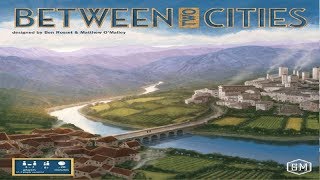



Between Two Cities: Capitals Deep Dive
What the Community Thinks About Between Two Cities: Capitals
Between Two Cities: Capitals occupies an interesting position in the expansion landscape: it did not quite crack the top of a major expansion ranking, yet every reviewer who played it found it to be a masterclass in thoughtful design. Board Games UnLocked viewers described it as a game that "adds just enough to make that game stellar," and across discussions, there emerges a strong consensus that Capitals is exactly the kind of expansion that deserves to exist. This is not a set that overwrites or fixes the base game, nor is it a sprawling box of optional modules. Instead, reviewers agree that Capitals adds strategic depth and variety in measured increments, making each play feel fresh without overwhelming new players. One host noted that if you are playing with anyone beyond casual gamers, the expansion becomes nearly essential to keeping the game at the table long term.
Core Mechanics That Define Between Two Cities: Capitals
Landscape Mats
The most visually distinct addition to Between Two Cities: Capitals is the set of landscape mats. Each mat is a unique 3x3 tile template featuring fixed artistic terrain (mountains, forests, waterways) that cannot be built upon. Cities expand from the base game's 4x4 grid to a 5x5 space, and each mat includes exactly four open spaces where players must place their civic and ordinary tiles. Bridges depicted on the mats allow tiles to be treated as adjacent even when not orthographically connected, creating shortcuts across terrain. Reviewers consistently praised the landscape mats for giving each shared city a distinct identity. Because every mat differs, the problem-solving required shifts from game to game. Players noted that one pairing might force a narrow, linear build while another mat opens up multiple strategic paths. The mats also alleviate analysis paralysis: instead of having unlimited placement options, the terrain itself narrows the field and suggests natural building zones. One reviewer observed that the mats gave them "more to think about" because the landscape became a puzzle constraint rather than a blank canvas.
Civic Buildings and District Scoring
Capitals introduces 21 civic building tiles, designed by Ben Rosset and Matthew Ali for Stonemaier Games. Each civic tile has a unique scoring condition: it prefers adjacency to certain building types (parks, houses, factories, offices, and taverns) and penalizes adjacency to others. A civic tile scores one point if it is isolated from both its preferred and disliked types. If adjacent to at least one preferred type and zero disliked types, it scores three points. If adjacent to both preferred types, it scores six points. This creates a secondary puzzle layer where players must decide whether to place a civic tile early and build around it, or wait and fill gaps strategically. Reviewers found civic tiles added "a little more puzzle" without forcing excessive planning. The expansion also introduces district scoring: three district tiles show random pairings of building types, and at game end, the largest contiguous region of those paired buildings in each city scores first and second place points. While some reviewers felt districts added valuable variety and replayability, others found them felt like an afterthought, a layer of scoring that existed somewhat independently of the core city-building puzzle. One host noted they would happily play future games with landscape mats and civic tiles but omit districts entirely.
The Between Two Cities: Capitals Experience
A Meaty, Thoughtful Puzzle
The expansion preserves the core cooperative tension of the base game while adding meaningful decisions at every turn. Because you build two cities simultaneously and your score is the lower of the two, the expansion forces constant negotiation: should you invest in this city to secure civic tile placement, or shore up your weaker sister city? Landscape mats and civic tile preferences create a web of constraints that makes each turn feel consequential. Players reported that games did not noticeably lengthen, yet the scoring increased noticeably, and the mental engagement remained high. One reviewer highlighted that the expansion succeeded because it did not bloat the rule set; instead, it gave players more avenues to score without making the game busier or harder to explain to newcomers.
Replayability Through Variety
Because seven different landscape mats are shuffled randomly each game, and district pairings are also randomized, no two games feel identical. Reviewers emphasized that the expansion flavors the base game just enough to keep it fresh if you have played the core game many times. One observer noted that the landscape mats alone ensure every city has a different shape and flow, preventing the base game's tile layouts from becoming rote. The civic tiles also provide modular variety: some players might ignore them entirely in early plays, or treat them as bonuses rather than central strategy. This flexibility means the expansion scales with player experience and preference, allowing both veterans and casual players to find their engagement level.
What Makes Between Two Cities: Capitals Stand Out
Restrained and Focused Expansion Design
Many expansions choose quantity over quality, dumping modules and variants into a box. Capitals does the opposite. Reviewers repeatedly praised the expansion as a masterclass in restraint. One observer called it "a perfect example of an expansion because it only adds just enough to give you variety but not too much where it becomes too much." The landscape mats add physical constraint without overwhelming rules; the civic tiles introduce a secondary scoring axis without creating decision paralysis; the districts offer optional additional complexity. This philosophy of measured addition stands in sharp contrast to expansions that require learning entirely new subsystems. The end result is an expansion that feels inevitable in hindsight, yet was not obvious before it was designed.
Natural Integration with Existing Gameplay
Because landscape mats must be incorporated into city setup, and civic tiles are mixed into the tile draw deck automatically, players cannot accidentally forget about these additions. Yet they do not force themselves into every decision either. A player might build an entire city without directly thinking about district scoring, and that is fine; the design permits different levels of engagement. Stonemaier Games ensured that the expansion deepened the puzzle for players who wanted depth without penalizing casual play. The scoring tokens included in the box feature city themes (Essen, Germany), adding thematic flavor without mechanical impact. Reviewers appreciated that the expansion felt like a natural extension of the original design rather than a bandage or a radical reimagining.
Potential Drawbacks
Districts Feel Tangential to the Core Experience
Not all reviewers embraced the district-scoring system. One host described districts as "annoying to pay attention to" and confessed they would drop that module from future plays. The concern was that districts operate somewhat orthogonally to the tile placement puzzle and civic tile optimization; they feel like a third scoring layer that neither amplifies nor deepens the core strategic tension of balancing two cities. In some games, districts will dominate the final score. In others, they are nearly irrelevant due to how tiles were drafted. This variance can feel arbitrary, and some players prefer the purer puzzle offered by landscape mats and civic tiles alone. The module is entirely optional, but the expansion does not flag this clearly in the marketing.
Requires the Base Game Between Two Cities to Play
This expansion is not standalone and requires ownership of the original Between Two Cities. While this is common for expansions and clearly disclosed in the product description, it is worth noting for buyers unfamiliar with the base game. If you do not already own Between Two Cities, you must purchase two boxes (one expansion plus the base game) to play Capitals. Reviewers did not mention this as a significant friction point, but it is a practical consideration for new entrants.
If You Enjoy Between Two Cities: Capitals
If Capitals resonates with you, consider Seven Wonders, which Reviewers mentioned multiple times alongside Between Two Cities because both games excel at creating cooperative tension in multiplayer settings. Seven Wonders is a card-drafting civilization builder where you and your neighbors draft cards in parallel; neither game pits players directly against each other, yet both encourage constant attention to the player next to you. The base Between Two Cities itself deserves a return visit if you found Capitals compelling; the core design is elegant enough that even without the expansion, it remains a quick and engaging city-building experience. Reviewers also noted that both games work particularly well at three players, where everyone affects everyone else in a balanced triangle, making these both excellent choices for medium player counts.
What Reviewers Are Saying
"I'm glad the expansion didn't just like blow it up like add too much to it is literally decided like a couple things that just gave you more to think about."
— Board Games UnLocked
"It gives every single city a uniqueness to it, because like this one we had to build this way, and now we had to build kind of the opposite, but we had a little bit more."
— Board Games UnLocked
"They certainly gave you a little more to think about."
— Board Games UnLocked