
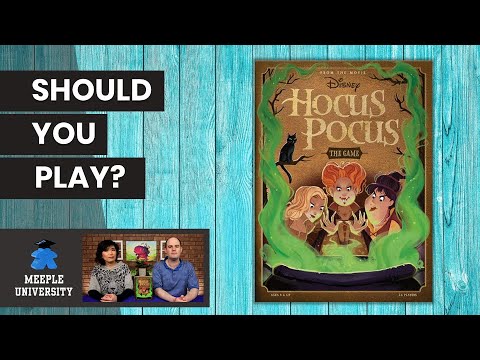



Disney Hocus Pocus: The Game Deep Dive
What the Community Thinks About Disney Hocus Pocus: The Game
The board game community has found Disney Hocus Pocus: The Game to be a charming family cooperative experience that sits at an interesting intersection between mechanical simplicity and practical difficulty. Reviewers praise it as an effective family-friendly cooperative game, though they also acknowledge that winning consistently proves far more challenging than the straightforward rules might suggest. The game's appeal lies less in deep strategic puzzle-solving and more in its ability to create shared tension and memorable moments through random card draws and time pressure. While some note that the core card-matching mechanic does not feel inherently thematic to the concept of potion-mixing, the thematic window dressing drawn directly from the 1993 film manages to elevate the experience into something that feels genuinely connected to the movie's world.
Core Mechanics That Define Disney Hocus Pocus: The Game
Hand Management and Card Matching
At its heart, Disney Hocus Pocus: The Game is driven by simple hand management. Each player holds a small number of ingredient cards, three or four depending on player count, and must decide when and where to play them into the cauldron's five ingredient piles. Every card must match either the color or ingredient type of the top card in its target pile. Players work together to create patterns, either all five visible cards of the same color or all five of the same ingredient type, to stun one of the three Sanderson Sisters. The constraint is that players can only ask yes-or-no questions about what cards others hold, creating a limited information puzzle. This elegant restriction forces players to work with incomplete knowledge, keeping everyone engaged even when it is not their turn.
Time Track and the Sunrise Mechanic
The actual challenge of Disney Hocus Pocus: The Game comes from the sunrise track, published by Ravensburger. Players win only by stunning the three witches before the sun rises. Each time a witch is stunned, cards leave the ingredient deck permanently; the cards that triggered Binks effects and spell icons are shuffled back in, but all others are discarded. As the game progresses and the deck shrinks, it becomes increasingly likely that players will run out of cards entirely, causing everyone to lose. This time pressure transforms a simple matching game into a tense race. Players must weigh whether to play cards that build toward a pattern or skip their turn entirely using special tokens, but every decision carries the weight of the dwindling deck and the need to complete three stuns before time runs out.
The Disney Hocus Pocus: The Game Experience
Cooperative Tension and Limited Communication
What makes Disney Hocus Pocus: The Game feel suspenseful is its restrictive communication system. The Sanderson Sisters' magic prevents most open discussion. Players can only ask single-attribute questions and cannot coordinate openly about their hand or strategy. This creates real tension; teammates must interpret ambiguous yes-or-no answers and make educated guesses about what others are holding. The shared goal of stunning the witches builds a sense of common purpose, but the inability to simply talk through a solution means every turn feels consequential and slightly uncertain.
Randomness and Unpredictability
Reviewers emphasize that Disney Hocus Pocus: The Game is not the type of cooperative game where skilled players can methodically solve it every time. Card draw plays a tremendous role in success or failure. A player might hold cards that simply do not match the current piles, forcing them to discard or use precious trick tokens. Spells drawn from the spell deck can disrupt carefully laid plans. While this randomness makes the game less of a solvable puzzle, it also means that every victory feels earned and every defeat remains unpredictable. The game becomes an effective family experience precisely because of those random elements; everyone is learning the situation together, and no single player can dominate through superior analysis.
What Makes Disney Hocus Pocus: The Game Stand Out
Movie-Faithful Thematic Flavor
Although the core mechanic of matching ingredient cards does not scream potion-mixing on its own, the game wraps its mechanical skeleton in Hocus Pocus flavor that genuinely lands. Spell cards named after spells the Sanderson Sisters cast in the film, tokens like the Circle of Salt and Billy the Zombie, and character names pulled directly from the movie all work to immerse players in the world. Players are literally working to stun the witches before sunrise, the core tension of the film, and the supporting elements feel authentic to the 1993 movie rather than slapped on as an afterthought. For fans of the film, this thematic throughline makes the game feel like a genuine extension of that world.
Accessibility Meets Genuine Challenge
The rules are genuinely simple; players learn to play in a few minutes, which makes the game an effective option for families and casual game nights. Yet despite those simple rules, the game presents a real challenge. Players cannot simply memorize an optimal strategy or puzzle their way through on their first attempt. The combination of limited information, random card draws, and time pressure creates a game that remains engaging across multiple plays without requiring deep rules overhead or a steep learning curve.
Potential Drawbacks
Card Draw Dominance Over Player Skill
The heavy reliance on card luck means that sometimes even optimal play leads to defeat. A player might hold four cards that cannot legally be played to any pile. Unlucky spell draws can wipe key cards from the deck. Reviewers note that this unpredictability, while creating memorable moments, also means the game does not reward mastery or clever planning the way some cooperative games do. For players who enjoy cooperative games where superior strategy leads to consistent wins, Disney Hocus Pocus: The Game can feel frustratingly opaque. It is not a game that can be mastered and then taught to others to play correctly every time; it is fundamentally a game of hope and adaptation.
Difficulty in Achieving Victory
The game is genuinely hard to win. Multiple plays by the same group may end in defeat, especially as players become more aware of the deck's limitations and the time pressure grows more apparent. Some groups lose specifically when the ingredient deck runs dry, and the race against time becomes very real. While this difficulty creates stakes and makes victory feel earned, it can also lead to frustration if a group simply cannot seem to crack the puzzle, or if they feel they are losing to luck rather than to decisions they made.
If You Enjoy Disney Hocus Pocus: The Game
Disney Hocus Pocus: The Game is an ideal choice for families and casual game groups seeking a light cooperative experience with genuine challenge. It works well for players who love the Hocus Pocus film and want to spend time in that world, as well as for groups new to cooperative games who want accessible rules without a patronizing difficulty level. The game also suits game nights where the goal is shared experience and teamwork rather than competitive point-scoring or solo puzzle-solving. Expect short play sessions around thirty minutes, plenty of groans when the deck runs low, and the satisfaction of finally achieving that third stun before sunrise.
What Reviewers Are Saying
"Overall it's a pretty simple card matching, limited communication cooperative game, and when I say simple I mean simple in rules, not simple in trying to defeat it."
— Meeple University
"The spells, all of these tokens like the circle of salt and the characters, all of that is straight from the movie and does feel very thematic. That sort of brings the Hocus Pocus fun to what could otherwise be an abstract game."
— Meeple University
"It is very simple to play and, you know, I think it, it becomes a effective family game because, you know, it's got all those random elements and it's this, this achievement that you're trying to meet. Maybe we have to communicate it better."
— Meeple University