
Game Info
Year
2012
Players
2-4
Age
8+
Playtime
15 min
Publisher
AMIGO
Complexity
1.2/5
Collection
Ratings
Creator Score
Mechanic profile
Waiting on more creator content
Vibe profile
Waiting on more creator content
Description
A fast-thinking anagram word game where players race to form words from a shared pool of letter tiles.
Featured Videos
Rules Teach

Kerflip! (Second Edition) - How To Play
Ask a Rules Question
Images
GID0452845.jpg

GID0452845_thumb.jpg
All mentions
Browse transcript mentions, sentiments, pros/cons, mechanics, topics, quotes, and references.
Total mentions: 2
This page: 2
Sentiment:
pos 1 ·
mix 0 ·
neu 0 ·
neg 0
Showing 1–2 of 2
Video xm6uVoQWWD8
Watch It Played Rules Teach at 0:00
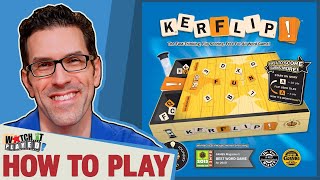
Click to watch at 0:00 · YouTube ↗
Pros
none
Cons
none
Thematic elements
none
Comparison games
none
Mechanics (from transcript analysis)
Mechanics unknown.
Video topics + discussion points
No key topics recorded for this video.
Quotes (from this video)
- I think we can learn how to play it as we play it.
- The important thing here is that we never touch anything on the board. Nothing stops because there are still two other players who need to call out words.
- The game's going to end as soon as someone's reaching into the bag to get their tiles, and there's not enough.
- If there's a tie, the person who had the fewest bonus point cards is the winner.
References (from this video)
No references stored for this video.
Video xm6uVoQWWD8
Watch It Played Rules Teach at 0:20 sentiment: positive
Click to watch at 0:20 · YouTube ↗
Overall sentiment (raw)
positive
Pros
- Can learn how to play as you play.
- Fast-paced gameplay due to the timer.
- Easy cleanup process with the box design.
- Encourages finding longer, more complicated words.
- Offers opportunities for strategy with bonus cards and tile usage.
Cons
- Using tiles already flipped by previous players scores fewer points.
- Risk of scoring zero if the timer runs out before a word is found.
- Potential for a disappointing loss in a tiebreaker based on the number of bonus cards.
Thematic elements
none
Comparison games
none
Mechanics (from transcript analysis)
- Bonus Cards — Players can earn bonus cards for using specific letter tiles, which are revealed and added to the score at the end of the game.
- Lightning round — A special round where the first player to call out a word receives a bonus, indicated by a lightning tile.
- scoring — Points are awarded based on the number of letters in the word. Tiles used by previous players score fewer points. Bonus points can be earned from specific tiles.
- tile drafting — Players draw a set number of letter tiles from a bag at the start of each round.
- timer — A sand timer is used to keep pressure on players to find words quickly. Flipping the timer can hurry up a player who is taking too long.
- Word Building — Players try to form words from letter tiles drawn from a bag. The faster a word is formed and the longer it is, the more points it is worth.
Video topics + discussion points
No key topics recorded for this video.
Quotes (from this video)
- I think we can learn how to play it as we play it.
- The important thing here is that we never touch anything on the board. Nothing stops because there are still two other players who need to call out words.
- The game's going to end as soon as someone's reaching into the bag to get their tiles, and there's not enough.
- If there's a tie, the person who had the fewest bonus point cards is the winner.
References (from this video)
No references stored for this video.
Transcript Navigation
Showing 1–2 of 2