

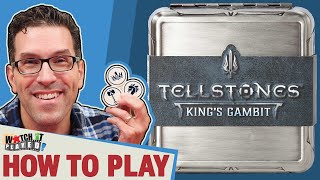

Tellstones: King's Gambit Deep Dive
What the Community Thinks About Tellstones: King's Gambit
Reviewers who have covered Tellstones: King's Gambit, designed by Chris Cantrell and published by Riot Games, come away with clearly different verdicts. Rodney Smith of Watch It Played presents it as a compact bluffing and memory game that rewards careful attention, and Smith walks through the full ruleset with the enthusiasm of someone who expects the table talk to be the best part. The Dice Tower takes a much cooler view. In a retrospective look back at games it reviewed years earlier, Tom Vassel recalls giving the game a three and says the memory-driven design astounded Vassel as the follow-up to Riot's Mechs vs. Minions, a title Vassel remembers as a big, cool game.
The reviewers agree on the core identity. Both treat Tellstones as a game about hidden information, where the stones on the line matter less than what each player believes about them. They disagree on whether that focus is the appeal or the problem. Smith sees the bluffing and the strain of tracking face-down stones as the source of the fun, while Vassel found the memory emphasis unrewarding. Neither review frames the game as a casual filler title, which fits its short playtime and its demanding recall.
Core Mechanics That Define Tellstones: King's Gambit
Memory and Concealed Information
Memory is the engine of the game. Players set the seven stones face up in a pool, then take turns placing them onto a shared line on the royal blue mat, always at the left or right end of the existing row. Once stones are on the line, the actions start to scramble it. The hide action has an opponent flip a chosen stone face down without changing its position, and the swap action has an opponent exchange two pointed stones while ignoring whatever the active player says aloud. Smith stresses that face-up stones are easy to follow while face-down stones are not, and that gap is where the design lives. Smith summarizes the experience as a "mental tug of war based on what you know, what you think you know and what you think your opponent knows."
Because the active player can mislabel stones while pointing at the correct ones, the memory test is also a test of composure. Smith notes that calling the wrong symbol can make an opponent second-guess what they believe each stone is, which Smith describes as pretty sneaky.
Deduction Through Challenges, Peeks and Boasts
Deduction is how players recover from memory lapses. The challenge action has a player point to a face-down stone and ask the opponent to name it. A correct answer gives the opponent a point, and a wrong answer gives the challenger one. The peek action lets a player secretly look at a face-down stone and return it to its spot. Smith points out that peeking immediately after an opponent scores becomes far more powerful, because the peeker can look at three face-down stones in any order and then has a strong idea of what the line contains. Players also reason from what the opponent's actions imply, such as whether a rival who has been hiding stones seems to be losing track.
The boast is the biggest deductive gamble. A player who believes they can name every face-down stone declares it, and the opponent chooses one of three responses: accept a single point, demand proof by naming and flipping every hidden stone, or claim they know the stones too, which steals the boast and forces the original player to choose between the first two options. Reaching three points wins the game immediately.
The Tellstones: King's Gambit Experience
Tense Bluffing Across the Line
Smith describes play as a slow contest of nerve. Players challenge each other's memory of the line bit by bit until one feels ready to call the other's bluff. The rule that the pointing hand matters more than the spoken words creates constant doubt, and Smith recommends that experienced players add their own theatre by taunting opponents, calling out random symbols, or telling a short story during their turn to distract them. Smith also cautions players not to distract themselves too much. The result is a tabletop experience that depends as much on reading faces as on reading the stones.
Memory Strain and Lingering Doubt
The memory load builds over the course of a game. Smith describes reaching a point where a player begins to suspect an opponent is losing track of the stones, and that suspicion, along with a creeping awareness of one's own gaps, drives the decision to challenge or boast. Vassel experienced the same pressure as a frustration rather than a pleasure. Vassel's review reads as a verdict that the strain of holding hidden symbols in mind did not produce enjoyable play for Vassel, even though Vassel acknowledges the design is deliberate.
What Makes Tellstones: King's Gambit Stand Out
The Boast as a High-Stakes Swing
Smith singles out the boast as the most distinctive action in the game. Smith describes it as the big swing, risky but rewarding, because it lets a player win or lose the game in a single action. The steal option is what keeps the boast from being a simple button press, since it forces the boaster to commit to either accepting a point or proving every hidden stone. That back-and-forth gives each boast a dramatic structure that Smith clearly enjoys.
Team Play in the Kings Round Variant
Smith also highlights the four-player Kings Round variant, which splits players into two teams that share a single scoring track. Teammates can offer to peek for each other, the player to the left handles challenges, and proving a boast alternates between both teammates. Smith notes that teammates may discuss the line and their guesses about the face-down tiles, provided they speak openly so that everyone can hear. Within the broader League of Legends theme of Runeterra, this variant turns the memory contest into a cooperative conversation. Smith also praises the production, noting the container has a spot for each component so that the pieces stay in place during transport.
Potential Drawbacks
A Memory-Centred Design Can Feel Unrewarding
The most pointed criticism comes from The Dice Tower. Vassel was surprised that a memory game was Riot's follow-up to Mechs vs. Minions, and Vassel did not find the design engaging enough to recommend it. Because Vassel's retrospective review is short, it focuses on the game's central mechanic rather than on the detailed rules, and it offers no fix or variant. Readers who find that the memory focus wears on them, as Vassel did, should weigh that before committing to a full game.
High Variance From Single Mistakes
The boast can decide the game in one moment. Smith explains that a player who is challenged to prove a boast wins outright only if every face-down stone is named correctly, and that a single error loses the game on the spot. This sharp edge rewards confidence and careful tracking, but it can also make a single mistake feel disproportionately costly. Smith's own explanation of why opponents often accept a point rather than call a bluff reflects this tension: accepting a point is the safer choice when the alternative is an all-or-nothing reveal.
If You Enjoy Tellstones: King's Gambit
Players drawn to Tellstones for its hidden information and deduction will appreciate The Search for Planet X, which Vassel praises as a great deduction game that brought the genre back into focus. Its appeal is similar to Tellstones in that players must reason through incomplete evidence, though it gives more room for methodical planning. Fans of the bluffing and table-talk side of Tellstones may also enjoy games that reward reading opponents and tracking concealed information, particularly when the rules let players choose what to say as well as what to do.
- Reasoning from incomplete evidence: Players who like the challenge of tracking what is present, absent, and implied will find a similar satisfaction in deduction-focused designs.
- Table talk and misdirection: Players who enjoy distracting or misleading opponents will value the open bluffing and taunting that Smith describes as part of experienced play.
- Short, sharp decisions: Players who like a single high-stakes action that can end a game will recognize the appeal of the boast.
What Reviewers Are Saying
"In Tellstones, you and your opponent will be taking turns placing stones onto the line and then rearranging them, and the game becomes a mental tug of war based on what you know, what you think you know and what you think your opponent knows."
— Rodney Smith, Watch It Played
"Man, I hated this game. I gave it a three. It's a memory game, and I, it just, it just astounded me that this was like their second game after their Mechs versus Minions."
— Tom Vassel, The Dice Tower
"A boast is the big swing. It's risky but the reward is great. It allows you to win or lose the game in a single action."
— Rodney Smith, Watch It Played