










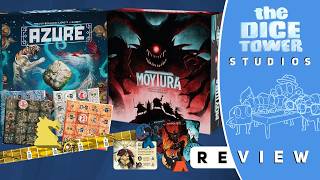




Azure Deep Dive
What the Community Thinks About Azure
Azure has emerged as a standout two-player abstract strategy game that commands enthusiastic praise from reviewers. The consensus is clear: this is a modern classic in the two-player board game space. Reviewers consistently highlight the elegance of its design and the depth it packs into a compact play experience. Board Game Animal captures the sentiment well, describing Azure as one that looks beautiful but proves that the beauty runs far deeper than aesthetics. The game's tight, tension-filled gameplay and smooth flow have earned comparisons to classic designs by Reiner Knizia, with designers Brett Gilbert and Trevor Benjamin creating something that feels fresh while honoring the tradition of excellent abstract two-player games. Even the most detail-oriented reviewers, who nitpick production choices or rule terminology, find themselves drawn back to the core experience repeatedly.
Core Mechanics That Define Azure
Area Control and Beast Majorities
At its heart, Azure revolves around controlling the four auspicious beasts positioned at strategic points on the board. Players vie for majority in the rows and columns of these mountains, with control shifting between players as stone placement evolves. The first player to establish majority in a beast's domain claims its favor, gaining immediate benefits such as victory points or card draws. However, control is never permanent. If an opponent places enough stones to overtake the majority, they steal the beast and flip the scoring: the opponent loses points while the new controller gains them. This creates the dynamic tension that defines the game's back-and-forth rhythm.
Engine Building Through Cascading Discounts
The second core pillar is an elegant efficiency engine. Players place colored stones onto matching-color regions of the board by paying cards. The crucial mechanic is that each stone placed in a row or column reduces the cost of placing any future stone in that row or column by one. This creates satisfying cascades where players invest modestly early, building infrastructure for dramatic cost reductions later. The payoff feels substantial: what once required three cards can eventually be played for free, opening access to the board's most lucrative scoring spaces. This captures the essence of the engine-building experience that appeals to euro game players, but filtered through an abstract spatial lens rather than a traditional tableau.
The Azure Experience
Tension and Snatching
The game creates a perpetual sense of pressure through its tug-of-war mechanics. Players must balance offensive point-scoring against defensive beast control. The moment you commit to chasing one beast, your opponent may strike at another. This forces constant reassessment and creates genuine moments of "I didn't realize you'd taken that advantage." As one reviewer notes, you need to be alert to who holds majorities, but that extra workload is worthwhile given the depth it creates. The racing structure toward 25 points keeps the game snappy, yet players frequently find themselves within striking distance of victory even from apparently distant positions, because stealing a high-value beast can swing multiple points at once.
Satisfying Emergence and Discovery
With over 10,000 possible board layouts due to the double-sided, rotatable tiles, each session feels fresh. Players describe spending five minutes at game start staring at the board, formulating initial strategy around which sections offer the best cost-to-benefit opportunities. However, the beauty is that there are always multiple viable paths forward. You can plan strategically or play more casually and still find success. Layers of decision-making unfold as you play: first, the obvious path to points; then, the realization of how to cut off your opponent; finally, the recognition of subtle engine-building synergies across the board. The game rewards thoughtful play without punishing looser approaches.
What Makes Azure Stand Out
Elegant Abstraction with Thematic Grace
Azure achieves something rare: it is a pure abstract strategy game that also feels beautiful and thematic without sacrificing gameplay clarity for theming. The artwork, credited to W Quanchoria, brings the four auspicious beasts to life through vivid, luscious renderings. The heavy ceramic stones feel wonderful to play, creating tactile satisfaction with each placement. Yet the mythological theming is genuinely just window dressing, as with most excellent European abstracts. What makes this special is that the theme never intrudes on the mechanics. The terminology around "boons" and "bonds" occasionally confuses new players, but the underlying systems are intuitive. The result is a game that sits beautifully on a shelf, reads as sophisticated and mysterious, yet plays cleanly and fairly for two players.
Tight Strategic Play in Twenty Minutes
Azure delivers a comprehensive game experience in remarkably little time. Reviewers consistently highlight playtimes around 15 to 20 minutes while noting the game feels meaty and consequential. You are never stuck in analysis paralysis; the limited hand size and board state mean you have a few clear options each turn. Yet each choice carries weight. The designers have avoided bloat and filler, creating a game where every action matters and where you feel you've played a full strategy game despite the brevity. This balance makes it equally appealing to players seeking a snappy opener, a competitive closer, or the entire session's main event.
Potential Drawbacks
Rule Terminology and Iconography
Several reviewers note that the rule book leans into thematic language where simpler terminology would help. Terms like "boons" (rewards) and "bonds" (discounts) are confusingly similar and don't immediately clarify their mechanical purpose. The iconography on the mountain spaces isn't always intuitive, particularly when the placed beast token obscures the icons beneath. While these aren't deal-breakers and experienced players quickly move past them, they create minor friction during initial teaching moments. A clearer reference card or slightly more direct terminology could smooth this aspect.
Constant Board State Awareness Required
With four beasts in play simultaneously, each offering different conditions for control and different benefits, tracking all active majorities demands vigilance. Players occasionally forget which beasts they or their opponent currently control, missing opportunities or overlooking shifts. This isn't a flaw in design so much as an inherent cost of the game's depth: the multiple simultaneous contests create more to track. Players must remain alert throughout, which some may find engaging and others might find slightly demanding in a 20-minute play.
If You Enjoy Azure
Players drawn to Azure's elegant abstract design will find similar satisfaction in other two-player classics. Those who appreciate the engine-building aspect should explore Splendor, which shares the cost-reduction arc but in a different context, or Splendor Duel, which brings Splendor's satisfaction to the two-player space with added tug-of-war elements. For reviewers who loved Azure's focus on area control and contested majorities, Mandala and Patterns, both by designers Brett Gilbert and Trevor Benjamin, offer similarly tight and elegant experiences. Those seeking the push-your-luck and majority-driven play found in the beasts might appreciate Azul or Seven Wonders Duel, which offer comparable strategic tension in compact forms. The comparison games frequently mentioned alongside Azure include Acquire, The Lord of the Rings Duel, and Mora, all of which share either the area-control focus, the two-player exclusivity, or the streamlined elegance that defines Azure's appeal.
What Reviewers Are Saying
"You could have an eight-point lead on somebody and that's not a safe lead because the way the beasts work is that if I'm taking from you, not only am I getting the points, you're losing the points."
— The Dice Tower
"Azure is a standout abstract strategy game that looks regal and classy, but with remarkable levels of replayability and nuance that shows the beauty isn't just skin deep."
— Board Game Animal
"This is as if Splendor was an abstract game because in this game, you are literally playing cards to be able to pay a cost to place a stone on a place on the board."
— TheGameBoyGeek - Hi Quality Hi Energy Board Game Reviews