



Ecosfera: Rewilding the World Deep Dive
What the Community Thinks About Ecosfera: Rewilding the World
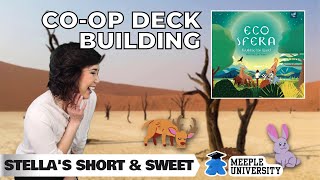
Coverage of Ecosfera: Rewilding the World comes from Meeple University, and all of it treats the game as an early prototype rather than a finished product. The channel's tone is generally positive. In a January roundup of new-to-them games, the hosts placed Ecosfera on their list and said it stood out from most cooperative deck-builders they had seen. A separate dedicated preview video from the same channel walks through the basic structure and presents the game as a cooperative deck-building and set-collection experience with an environmental goal.
Because the coverage is limited to prototype previews, the picture is narrow. The channel did not describe final components, finished rules, or a complete balance pass, and the hosts were clear that their impressions came from an early version of the game.
Core Mechanics That Define Ecosfera: Rewilding the World
Set Collection
Set collection is the engine that turns elemental cards into living things. Players gather element cards for plants and fungi, and buying a plant or fungi card requires the matching elements. When a player has at least two of the same plant symbol in their play area, they can gain the corresponding animal card as part of a purchase. When two animals carry the same color or symbol, the team can build the matching biodome. Each of these steps feeds the next, so a sequence of combinations is what moves the team toward its win condition of restoring all seven biomes.
The preview also notes that an element can be gained for free in one situation. If a player is trying to buy a plant or fungi card and is exactly one element short, that element is immediately added to their display, which helps avoid being stuck with a useless card.
Deck Building
Each player starts with a small personal deck of five different elements and two disaster cards. On a turn, the player draws four cards and must buy at least one card from the common display. Buying is compulsory, and failing to buy anything earns a penalty in the form of a disaster card that clogs the hand. Purchased cards go to the play area, where they can be used immediately to buy another card, creating a chain within the same turn. Players can also hand cards to one another with a special action, which the preview presents as a way to support teammates. At the end of the turn, the player discards the cards from their hand area and draws another four for the next round. Cards bought from the market join the personal deck, so the deck grows and changes as the game goes on.
The Ecosfera: Rewilding the World Experience
A Deck Optimization Flow Like Klondike Solitaire
The most distinctive point in the roundup is how the game felt to play. The host who chose Ecosfera said it reminded them of a classic Klondike Solitaire, a comparison they admitted they could not fully explain but that made the game click for them. The host described trying to make sets of cards to buy one layer of cards, then setting those cards together to buy the next layer, and so on. The result, in their words, was a nice flow of deck optimization that grows the deck up and down while the player collects small bonuses along the way.
The preview frames the same idea differently. It describes the cooperative deck-building as something that could also be called deck optimization, and it points to a few twists that shape the experience: buying is compulsory, unwanted cards are left in the market for other players, and the team has to plan its strategy together if it wants to save the animals.
An Environmental Rewilding Theme
The theme places players in the role of environmentalists working together to restore biomes. The preview opens with the idea that animals are losing their homes and that the team's job is to restore the wild world. Each combination of conditions is framed as a step toward suitable habitats, which gives the mechanics a clear purpose beyond the card math. The preview also says the game offers different difficulty levels, and it describes the components as colorblind friendly, with a color plus symbol shown on each card.
What Makes Ecosfera: Rewilding the World Stand Out
The main reason the roundup host singled out Ecosfera is its contrast with the cooperative deck-builders they usually see. Those games tend to be battle games, and Marvel Legendary is the kind of example cited. Ecosfera instead has a cooperative goal built around ecology and assembling sets, and it does not center on combat.
The combination chain is also what makes the game feel distinctive, and it cuts both ways. A strong run of combinations can unlock animals and biomes quickly. The host noted that if bad combinations come up, the game progresses the player down a bad track. The host paired that risk with the reward, describing the flow as a rise and fall in which the player keeps collecting bonuses as the deck grows up and down.
Potential Drawbacks
The most important caveat is that Ecosfera was covered only as a prototype. The preview states that the components shown are prototypes and that the rules are not final, so the published rules, balance, and difficulty levels could change before release. The roundup host said they enjoyed the game as an early prototype and looked forward to the finished version, which shows that the reviews were judging potential rather than a complete product.
The one specific risk mentioned in the source material is the bad-combination track described above. Neither video reports how that risk plays out over a full game with a final rule set, so the long-term experience remains an open question.
If You Enjoy Ecosfera: Rewilding the World
The source material does not identify a close comparison title for Ecosfera. Marvel Legendary appears only as the kind of battle-style cooperative deck-builder that Ecosfera is described as not resembling, so it is a contrast rather than a recommendation. Readers who want a clearer sense of the game should watch the featured videos for the full context.
What Reviewers Are Saying
it felt kind of like a classic Klondike Solitaire sort of thing
— Meeple University
these animals are losing their homes it is our job to try to restore the wild world
— Meeple University
really you're trying to make sets of cards to buy one layer of cards and then set them together to buy the next one
— Meeple University