

















Gazebo Deep Dive
What the Community Thinks About Gazebo
Gazebo has earned extraordinary enthusiasm across the board game community, with reviewers repeatedly emphasizing its elegant simplicity masking strategic depth. The consensus is clear: this is Reiner Knizia's design philosophy at its finest. TheGameBoyGeek calls it "the hallmark of a Knizia design. Simple turns but tons of depth," while Board Game Animal's Justin goes further, calling it "one of the best board games period that will equally appeal to gamers and non-gamers alike through its approachability and ingenuity." Even among reviewers who compare it to Knizia's extensive catalog, there is broad agreement that Gazebo delivers something special. The Dice Tower's Mike Delissio ranks it as his fifth-best Knizia game of 2025, while Board of It's Tally and Farrell describe it as "a very sharp little domino game" worthy of a place in any collection. The game's universal appeal emerges not from innovation, but from refinement: it feels like a design that was always meant to exist.
Core Mechanics That Define Gazebo
Tile Placement
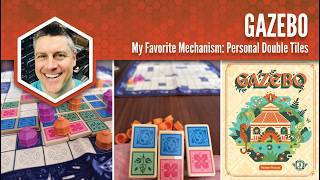
At its heart, Gazebo is a domino-placement game where players build a botanical garden of interconnected tiles. Each domino carries two colored halves, and players place them on a shared board next to starting positions or adjacent to existing dominoes. The elegance lies in the freedom: color matching is not required for placement, giving players enormous flexibility in how they shape the board. However, strategic placement becomes everything once players recognize that grouping colors creates "nooks," triggering gazebo placement. TheGameBoyGeek notes that players must constantly think "what am I going to do right now?" while simultaneously planning two, three, four, five turns ahead. Stonemaier Games' Jamie praises how the game lets players obtain special single-color dominoes in multiple ways, creating genuine strategic decisions about when to leverage the board's special spaces versus drawing from a personal supply of five face-down double-colored dominoes.
Area Majority and Direct Conflict
Beyond tile placement, Gazebo implements area majority scoring through patio tiles, where the player with the most gazebos adjacent to a patio claims control and places additional gazebos there. This mechanic creates a constant push-and-pull: players can steal patios from opponents by gaining majority, or absorb an opponent's entire nook into their own if they build a larger connected region. TheGameBoyGeek draws an explicit parallel to the classic economic game Acquire, noting that this nook-absorption mechanic feels like "a nod" to Sackson's 1960s masterpiece. This is not a game about polite area control; Board of It's reviewers call it "pretty savage," with tension rising as the board fills and end-game positions become increasingly desperate. A single gazebo placement can swing the game entirely, making every turn consequential.
The Gazebo Experience
Tense, Chess-Like Tactical Calculation
Gazebo plays like a two-player abstract war despite supporting up to four players. TheGameBoyGeek emphasizes that at two players, "it's very chess-like" where players can "think three, four turns in a row" and set up distinct zones of the board, each player building toward their own strategy while anticipating the opponent's counter-moves. Board of It's reviewers echo this: "there's kind of that perfect spot that you really wanted and someone else goes there and it actually gets quite spicy." Late-game turns stretch dramatically as players hunt for the single perfect placement that can change everything. The game's race mechanic amplifies urgency: every decision matters because players are genuinely racing to place their final gazebos. There is no catch-up mechanism, and falling behind early makes victory increasingly unlikely.
Brutal, Cutthroat Gameplay Beneath a Charming Aesthetic
The presentation belies the ruthlessness underneath. Gazebo's botanical-garden theme, with its delicate pastel artwork and physical dominoes, suggests a peaceful, meditative experience. But reviewers consistently describe the actual table experience as "brutal," "savage," and intensely antagonistic. Board of It notes that despite how "cutesy" the theme appears, "it got pretty rough between us" during play, with players actively blocking territory and taking over each other's established areas. At three or four players, there's a dynamic where "everyone's ganging up on whoever had the most gazebos out," creating moments of coordinated spite. This tension arises not from scripted conflict but from pure spatial scarcity: as the board fills with dominoes, opportunities narrow, and each placement's consequences multiply. The satisfaction comes precisely from outmaneuvering opponents in this confined space.
What Makes Gazebo Stand Out
Extreme Design Elegance and Rule Minimalism
Gazebo exemplifies Knizia's philosophy of removing every mechanical ounce of fat. Board Game Animal's Justin describes teaching the game: it has "essentially non-existent overhead rules that you could teach in less than a minute. And yet, the game is dungeons deep in how it could be played." Players' turns are mechanically trivial: place one domino, draw one replacement. That's the entire turn structure. Yet from this simplicity emerges a game so tactically rich that players spend five minutes analyzing a single placement, calculating how their move benefits or damages opponents and what windows it opens or closes for future turns. TheGameBoyGeek celebrates this as "not an ounce of fat on it," making the game's depth-to-complexity ratio exceptional. The redesign from the original Qin also removed a major luck factor: instead of special dominoes being randomly shuffled into the main deck, they are now accessed through specific board triggers and a personal player supply, giving players agency over when and how to deploy their strongest pieces.
Multiple Maps and Exceptional Portability
Gazebo ships with a double-sided game board, each side playing distinctly, and an optional expansion double-sided map adds two more variants. Board Game Animal emphasizes that these different boards create replayability while the cloth-based board design makes Gazebo "one of the most portable games of this richness that you're going to find." The game fits into a travel case, requires minimal setup and teardown, and plays in 30 minutes. Yet the production quality belies its compact footprint; the art, the deluxe domino upgrades, and the overall presentation make it feel like a classic heirloom game you'd find in your grandparents' closet, not a modern compact game. This combination of portability and perceived depth creates a unique value proposition in the modern hobby.
Potential Drawbacks
Catch-Up Difficulty and Runaway Leader Problems
Gazebo is a race game with limited catch-up mechanics, creating a scenario where early leads become difficult to overcome. TheGameBoyGeek notes that if you "find yourself behind early, it's going to be a bit hard to sort of really catch up and pass them." Players can steal patios or absorb nooks, which create swings in board state, but these moments are relatively rare. The race structure means efficient plays dominate over value-maximization, so players focused on rapid gazebo placement gain compounding advantages. This design choice is intentional and works beautifully at two players; at higher counts with more turns between your own, a player who has fallen behind may spend the later game knowing they cannot win rather than genuinely contesting for victory.
Domino Draw Variance and Hand Consistency Issues
With only three possible colors in the game and random draws from the central domino pool, players can find themselves holding identical color pairs for multiple consecutive turns, severely limiting their placement options. Board of It's reviewers encountered frustration when stuck with "all the the same" combination, unable to pursue their strategic goals while waiting for a different color to appear. One reviewer notes the original Qin suffered more severely from this (where all dominoes mixed randomly), but the revised version still contains the problem in diluted form. While the personal five-domino supply mitigates this somewhat, the core luck factor remains, and players can feel constrained by an unforgiving draw.
If You Enjoy Gazebo
Players drawn to Gazebo's tile-placement puzzle will find similar satisfaction in King Domino, which shares the domino placement family but emphasizes tile-chaining over conflict. Those who love the area-majority mechanics and the direct player interaction should explore Acquire, the classic economic game that influenced Gazebo's nook-absorption system and offers negotiation and stock-trading alongside territory control. Players who want more Knizia games delivering simple rules with vast strategic depth should investigate Tiger and Euphrates, another area-majority game that shares Gazebo's elegance. For those who fell in love with the two-player chess-like nature of Gazebo, designer Reiner Knizia's Qin, the original version of Gazebo, remains a worthwhile experience, though Gazebo's refinements and modern production make it the stronger choice for most players.
What Reviewers Are Saying
"It's a race. It's simple turns, tons of depth. I mean literally, place a domino, draw a domino. That's your whole turn. That is the hallmark of a Knizia design. Simple turns but tons of depth."
— TheGameBoyGeek
"It's not necessarily a game that changes everything or overhauls the hobby. But it'll make you ooh and awe at the elegance of the design itself. One that will really make you go, 'Wow, how is this game not more famous?'"
— Board Game Animal
"We like things that are a little bit savage and as kind of cutesy as this looks and the production is very beautiful, it got pretty rough between us. You're trying to take over spaces, take over gazebos, and it actually gets quite spicy."
— Board Of It